
Vector Database Job Support & Interview Preparation | ML Engineer — Codersarts
Vector Database Job Support & Interview Preparation — Get the Role You Are Targeting
Vector database skills are now tested in interviews at Google, Amazon, Flipkart, Swiggy, PhonePe, Meesho, CRED, and every AI-first startup. But most preparation resources stop at theory — they do not prepare you for the system design rounds, coding challenges, and production-depth questions that top companies actually ask.
At Codersarts, our experts prepare you with the exact content that gets ML engineers and AI engineers hired — vector DB concept mastery, RAG system design walkthroughs, hands-on coding rounds, take-home assignment delivery, and live job support while you are actively working on client projects.
Whether your interview is in 3 days or 3 weeks, or you need someone in your corner while you deliver a live project — we have a service for your exact situation.
5 services Interview + job support | 3 days Minimum prep timeline | < 4h First response | India Specialists in India market | NDA For live project support |
Why Vector DB Skills Command a Premium in 2025 — and What Interviewers Actually Test
The explosion of LLMs and RAG-based products has made vector database knowledge a hard requirement for senior ML engineer, AI engineer, and backend engineer roles at most technology companies. Yet the supply of engineers with genuine hands-on experience remains small.
The result: candidates who can speak fluently about HNSW parameters, RAG pipeline design, embedding model selection, and production vector search tradeoffs consistently outperform equally experienced peers who cannot. Our prep programme targets exactly those competencies.
Company Type | Roles Tested | Vector DB Topics Covered | Prep Time Needed |
Top-tier (Google, Amazon, Meta) | ML Engineer, Senior SWE | System design depth: HNSW theory, quantization, RAG architecture, scale tradeoffs | 3–4 weeks |
AI startups (Series A–C) | AI Engineer, Backend Engineer | Practical: build RAG, choose a vector DB, tune HNSW, explain recall vs latency | 1–2 weeks |
Product companies (India) | ML Engineer, Data Scientist | Applied: implement semantic search, explain embeddings, debug a RAG pipeline | 1–2 weeks |
Consulting / freelance | Vector DB Specialist | Client-facing: architecture decisions, cost justification, implementation planning | 1 week |
Active project (job support) | Any role | Daily: code review, query help, implementation support on live deliverables | Ongoing |
1. ML Engineer Interview Preparation — Vector DB |
The Most In-Demand Vector DB Interview Topics for ML Engineer Roles
ML engineer interviews at top companies follow a structured format: an online assessment (coding round), a system design round, and a technical deep-dive. Vector databases appear in all three — from implementing a basic nearest-neighbour search in the coding round, to designing a full semantic search system in system design, to explaining HNSW graph construction in the deep-dive.
Our preparation programme covers all three formats — with real questions from actual interviews at target companies, not generic textbook problems.
Concept Modules We Cover
Vector space fundamentals: dense vs sparse vectors, embedding dimensions, semantic similarity
Distance metrics: cosine similarity, L2 (Euclidean), dot product — when to use which and why
Approximate Nearest Neighbour: why exact search is impractical at scale, ANN tradeoffs
HNSW deep-dive: graph structure, M parameter, ef_construction, ef search, build vs query complexity
IVF (Inverted File Index): Voronoi cells, nlist, nprobe, when IVF beats HNSW and when it does not
Product Quantization: codebooks, subvectors, memory vs recall tradeoff, when to quantize
Embedding models: architecture differences, why model choice affects recall, fine-tuning for domain
RAG architecture: chunking, retrieval, reranking, hallucination mitigation — production depth
Hybrid search: why hybrid outperforms pure vector, BM25+vector fusion, RRF vs linear combination
Platform comparison: Pinecone vs Weaviate vs Qdrant vs Milvus vs pgvector — interview-ready comparison
Production concerns: multi-tenancy, sharding, replication, monitoring, cost at scale
50 High-Frequency Interview Questions We Practise
Category | Sample Interview Question |
Concepts | What is the difference between cosine similarity and dot product? When would you use each? |
HNSW | Walk me through how HNSW builds a navigable graph. What happens during search? |
HNSW | You have 10M vectors and queries are taking 800ms. How do you diagnose and fix this? |
IVF / PQ | When would you choose IVF+PQ over HNSW? What do you give up? |
Embeddings | Your RAG system has poor recall. How do you determine if the embedding model is the problem? |
RAG | Design a RAG system for a legal document Q&A tool with 500,000 PDF pages. |
RAG | A user's question returns a hallucinated answer. Walk me through how you debug this. |
System design | Design a semantic search system for an e-commerce catalogue with 50M products. |
System design | How would you architect a multi-tenant vector search system for a SaaS product? |
Platform | Why would you choose pgvector over Pinecone for a given use case? |
Production | How do you handle vector DB migrations with zero downtime? |
Hybrid search | Explain how you would implement hybrid keyword + semantic search and evaluate which is better. |
Full ML Engineer Interview Prep service → Our ML Engineer Interview Preparation page covers all 50 interview questions with model answers, a 3-week structured prep plan, company-specific question banks for Google, Amazon, Flipkart, and top India AI startups, and 2 full mock interview sessions with feedback. |
2. Vector Search System Design Rounds |
System Design Is Where Most ML Engineers Lose Senior Roles — We Make Sure You Do Not
The system design round is the highest-stakes interview round for senior and staff engineer roles. It tests your ability to think at scale — 100M users, 50M vectors, 10,000 QPS — and justify every architectural decision under pressure. Most candidates prepare for generic system design but are caught off-guard by vector-specific design questions.
We run full 45-minute mock system design sessions on the exact vector search scenarios you will face — with the same time pressure, whiteboarding structure, and follow-up probing that real interviewers use.
System Design Scenarios We Walk Through
Semantic search for a major e-commerce platform: 50M products, 100M users, sub-100ms query latency
RAG-based internal knowledge base: 200,000 documents, 10,000 employees, multi-language support
Customer support chatbot with vector memory: 500 concurrent conversations, contextual retrieval
Real-time product recommendation engine: 100M user-item interactions, streaming updates
Multi-tenant SaaS vector search: 10,000 tenants, strict data isolation, variable data sizes
Code search system: 1M GitHub repos, semantic + keyword hybrid, function-level granularity
Medical record semantic search: privacy-first, on-premise, high recall requirement for safety
News article similarity and deduplication at scale: real-time ingestion, sub-second clustering
What Our System Design Sessions Cover
Structured framework: requirements clarification → capacity estimation → component design → deep-dive → tradeoffs
Vector DB selection with justification — not just 'I'd use Pinecone' but why, with specific tradeoffs
Capacity estimation: vector count, embedding dimensions, storage, QPS, latency budget
Index selection: HNSW vs IVF vs hybrid — argued from first principles, not memorised
Scaling decisions: sharding strategy, replication factor, read vs write replica trade-offs
Embedding pipeline design: batching, caching, incremental updates, cost at scale
Failure mode handling: what happens if the vector DB goes down, index corrupts, or quality degrades
Interviewer simulation: we probe your decisions aggressively, just like a real senior interviewer would
Full system design prep service → Our Vector Search System Design page covers all 8 scenarios with complete model answers, the exact framework top interviewers expect, and 2 live mock sessions with written feedback. |
3. Vector DB Coding Challenge Help |
Coding Rounds — Implementation Questions That Actually Appear in Interviews
Coding rounds for ML engineer and AI engineer roles increasingly include vector database implementation problems. These are not LeetCode array problems — they test your ability to implement similarity search, build an embedding pipeline, integrate a vector DB into a working system, or fix a broken RAG pipeline under time pressure.
We prepare you with the exact implementation problems that appear in online assessments and coding rounds at top companies — with working solutions, explanation of the approach, and edge case handling.
Coding Problem Categories We Cover
Implement cosine similarity from scratch in Python — vectorised with NumPy, not a loop
Build a K-Nearest-Neighbour search without using a library — brute force then optimise
Implement a simple HNSW-style graph index from scratch (commonly asked at research-heavy companies)
Build a basic RAG pipeline: load documents, chunk, embed, store in FAISS, query, generate answer
Add vector search to an existing REST API (FastAPI or Django) — end-to-end in 90 minutes
Implement a batch embedding pipeline with rate limit handling and retry logic
Debug a broken RAG pipeline — identify why retrieval quality is poor and fix it
Implement metadata-filtered vector search on a given dataset
Build a semantic deduplication system: find near-duplicate documents using vector similarity
Take-home: Build a complete document Q&A system with evaluation metrics
How Our Coding Prep Works
Problem bank: 30+ vector DB coding problems at three difficulty levels (junior, senior, staff)
Timed practice: solve under real interview time pressure with our expert watching
Code review: line-by-line feedback on your solution approach, code quality, and edge cases
Optimisation walkthrough: we show the interviewer-level solution after you attempt it
Common mistakes guide: the 10 implementation errors that immediately signal inexperience to interviewers
Full coding prep service → Our Vector DB Coding Challenge Help page includes the full 30-problem bank with solutions, timed mock sessions, and a common mistakes guide that covers the exact errors that disqualify candidates in online assessments. |
4. AI Engineer Technical Interview Preparation |
AI Engineer Roles Demand a Different Depth — Broader Than ML Engineer, More Applied
The AI engineer role has emerged as distinct from the ML engineer role in 2024–2025. Where ML engineers are expected to understand model training and evaluation, AI engineers are expected to build production AI systems — RAG pipelines, embedding infrastructure, LLM orchestration, and vector search APIs — and to do it fast.
Interviews for AI engineer roles test a broader set of skills: LLM integration, prompt engineering, RAG architecture, vector database selection, API design, and production reliability. Our preparation covers all of these, with specific depth on the vector database component that most candidates underprepare.
AI Engineer Interview Topics We Cover
Topic Area | What Interviewers Test | How We Prepare You |
LLM Integration | GPT-4o, Claude, Mistral API usage, token management, streaming | Code walkthroughs + common failure modes |
RAG Architecture | Chunking strategy, retrieval design, hallucination mitigation | System design sessions + debugging exercises |
Vector DB Selection | Justify Pinecone vs Qdrant vs pgvector for a given scenario | Decision framework + scenario practice |
Embedding Models | When to use OpenAI vs HuggingFace vs Cohere, cost vs quality | Benchmark analysis + recommendation practice |
Prompt Engineering | System prompts, few-shot, chain-of-thought, output parsing | Live prompt design exercises |
LangChain / LlamaIndex | LCEL chain composition, retriever setup, memory management | Code review of your existing projects |
Evaluation | How to measure RAG quality: faithfulness, relevance, recall metrics | Evaluation framework implementation |
Production Reliability | Monitoring, fallback LLMs, rate limit handling, cost control | Production scenario walkthroughs |
API Design | FastAPI endpoint design for RAG, streaming responses, auth | Live API design session |
Cost Optimisation | How to reduce embedding and LLM API costs without recall loss | Cost modelling exercises |
Full AI Engineer prep service → Our AI Engineer Technical Interview page covers all 10 topic areas with question banks, a 2-week structured prep plan targeting AI engineer roles at top India and global companies, and 2 full mock interview sessions. |
5. Live Job Support for Working Professionals |
Active on a Client Project and Stuck? We Are Your Expert in the Background
Job support is different from interview prep. You have already landed the role or contract — now you need to deliver. You are working on a live vector DB implementation, a RAG pipeline, or a semantic search feature, and you are hitting walls you cannot clear alone.
Our live job support service puts a vector database expert on your side during working hours — available for questions, code review, pair programming, debugging, and architectural decisions — so you deliver confidently and meet your deadlines.
What Live Job Support Covers
Daily availability: reach us on WhatsApp or email during working hours for questions and code review
Same-day response on all technical queries — no 3-day wait for a Stack Overflow answer
Code review: share your implementation and get line-by-line feedback within 4 hours
Pair programming sessions: live screen-share debugging and implementation walkthroughs
Architecture decisions: stuck between two approaches? We advise based on your specific constraints
Client communication support: help structuring technical explanations for non-technical stakeholders
Debugging production issues: vector search returning wrong results, slow queries, pipeline failures
Documentation review: ensure your handover docs are complete and professional
NDA available: all project code and details kept strictly confidential
Who Uses Live Job Support
Situation | How We Help |
Freelancer on a vector DB contract, first time with this platform | Daily support — questions, code review, implementation guidance |
Junior ML engineer at a startup, no senior to ask | Async support + weekly live sessions to unblock you |
Developer delivering a RAG project for a client | End-to-end implementation review from kickoff to handover |
Engineer tasked with migrating vector DBs under a deadline | Migration plan, implementation support, validation testing |
Consultant pitching a vector DB solution to a client | Architecture advice + proposal review + technical Q&A prep |
Developer maintaining a live vector search system alone | On-call support for production issues, optimisation advice |
Job Support Packages
Package | Duration | What Is Included | Best For |
Starter | 1 week | Unlimited WhatsApp Q&A + 1 code review session | Short contract, specific blocker |
Standard | 2 weeks | Unlimited Q&A + 3 code reviews + 1 live pair programming session | 2-week project or sprint |
Professional | 1 month | Unlimited Q&A + daily code review + 2 live sessions + architecture review | Full project engagement |
Retainer | Ongoing | All Professional features, monthly renewal, priority same-hour response | Long-term contract or role |
Full live job support service → Our Live Job Support page covers all packages with pricing, the NDA process, how to get started same-day, and testimonials from professionals we have supported through live vector DB projects at Indian and international companies. |
Interview Prep Timelines — Your Plan Based on Your Date
Tell us your interview date when you enquire and we build a structured prep plan backwards from it. Here are typical timelines:
Time Available | Focus | Sessions | Expected Outcome |
3 days (urgent) | Highest-frequency concept questions + 1 system design mock + coding round practice | 2–3 intensive sessions | Cover 80% of what will actually appear in the interview |
1 week | Full concept coverage + 2 system design mocks + 3 coding problems + take-home review | 5–6 targeted sessions | Confident across all interview formats |
2 weeks | Full programme above + company-specific question bank + 2 full mock interviews | 8–10 sessions | Interview-ready with company-specific preparation |
3–4 weeks | Complete programme + peer mock sessions + portfolio review + CV optimisation | 12–15 sessions | Strongest possible preparation for senior roles |
Why Engineers Choose Codersarts for Vector DB Interview Prep
✓ Real questions from actual interviews at target companies | ✓ Prep mapped to your specific company and role level |
✓ System design sessions with aggressive interviewer simulation | ✓ Coding rounds timed and reviewed line by line |
✓ India market specialist — Flipkart, Swiggy, CRED, PhonePe | ✓ Global companies covered — Google, Amazon, Meta, Stripe |
✓ NDA for all live job support engagements | |
✓ Vector DB + RAG + LLM integration all covered | ✓ Take-home assignment delivery with your sign-off |
✓ Post-interview debrief — learn from what went wrong | ✓ Affordable India-based pricing, senior expert quality |
Sample Interview Questions — What You Will Be Able to Answer Confidently
After our preparation, you will have model answers for every question below — not memorised scripts, but genuine understanding you can explain under pressure.
Difficulty | Interview Question |
Junior | What is a vector embedding? How does it capture semantic meaning? |
Junior | What is the difference between exact nearest-neighbour and approximate nearest-neighbour search? |
Mid | Explain cosine similarity. Why is it preferred over Euclidean distance for embeddings? |
Mid | What is HNSW and why is it faster than brute-force search? |
Mid | What are the tradeoffs between Pinecone and self-hosted Qdrant? |
Mid | How would you implement semantic search on a PostgreSQL database? |
Senior | You need to serve 10,000 semantic search queries per second at < 50ms p99. Design the system. |
Senior | Your RAG system's answers are factually wrong even though the relevant documents exist. Debug it. |
Senior | How would you design a multi-tenant RAG system where each tenant's data is strictly isolated? |
Senior | Explain Product Quantization. When would you use it, and what recall loss should you expect? |
Staff | Design the vector search infrastructure for a billion-scale e-commerce recommendation system. |
Staff | How would you evaluate and improve the quality of a production RAG system over time? |
Frequently Asked Questions
Q: My interview is in 3 days. Is it too late to prepare?
A: No — 3 days is enough to cover the highest-frequency topics. We run an intensive focused session on the concept questions most likely to appear in your specific role and company, one system design mock, and a coding round practice. You will not cover everything, but you will be significantly more prepared than most candidates walking in cold.
Q: I have never used a vector database professionally. Can I still do the interview prep?
A: Yes. We start from your current level. If you are strong on Python and machine learning but new to vector databases, we build the foundation in the first session and move quickly to interview-level depth. Most candidates with a solid ML background reach interview-ready level within 5–7 sessions.
Q: Can you help me with a take-home assignment that is part of my interview process?
A: Yes. Take-home assignment support is one of our most common requests. You work on it yourself, we review your approach and code, suggest improvements, and ensure it meets a senior engineer's quality bar before you submit. We do not do it for you — we make sure your work is as strong as it can be.
Q: I am an active freelancer working on a vector DB project. How does job support work day-to-day?
A: After you sign up for a job support package, you get a dedicated WhatsApp contact. You message us when you are stuck — with code, error messages, or architecture questions — and we respond within 4 hours on working days. For complex issues, we schedule a live screen-share session. Everything is covered by NDA.
Q: Which companies' interview processes do you have specific preparation for?
A: India: Flipkart, Amazon India, Swiggy, Zomato, PhonePe, CRED, Meesho, Razorpay, Zepto, and top Series A/B AI startups. Global: Google, Meta, Microsoft, Stripe, Databricks, Hugging Face, Cohere, and other AI-native companies. We update our question banks quarterly based on feedback from candidates who have gone through the process.
Q: Can you help me negotiate my salary if I get the offer?
A: We do not provide formal salary negotiation coaching — but after your prep sessions we will give you an honest assessment of your market rate for the role you are targeting, based on what we see across our candidate base. That context alone helps many candidates negotiate more confidently.
Q: I failed a vector DB interview last month. Can you help me understand what went wrong?
A: Yes. If you can share the questions you were asked — even from memory — we debrief the interview, identify the gaps in your answers, and build a targeted prep plan for your next attempt. Many of our strongest success stories are candidates who failed a first attempt and came back prepared.
Interview coming up? Active project and stuck? We are ready when you are. |
📋 Book Interview Prep Tell us your target role & timeline. Response in 4 hours. | 📞 Free Strategy Call 15 min. We map your prep plan to your interview date. | 💬 WhatsApp Us Interview this week? Message us now and we start today. |

Other Services That Support Your Career in Vector Databases
Job support and interview prep sit at the top of the learning journey. If you want to build genuine depth before your next interview — or deepen your skills while on the job — the pages below cover every technical area you will be tested on.
Interview Prep Sub-services → ML Engineer Interview Preparation — Vector DB — 50 questions, system design, coding rounds, mock interviews → System Design — Vector Search at Scale — 8 full system design scenarios with model answers and mock sessions → Vector DB Coding Challenge Help — 30-problem bank, timed practice, code review, common mistakes guide → AI Engineer Technical Interview Prep — RAG, LLM integration, embeddings, production AI systems → Live Job Support for Working Professionals — daily WhatsApp support, code review, NDA, all packages |
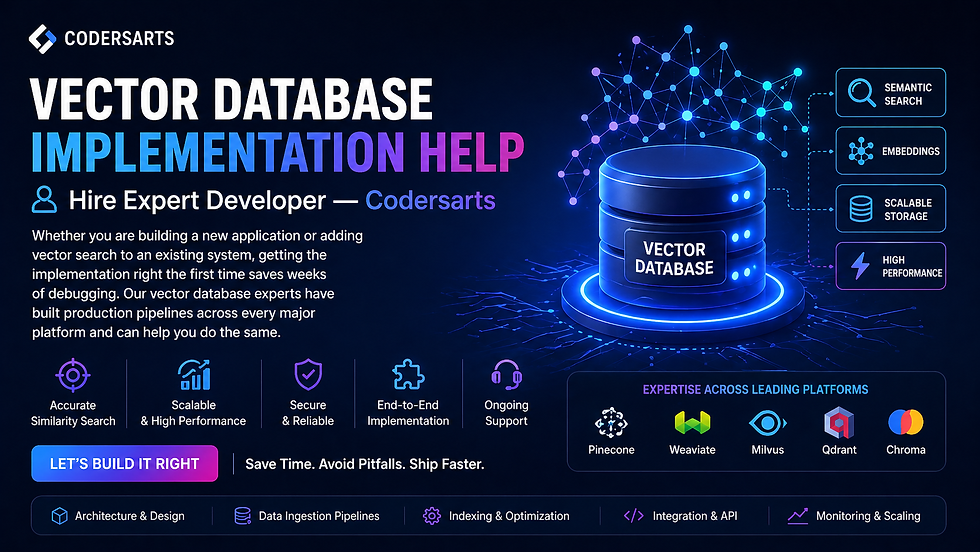
Build the Skills You Are Being Interviewed On → Vector Database Implementation Help — hands-on: Pinecone, Weaviate, Qdrant, Milvus, pgvector, ChromaDB → RAG Pipeline Development — build production RAG with LangChain, LlamaIndex, any LLM → Embedding Pipeline Development — batch, async, cached, multi-modal embedding pipelines → Vector Search Performance Optimisation — HNSW tuning, hybrid search, latency debugging → Hybrid Search Implementation Help — BM25 + vector fusion, the most common senior interview topic |
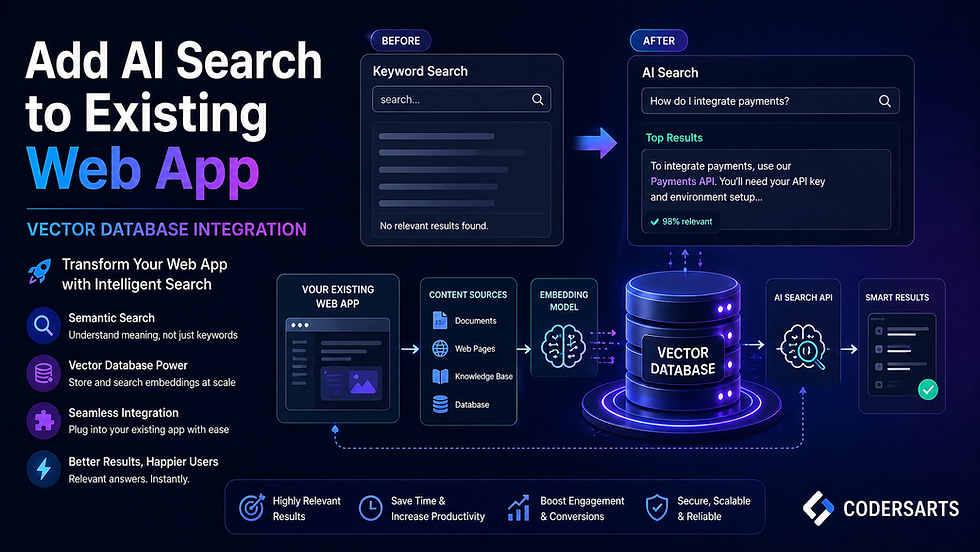
For Startups & Products Built After the Interview → Vector Database Architecture Design for Startups — design the right system before you build it → Add AI Search to Existing Web App — implement what you learned in interviews into a real product → RAG System Development for SaaS — production RAG for your own product after you land the role |
Not sure where to start? Tell us your target role, target company, and timeline and we will map the exact prep plan you need.
Codersarts — Vector DB Interview Prep & Job Support for ML & AI Engineers | codersarts.com |

Comments