
Vector Database Implementation Help | Hire Expert Developer — Codersarts
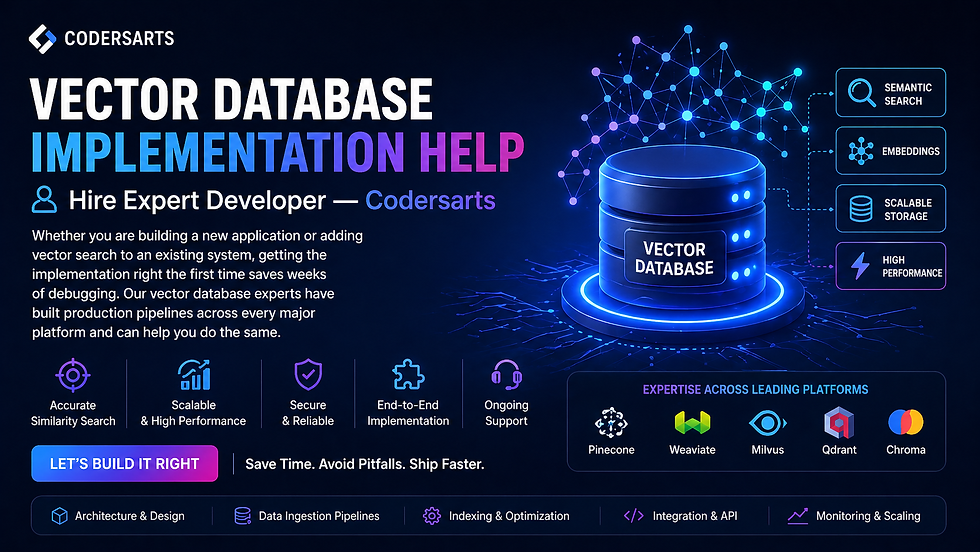
Vector Database Implementation Help — Expert Developers, Production-Ready Code
Implementing a vector database is not like adding a REST API endpoint. It requires the right embedding model, indexing strategy, query architecture, and integration layer — and getting any one of them wrong costs weeks of debugging and re-work.
At Codersarts, our vector database engineers have built production pipelines across every major platform — Pinecone, Weaviate, Qdrant, Milvus, ChromaDB, pgvector, and Redis Vector. We deliver clean, documented, scalable code that works in your stack from day one.
Whether you are starting from zero or fixing an existing implementation that is not performing, we cover the full stack.
What Our Vector Database Experts Implement for You
Every implementation we deliver is tailored to your data type, query volume, latency requirements, and hosting environment. Below is a full breakdown of what we handle end-to-end.
✓ Pinecone index creation & upsert pipeline | ✓ Weaviate schema design & class configuration |
✓ Qdrant collection setup & named vector config | ✓ Milvus / Zilliz Cloud collection & index setup |
✓ pgvector extension install & vector column design | ✓ ChromaDB embedded & client-server configuration |
✓ Redis Vector Search index creation | ✓ OpenAI / Cohere / HuggingFace embedding pipeline |
✓ Batch embedding with rate limiting & retry logic | ✓ LangChain VectorStore integration |
✓ LlamaIndex vector index setup | ✓ Metadata filtering & hybrid search |
✓ HNSW / IVF / Flat index selection & tuning | ✓ Vector DB REST API wrapper (FastAPI / Express) |
✓ Cloud deployment (AWS, GCP, Azure, Render) | ✓ Migration from one vector DB to another |
Platform-by-Platform Implementation Guides
We work across every major vector database. Below is a summary of what each platform implementation involves — click through to each dedicated service page for a full breakdown, pricing, and FAQs.
1. Pinecone Integration & Setup Help |
Why Developers Choose Pinecone — and Where It Gets Tricky
Pinecone is the most popular managed vector database for production applications. Its serverless tier makes it easy to start, but a correct production setup requires careful namespace design, metadata indexing strategy, embedding dimension alignment, and upsert batch management.
Common implementation mistakes we fix: using the wrong metric (cosine vs dot product for your model), missing metadata schema planning that makes filtering impossible later, and embedding dimension mismatches that cause silent failures.
What Our Pinecone Implementation Covers
Serverless vs Pod-based index selection with justification
Namespace design for multi-tenant or multi-category data
Upsert pipeline with batching (100 vectors per batch, rate-limit aware)
Metadata schema design for efficient filtered queries
Query layer with top-K retrieval and score thresholding
LangChain / LlamaIndex Pinecone integration
Cost estimation at your vector volume
Index backup and migration strategy
Ready for a full Pinecone implementation? Our dedicated Pinecone Integration & Setup Help page covers pricing, detailed FAQs, and a step-by-step of what we deliver. Visit it for the complete breakdown. |
2. Weaviate Schema Design & Implementation |
Weaviate — The Most Feature-Rich Open-Source Vector DB
Weaviate is unique in that it stores both vector embeddings and the original object data together, making it ideal for applications that need rich filtering, GraphQL querying, and multi-tenancy out of the box. But its schema-first design means a wrong class definition early on is expensive to undo at scale.
We design your Weaviate schema from the ground up — properties, data types, vectorizer modules, cross-references, and tenant isolation — before a single record is indexed.
What Our Weaviate Implementation Covers
Class and property schema design (text2vec-openai, text2vec-cohere, custom)
Vectorizer module configuration (OpenAI, Cohere, HuggingFace, Ollama)
Multi-tenancy setup with tenant isolation
Batch import pipeline with error recovery
GraphQL query layer design
Hybrid search (BM25 + vector) configuration
Weaviate Cloud (WCS) vs self-hosted deployment
Cross-reference and linked class design
Reranking with Cohere or cross-encoders
Need full Weaviate schema design? Our Weaviate Schema Design & Implementation page covers the complete service — including schema audits for existing broken setups, migration help, and multi-tenant architecture patterns. |
3. Qdrant Collection Setup Help |
Qdrant — The Developer-Favourite Open-Source Option
Qdrant has become the top choice for developers who want full control, open-source transparency, and performance that rivals managed solutions. Its payload filtering, sparse vector support for hybrid search, and named vectors make it exceptionally flexible — but also more complex to configure correctly.
What Our Qdrant Implementation Covers
Collection creation with correct vector config (size, distance metric)
Named vectors for multi-modal or multi-model setups
Sparse vector setup for hybrid BM25 + dense search
Payload schema and filtering index design
Qdrant Cloud vs self-hosted Docker deployment
Batch upload pipeline with point ID management
Scroll, search, and recommend API implementation
LangChain and LlamaIndex Qdrant integration
Snapshot backup and collection migration
Want a complete Qdrant setup? Our Qdrant Collection Setup Help page walks through every configuration option, self-hosting vs cloud tradeoffs, and includes a real-world implementation example. |
4. Milvus / Zilliz Cloud Integration Help |
Milvus — Built for Billion-Scale Vector Search
Milvus is the go-to vector database when you are operating at scale — billions of vectors, millisecond query latency, and enterprise-grade reliability. It is more complex to set up than managed alternatives, but delivers unmatched throughput for large-scale AI applications.
Zilliz Cloud is the fully managed version of Milvus — ideal for teams who want Milvus performance without the infrastructure overhead.
What Our Milvus / Zilliz Implementation Covers
Collection schema design with primary key and vector field configuration
IVF_FLAT, HNSW, DISKANN index selection based on your scale
Partition design for multi-tenant or time-partitioned data
Zilliz Cloud cluster setup and connection management
PyMilvus SDK integration with your Python backend
Bulk insert pipeline for large-scale data loading
Search with output fields and expression filtering
Milvus Standalone (Docker) vs Distributed (Kubernetes) deployment
Need Milvus at scale? Our Milvus / Zilliz Cloud Integration Help page covers enterprise-scale architecture patterns, cost modelling, and deployment options in detail. |
5. pgvector Setup in PostgreSQL |
pgvector — Add AI Search Without Leaving PostgreSQL
If your application already uses PostgreSQL, pgvector is almost always the smartest first choice. There is no new database to manage, no new bill to pay, and no data migration. You get vector search as a native SQL query — and it scales further than most teams realise.
pgvector is available on Supabase, AWS RDS, AWS Aurora, Neon, Railway, Render, and most modern managed Postgres providers.
What Our pgvector Implementation Covers
Extension install on local, Supabase, RDS, Aurora, Neon, Railway
Vector column design and table schema update (no disruption to existing data)
Embedding pipeline to process and store embeddings for existing rows
HNSW index creation for fast approximate nearest neighbour queries
IVFFlat index for large datasets where HNSW memory is a constraint
Cosine, L2, and inner product operator setup
Hybrid search: pgvector similarity + PostgreSQL full-text search (tsvector)
SQLAlchemy / Django ORM / Prisma integration
Re-embedding trigger on content update
Query performance benchmarking and index parameter tuning
Already on PostgreSQL? pgvector is the fastest path to AI search. Our pgvector Setup in PostgreSQL page covers Supabase-specific setup, ORM integration patterns, and benchmarks comparing pgvector to standalone vector DBs at various scales. |
6. Redis Vector Search Implementation |
Redis Vector Search — Real-Time Similarity at In-Memory Speed
Redis Stack's vector search capability (RediSearch) enables millisecond similarity queries on top of your existing Redis infrastructure. It is the right choice when you need real-time vector search with ultra-low latency — for example, live product recommendations, real-time fraud detection embeddings, or instant semantic search on a small-to-medium dataset.
What Our Redis Vector Search Implementation Covers
Redis Stack installation and RediSearch module setup
Hash vs JSON document index design
FLAT and HNSW index creation with correct parameters
Vector field configuration (FLOAT32 / FLOAT64, dimension alignment)
Embedding pipeline: generate → store → index
KNN search query implementation with Redis query syntax
LangChain Redis VectorStore integration
TTL management for time-sensitive vector data
Redis Cloud vs self-hosted Docker deployment
Need real-time vector search on Redis? Our Redis Vector Search Implementation page covers benchmarks, index design tradeoffs, and step-by-step setup for Redis Cloud and self-hosted environments. |
7. ChromaDB Integration Help |
ChromaDB — The Easiest Way to Start with Vector Search
ChromaDB is the most beginner-friendly vector database and the dominant choice for RAG prototypes, student projects, and local development. Despite its simplicity, it has several non-obvious configuration decisions that trip up even experienced developers — especially around persistence, client modes, and production readiness.
We help you set up ChromaDB correctly from the start — and migrate to a more scalable platform when you outgrow it.
What Our ChromaDB Implementation Covers
EphemeralClient vs PersistentClient vs HttpClient — correct setup for your use case
Collection creation with custom embedding functions
Document ingestion, chunking, and batch add pipeline
Metadata schema design for filtered queries
LangChain Chroma VectorStore integration
ChromaDB server deployment (Docker) for team use
ChromaDB auth setup for multi-user environments
Migration from ChromaDB to Pinecone / Qdrant when scaling
Query optimisation for relevance quality improvement
ChromaDB not scaling or not persisting correctly? Our ChromaDB Integration Help page covers the most common failure modes, LangChain integration patterns, and a clear migration path to production-grade platforms. |
Which Vector Database Is Right for Your Project?
One of the most common questions we get is: which platform should I use? The honest answer is — it depends on your data volume, query latency requirements, hosting preference, and budget. Here is a practical comparison to guide your decision.
Platform | Best For | Hosting | Free Tier | Our Rating |
Pinecone | Managed, fast startup | Fully managed | Yes (serverless) | ⭐⭐⭐⭐⭐ |
Weaviate | Rich filtering, multi-tenancy | Cloud + self-host | Yes (WCS sandbox) | ⭐⭐⭐⭐⭐ |
Qdrant | OSS, hybrid search, control | Cloud + self-host | Yes (Cloud free) | ⭐⭐⭐⭐⭐ |
Milvus | Billion-scale, enterprise | Self-host / Zilliz | Yes (Zilliz free) | ⭐⭐⭐⭐ |
pgvector | Already on PostgreSQL | Your existing Postgres | Yes (extension) | ⭐⭐⭐⭐⭐ |
ChromaDB | Prototypes, RAG, local dev | Self-host / embedded | Yes (open-source) | ⭐⭐⭐⭐ |
Redis | Real-time, ultra-low latency | Cloud + self-host | Limited | ⭐⭐⭐⭐ |
Not sure which platform to choose? Share your project requirements — data volume, query type, hosting preference, and budget — and we will recommend the best fit with a written justification. No commitment required. |
Why Developers Choose Codersarts for Vector DB Implementation
✓ Production-grade code — not tutorial stubs | ✓ We match your stack: FastAPI, Django, Node, Rails |
✓ All cloud providers: AWS, GCP, Azure, Render | ✓ Full documentation delivered with every project |
✓ Code review and pair-programming available | ✓ NDA available before any code review |
✓ First response within 4 hours | ✓ Delivery within 24–48 hours for most tasks |
✓ Ongoing support retainer available | ✓ Migration help if you outgrow your current setup |
✓ Interview prep and job support available | ✓ India-based pricing, global quality |
How It Works — From Inquiry to Working Implementation
Step | What Happens | Timeline |
1. Submit requirements | Fill the contact form with your platform, data type, and use case | 5 minutes |
2. Scoping call or written brief | We clarify requirements, ask 3–5 targeted questions, and confirm scope | Within 4 hours |
3. Proposal & timeline | You receive a clear proposal with delivery date and price | Same day |
4. Implementation | We build, test, and document your vector DB pipeline | 24–48 hours (typical) |
5. Code delivery + walkthrough | Full source code, documentation, and a walkthrough session if needed | On delivery |
6. Revision window | Free revisions within 48 hours of delivery | 48h post-delivery |
Frequently Asked Questions
Q: I am not sure which vector database is right for my project. Can you help me decide?
A: Yes — and this is one of the most valuable things we do. Tell us your data volume, query type (semantic search, RAG, recommendations), hosting preference, and budget. We give you a clear recommendation with written justification, so you are not guessing.
Q: My current vector search implementation is slow and returning bad results. Can you fix it?
A: Yes. Performance and recall quality issues are our most common incoming requests. Share your current code and we diagnose the root cause — usually an index type mismatch, wrong distance metric, poor chunking strategy, or missing metadata filtering. We fix it and document what we changed.
Q: We have 50 million existing records in PostgreSQL. Can you add vector search without disrupting the live database?
A: Yes. We design the migration carefully — adding a vector column to your existing table, building an offline batch embedding pipeline that runs without locking your DB, and creating the HNSW index once embedding is complete. Zero downtime to your live application.
Q: Can you integrate the vector database with our existing FastAPI or Django backend?
A: Yes. We write the vector DB integration as a clean service layer that plugs into your existing API. You get the search endpoint, the indexing endpoint, and the update/delete handling — documented and tested.
Q: Do you work with LangChain and LlamaIndex as well?
A: Yes. Most of our implementations include LangChain or LlamaIndex as the orchestration layer. We build the full chain — loader, splitter, embedder, vector store, retriever, and LLM — not just the isolated vector DB piece.
Q: What if our data is sensitive? We cannot share it externally.
A: We sign NDAs before any code or data review. We can also work with anonymised or synthetic sample data for initial scoping, then implement against your real data once NDA is in place.
Q: Can you help us after delivery if something breaks in production?
A: Yes. We offer post-delivery support windows and monthly retainer packages for ongoing maintenance. Ask about our support options when submitting your project.
Ready to implement your vector database correctly the first time? |
📋 Submit Project Brief Fill our contact form with your requirements. Response in 4 hours. | 📞 Book a Free Scoping Call 15 minutes. No commitment. We scope your project live. | 💬 WhatsApp Us Now For urgent requests or quick questions — message us directly. |
Other Vector Database Services We Offer
This page covers our end-to-end vector database implementation service. If you need help with a specific platform, a more focused task, or a related area of your AI pipeline, the pages below go deeper into each topic.
Platform-Specific Implementation Help→ Pinecone Integration & Setup Help — index design, upsert pipeline, namespace strategy → Weaviate Schema Design & Implementation — class schema, vectorizer modules, multi-tenancy → Qdrant Collection Setup Help — named vectors, payload filtering, hybrid search → Milvus / Zilliz Cloud Integration — billion-scale indexing, partition design, bulk insert → pgvector Setup in PostgreSQL — HNSW index, Supabase setup, ORM integration → Redis Vector Search Implementation — real-time KNN, RediSearch index, TTL handling → ChromaDB Integration Help — persistence fix, LangChain setup, production migration |
Pipeline & Framework Help → RAG Pipeline Development (LangChain / LlamaIndex) — full retrieval-augmented generation builds → Embedding Pipeline Development — batch embedding, caching, model selection, async pipelines → LangChain Vector Store Integration — all supported stores, retrieval chains, LCEL → OpenAI Embeddings Integration — batching, cost optimisation, dimension management → Hybrid Search (Vector + BM25) Implementation — best of semantic + keyword combined |
Performance, Scaling & Career → Vector Search Performance Optimisation — HNSW tuning, quantization, latency debugging → Vector DB Migration Help — move between platforms with zero data loss → Vector DB Job Support & Interview Preparation — ML engineer interview, system design rounds → Vector Database Architecture Design for Startups — DB selection, scaling plan, cost modelling |
Not sure which service you need? Describe your project on our contact page and we will point you in the right direction.
Need vector DB implementation? Share your project requirements and get a scoped proposal within 4 hours. |


Comments