
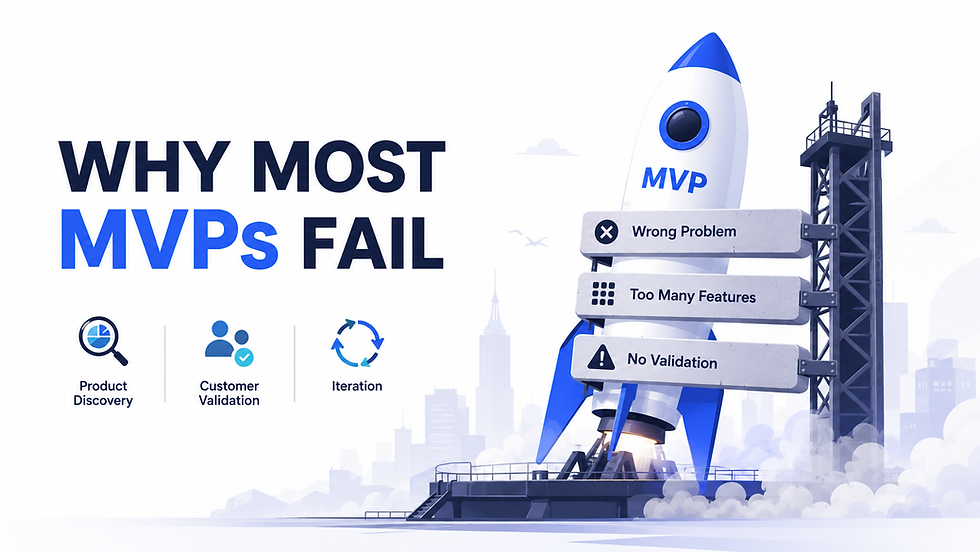
Why Most MVPs Fail: 15 Costly Mistakes Founders Make (And How to Avoid Them)
- 12 minutes ago
- 13 min read
Introduction
Every successful startup begins with an idea. Some ideas solve obvious problems, while others challenge industries by introducing entirely new ways of working. Regardless of the idea, almost every founder eventually faces the same question:
What should we build first?
For many startups, the answer is an MVP—a Minimum Viable Product.
Over the last decade, the term "MVP" has become one of the most misunderstood concepts in product development. It's frequently used to describe anything from a rough prototype to a feature-complete application released on a tight budget. As a result, many founders believe that building an MVP simply means building a cheaper or smaller version of their product.
That misunderstanding is one of the primary reasons so many MVPs fail.
An MVP is not about building the fewest features possible. It is not about launching quickly for the sake of speed. And it certainly isn't about cutting corners on quality.
A successful MVP is designed to answer one fundamental question:
"Are we solving a real problem for a clearly defined group of users?"
Everything else—technology choices, design systems, infrastructure, and scaling—comes later.
At Codersarts, we've worked with startups and businesses across different industries, helping them transform ideas into working products. While every product is different, we've observed that unsuccessful MVPs often fail for remarkably similar reasons. The issues usually aren't technical. They're strategic.
Some founders skip customer research because they're eager to start building. Others attempt to launch a product with every feature they've imagined. Some invest heavily in development before validating whether anyone actually wants the solution.
These decisions increase costs, extend timelines, and reduce the chances of finding product-market fit.
The encouraging news is that most of these mistakes are preventable.
This guide explains the most common reasons MVPs fail, the lessons we've learned from real product development projects, and practical approaches founders can use to reduce risk before writing their first line of code.
Whether you're a first-time entrepreneur, an experienced founder, or part of an enterprise innovation team, understanding these principles can help you build products that learn faster, adapt quicker, and create lasting value.
What You'll Learn
By the end of this guide, you'll understand:
What an MVP is actually designed to accomplish.
Why many founders misunderstand the purpose of MVP development.
The fifteen most common mistakes that lead to unsuccessful MVPs.
How to validate ideas before making significant investments.
Practical frameworks for reducing product development risk.
How experienced product teams approach MVP planning differently.
A founder's checklist before beginning development.
More importantly, you'll learn how to think like a product builder rather than simply a software buyer.
What an MVP Is Really Meant to Achieve
The phrase Minimum Viable Product was introduced to encourage learning—not minimal development.
Unfortunately, many teams interpret the word "minimum" as an instruction to build as little as possible.
In reality, an MVP should be the smallest product capable of testing your most important business assumptions while delivering genuine value to early users.
That distinction matters.
A product with very few features isn't automatically an MVP.
Likewise, a technically sophisticated application isn't automatically a successful product.
The objective of an MVP isn't to impress investors or showcase engineering capabilities. Its purpose is to generate learning.
Every MVP should answer a series of important questions:
Does this problem genuinely exist?
Who experiences this problem most frequently?
Are users actively searching for a solution?
Will people consistently use the product?
Will customers eventually pay for it?
Which features create the greatest value?
Which assumptions were incorrect?
Notice that none of these questions focus primarily on technology.
They're business questions.
Technology simply enables the experiment.
When founders begin to view an MVP as a learning system rather than a software project, the entire product development process changes.

The Biggest Myth About MVP Development
One of the most common misconceptions is surprisingly simple:
"An MVP is just a smaller version of the final product."
This belief causes many startups to spend months deciding which features to remove instead of asking what they actually need to learn.
Imagine two founders building project management software.
The first founder starts with fifty planned features and reduces the list to twenty-five.
The second founder asks a different question:
"What's the simplest experience that proves teams will actually manage projects using our platform?"
Although both products might be called MVPs, they're fundamentally different.
The first approach optimizes for development.
The second optimizes for validation.
The second founder is far more likely to discover valuable customer insights before investing additional time and money.
An MVP should never be measured by how many features it contains.
It should be measured by how effectively it reduces uncertainty.
The Three Questions Every MVP Must Answer

Before beginning development, every founder should clearly define three questions.
1. Are We Solving a Real Problem?
Many startups begin with an interesting solution before confirming that the underlying problem actually matters.
Successful products begin by deeply understanding customer pain points, workflows, frustrations, and existing alternatives.
If customers don't experience meaningful pain, even excellent software struggles to gain traction.
2. Are We Solving It for the Right Audience?
Not everyone experiences the same problem with equal intensity.
A common startup mistake is attempting to build for everyone.
Successful MVPs intentionally focus on a narrow audience first.
Specific users provide clearer feedback, adopt products faster, and help founders refine their positioning before expanding into larger markets.
3. Will Users Change Their Behaviour?
Perhaps the most difficult question is behavioural rather than technical.
Will someone:
Change their workflow?
Spend time learning a new product?
Replace an existing solution?
Recommend it to others?
Return after the first experience?
Until these questions are answered, building additional functionality creates more uncertainty rather than less.
The Codersarts MVP Validation Pyramid™

Through working with founders, we've found it helpful to think of MVP development as a hierarchy of validation rather than a development checklist.
Instead of asking:
"What should we build?"
Ask:
"What must we validate first?"
Level 1 — Problem Validation
Does the problem genuinely exist?
Are enough people experiencing it?
How important is it?
Level 2 — Customer Validation
Who experiences this problem most frequently?
Who becomes your earliest adopter?
Who will actively provide feedback?
Level 3 — Solution Validation
Does your proposed solution meaningfully improve the customer's situation?
Can users understand its value quickly?
Level 4 — Product Validation
Can people successfully use your product?
Does the experience match their expectations?
Can they complete their primary task without confusion?
Level 5 — Business Validation
Can this product become a sustainable business?
Will customers pay?
Can acquisition costs support long-term growth?
Can the business scale?
Many startups begin at Level 4.
Successful startups almost always begin at Level 1.
That's one of the biggest differences between building software and building products.
Mistake #1: Building for Everyone Instead of Someone
One of the fastest ways to create an unsuccessful MVP is trying to satisfy every possible customer.
Founders often worry that narrowing their audience will reduce market size.
Ironically, the opposite usually happens.
Products that attempt to solve everyone's problems rarely solve anyone's problem particularly well.
Instead of targeting:
Small businesses
Enterprises
Freelancers
Agencies
Students
Consultants
Choose one.
Build specifically for that audience.
Understand their daily workflow.
Learn their frustrations.
Observe how they currently solve the problem.
Your first customers are not your final market.
They're your learning partners.
The narrower your focus, the faster you'll receive meaningful feedback.
In Part 2, we'll continue with Mistakes #2 through #10, covering issues such as feature overload, skipping product discovery, choosing technology too early, ignoring customer interviews, and building without measurable success criteria.
Part 2: The Most Common MVP Development Mistakes
Mistake #2: Building Too Many Features

One of the biggest misconceptions about MVP development is that the first release should include every feature the team believes customers might eventually need.
Founders often think:
"If we're already building the product, we might as well include this feature too."
Then another feature is added.
Then another.
Before long, a product originally planned for eight weeks becomes a six-month project.
This is known as feature creep, and it's one of the most common reasons MVPs miss their launch window.
Every additional feature introduces new design decisions, development effort, testing requirements, and maintenance costs. More importantly, it delays the one thing founders need most—real customer feedback.
Successful MVPs focus on validating a single core value proposition.
Ask yourself:
If we could solve only one customer problem, what would it be?
Everything else belongs in future iterations.
How to Avoid It
Define one primary customer problem.
Identify the smallest feature set that solves it.
Separate "Must Have" from "Nice to Have."
Maintain a backlog for future releases instead of expanding Version 1.
Mistake #3: Skipping Product Discovery

Many startups begin development immediately after coming up with an idea.
The assumption is simple:
"We already know what customers need."
Unfortunately, assumptions are rarely enough.
Product discovery is the process of validating the problem, understanding users, analyzing competitors, and defining product goals before writing production code.
Skipping this stage often results in expensive redesigns later.
Product discovery doesn't need months of research. Even a structured one- or two-week discovery process can uncover insights that dramatically improve product decisions.
Product Discovery Should Answer
Who are our users?
What problem are we solving?
Why does this problem exist?
How are users solving it today?
What makes our solution different?
Which assumptions are we testing?
Founders who invest time in discovery often spend less time rebuilding features later.
Mistake #4: Talking to Developers Before Talking to Customers

One of the most expensive conversations a founder can have is this:
"Can you build this?"
before asking:
"Would anyone actually use this?"
Software developers can build almost anything.
Customers determine whether it should have been built.
Many MVPs fail because founders collect technical opinions instead of customer insights.
Before investing in development, speak with potential users.
Understand:
Their daily workflow.
Their frustrations.
Existing alternatives.
Current spending habits.
Desired outcomes.
Technology validates feasibility.
Customers validate demand.
You need both.
Mistake #5: Choosing Technology Before Defining the Product
Questions like these are common:
Should we use React or Next.js?
Flutter or React Native?
Node.js or Django?
AWS or Google Cloud?
These are important technical decisions.
However, they're rarely the first questions founders should ask.
Before selecting a technology stack, define:
Business goals.
User experience.
Product scope.
Growth expectations.
Budget.
Timeline.
Technology should support business objectives—not dictate them.
Experienced engineering teams recommend technology after understanding the product, not before.
Mistake #6: Building Without Clear Success Metrics
Many founders celebrate launching their MVP.
But launch isn't success.
Success is learning something valuable.
Every MVP should have measurable objectives.
Examples include:
Number of active users
Customer interviews completed
Weekly retention
Feature adoption
Conversion rate
Trial sign-ups
Customer feedback collected
Without measurable goals, founders often rely on opinions instead of evidence.
Good product decisions come from data.
Mistake #7: Treating Design as Decoration
Some startups believe design can wait until after development.
The result is often an application that works technically but feels confusing to users.
Good UX isn't about visual polish.
It's about helping users complete tasks with minimal effort.
A simple, intuitive product often outperforms a feature-rich product with poor usability.
Before development begins:
Map user journeys.
Design primary workflows.
Remove unnecessary friction.
Test prototypes with real users.
Small usability improvements can significantly increase adoption.
Mistake #8: Waiting Too Long to Launch

Perfection is one of the biggest enemies of startup progress.
Many founders delay launch because they want:
More features.
Better branding.
Better animations.
Better dashboards.
Better documentation.
Meanwhile, competitors begin learning from real customers.
An MVP isn't meant to be perfect.
It's meant to create learning.
The earlier you launch, the sooner you replace assumptions with evidence.
Remember:
Shipping Version 1 is the beginning of product discovery—not the end.
Mistake #9: Ignoring User Behaviour After Launch

Collecting feedback is valuable.
Observing behaviour is even more valuable.
Customers don't always describe their problems accurately.
Their actions often tell a clearer story.
After launching your MVP, monitor:
Where users drop off.
Which features receive the most engagement.
Which workflows cause confusion.
How frequently users return.
Which pages generate conversions.
Product analytics often reveal opportunities that customer interviews alone cannot.
The best product teams combine qualitative feedback with quantitative data.
Mistake #10: Confusing Feedback with Validation
Hearing positive comments from friends, mentors, or investors can feel encouraging.
However, encouragement isn't validation.
Real validation occurs when users consistently demonstrate value through action.
Examples include:
Returning regularly.
Recommending the product.
Completing important workflows.
Paying for the service.
Requesting additional functionality.
Validation comes from behaviour—not compliments.
A founder's goal isn't collecting praise.
It's discovering evidence that customers genuinely need the product.
Key Takeaways
Across these nine mistakes, a clear pattern emerges.
Successful MVPs are rarely built by teams with the largest budgets or the most advanced technology.
They're built by teams that learn faster than everyone else.
The most effective founders:
Start with customer problems.
Prioritize learning over feature count.
Validate assumptions continuously.
Launch early.
Measure real user behaviour.
Improve through iteration.
These habits create products that evolve based on evidence rather than assumptions.
In Part 3, we'll explore the remaining five critical mistakes, introduce the Codersarts MVP Success Framework™, provide a founder's pre-development checklist, answer common questions, and conclude with a practical roadmap for building an MVP that is designed to learn, adapt, and grow.
Part 3: Building MVPs That Succeed
By now, you've seen that successful MVPs are rarely the result of better programming alone. They're the outcome of making better product decisions from day one.
In this final section, we'll explore the remaining mistakes founders make, introduce the Codersarts MVP Success Framework™, and provide a practical checklist you can use before starting development.
Mistake #11: Building an MVP Without a Business Model
Many founders become so focused on launching a product that they postpone thinking about how the business will generate revenue.
Questions like these are often left unanswered:
Who will pay?
What pricing model makes sense?
How will customers discover the product?
What will customer acquisition cost?
Can the business become sustainable?
Your MVP doesn't need to maximize revenue on day one, but it should validate whether a viable business can eventually exist.
Ask yourself:
What business assumption are we trying to validate alongside the product?
Sometimes the biggest risk isn't whether users like your product—it's whether they'll ever pay for it.
Mistake #12: Treating the MVP as the Final Product
The word Minimum often creates the wrong mindset.
Some founders treat the MVP as Version 1 of the final product.
Others assume they'll eventually rebuild everything.
Neither approach is ideal.
A successful MVP should become the foundation for future iterations.
That means:
Writing maintainable code
Designing scalable architecture
Keeping documentation updated
Building reusable components
Planning for growth
An MVP shouldn't be over-engineered.
But it shouldn't become technical debt either.
Think of it as the first floor of a building, not a temporary tent.
Mistake #13: Working Without a Feedback Loop

Shipping software without collecting structured feedback is like flying without instruments.
Many startups launch, celebrate, and immediately start building new features.
Instead, they should pause and ask:
What did users actually do?
Which assumptions were wrong?
What surprised us?
What should change next?
Every release should create learning.
The best teams establish a continuous feedback loop:
Build → Launch → Measure → Learn → Improve
This cycle never ends.
Mistake #14: Ignoring Technical Debt
Speed matters.
But speed without discipline creates future problems.
Poor architecture, inconsistent coding practices, missing documentation, and rushed development eventually slow every product.
Technical debt is acceptable when it's intentional.
It's dangerous when it's accidental.
Balance speed with engineering quality.
A well-built MVP allows future growth without requiring a complete rewrite.
Mistake #15: Hiring a Development Team Instead of a Product Partner
Perhaps the biggest mistake founders make isn't technical at all.
It's choosing the wrong partner.
Many companies hire developers expecting product guidance.
Developers write code.
Product partners help founders answer questions like:
Should we build this?
Is this feature necessary?
What can wait?
What should we validate first?
What happens after launch?
Building software is a technical exercise.
Building a successful product is a strategic one.
Choose partners who challenge assumptions—not just implement requirements.
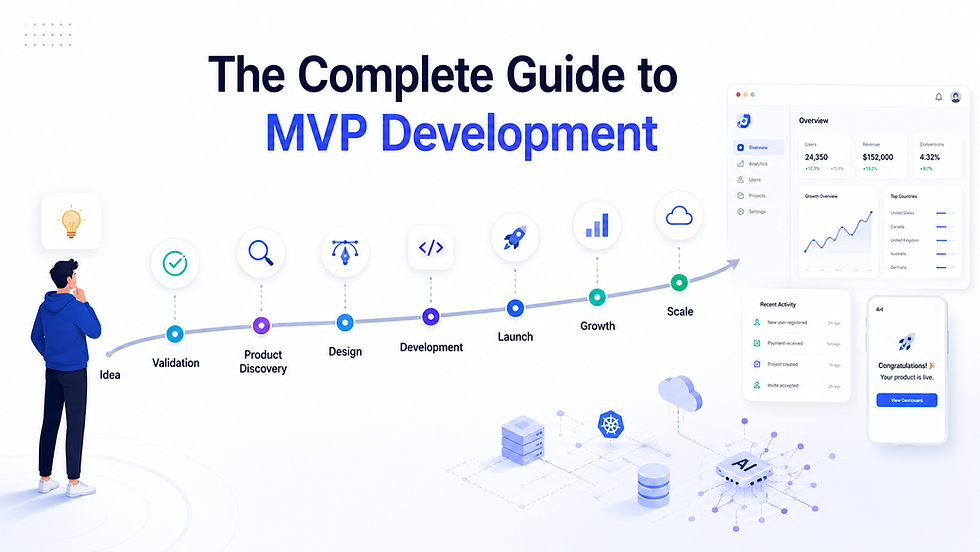
The Codersarts MVP Success Framework™
At Codersarts, we've found that successful MVPs follow a repeatable pattern. We call it the Codersarts MVP Success Framework™.
Rather than starting with development, we begin with validation.
Stage 1: Discover
Understand the business problem, customer pain points, market opportunity, and product vision.
Goal: Validate the problem.
Stage 2: Validate
Interview potential users, analyze competitors, prioritize assumptions, and identify the smallest experiment worth building.
Goal: Validate the solution.
Stage 3: Prioritize
Separate essential features from future enhancements.
Define a clear MVP scope.
Goal: Reduce complexity.
Stage 4: Design
Create user journeys, wireframes, prototypes, and intuitive user experiences before development begins.
Goal: Validate usability.
Stage 5: Build
Develop a scalable MVP using modern engineering practices.
Focus on quality, maintainability, and rapid iteration.
Goal: Deliver working software.
Stage 6: Launch
Release the MVP to real users.
Configure analytics, monitoring, and feedback collection.
Goal: Begin learning.
Stage 7: Learn
Analyze product usage, customer interviews, retention metrics, and feature adoption.
Goal: Replace assumptions with evidence.
Stage 8: Scale
Improve the product based on real-world data.
Expand features, optimize performance, and prepare for long-term growth.
Goal: Achieve product-market fit.
Founder Checklist Before Building an MVP
Before starting development, ask yourself these questions.
Problem Validation
✔ Have we identified a real customer problem?
✔ Have we spoken with potential users?
✔ Do we understand current alternatives?
Product Validation
✔ What assumption are we testing?
✔ What is the smallest product that can test it?
✔ Which features can wait?
Business Validation
✔ Who is our target customer?
✔ How will we acquire users?
✔ What business model are we testing?
Technical Readiness
✔ Do we have a realistic budget?
✔ Have we selected the right technology?
✔ Is our architecture designed for future growth?
Launch Readiness
✔ How will success be measured?
✔ Which analytics will we track?
✔ How will customer feedback be collected?
If you can't confidently answer these questions, spend more time planning before investing in development.
Frequently Asked Questions
How many features should an MVP include?
Only enough features to solve one meaningful customer problem and validate your core assumptions. Resist the temptation to include every idea in the first release.
How long should MVP development take?
The timeline depends on complexity, but most MVPs should focus on reaching the market as quickly as practical while maintaining quality. The objective is learning—not perfection.
Should I build a prototype before an MVP?
In many cases, yes. A prototype helps validate user experience and gather early feedback before investing in full-scale development.
Can AI be part of an MVP?
Absolutely. AI can create significant value when it solves a genuine business problem. However, avoid adding AI simply because it's a trend. Validate that it improves the user experience and supports your product goals.
Is an MVP only for startups?
No. Established businesses, enterprises, and innovation teams also use MVPs to validate new products, internal tools, and digital initiatives before committing larger budgets.
Final Thoughts

Every successful product you use today began as an assumption.
Some assumptions were proven right.
Many were proven wrong.
The companies that succeeded weren't the ones with perfect ideas—they were the ones that learned the fastest.
An MVP isn't about launching a smaller product.
It's about reducing uncertainty.
It's about replacing opinions with customer feedback.
It's about making better product decisions before making bigger investments.
If your MVP helps you learn something meaningful about your customers, your market, or your business model, it has already succeeded—even if Version 1 isn't perfect.
The goal isn't to build software.
The goal is to build the right product.
Ready to Build an MVP?
If you're planning to launch a startup, validate a new product idea, or bring an AI-powered application to market, the right strategy matters as much as the technology.
At Codersarts, we help founders move from idea validation to product launch through structured product discovery, user-focused design, scalable engineering, and continuous product improvement.
Whether you're starting with a concept, a prototype, or an existing application, our team can help you build an MVP that reduces risk, accelerates learning, and creates a strong foundation for long-term growth.
👉 Explore our MVP Development Services and schedule a discovery call to discuss your product vision.
Comments