
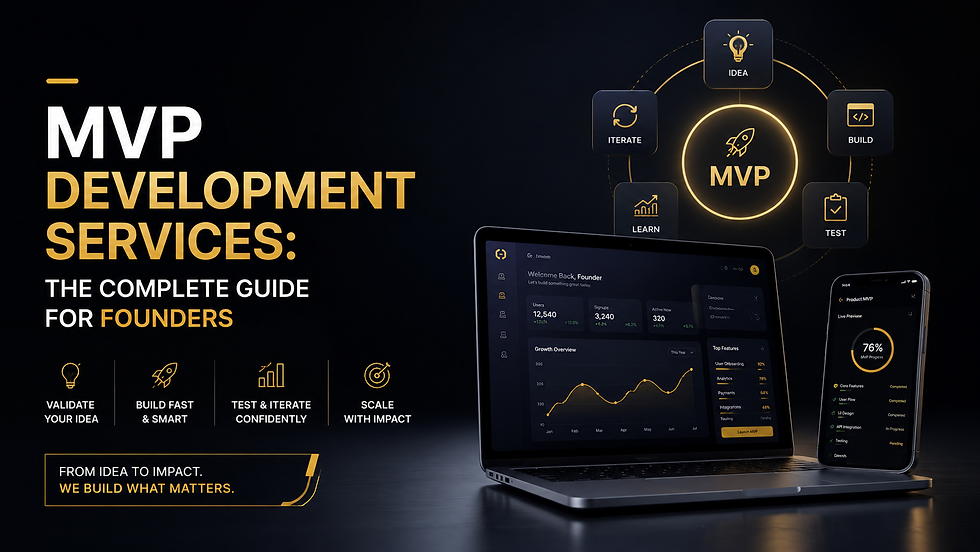
MVP Development: Idea to Launch — The Complete 2026 Guide
Updated: Aug 23
Part 1: Understanding MVP Development
Everything founders need to know before investing in product development.
Building a startup has never been easier—and it has never been more competitive.
Today, founders have access to AI-powered development tools, cloud infrastructure that scales globally, open-source frameworks, and worldwide talent. A motivated team can build in weeks what once required months or even years.
Yet despite these advantages, most startups still fail.
The reason usually isn't poor engineering.
It isn't a lack of funding.
And it isn't because someone copied the idea.
More often, startups fail because they spend months building products that customers never wanted.
That's exactly the problem a Minimum Viable Product (MVP) is designed to solve.
An MVP is not simply a smaller version of your application. It is a disciplined product development strategy that helps founders reduce uncertainty before investing significant time and capital.
Instead of asking:
"How can we build everything?"
successful founders ask:
"What is the smallest product that proves we're solving a real customer problem?"
That single question changes every decision that follows.
Whether you're building a SaaS platform, an AI application, a marketplace, a mobile app, or an enterprise solution, the purpose of an MVP remains the same:
Validate assumptions with real users before scaling your investment.
This guide brings together the practical lessons, frameworks, and decision-making processes used by experienced product teams to help founders move from an idea to a validated product.
By the end of this guide, you'll understand:
What an MVP actually is—and what it isn't
When an MVP makes sense
How successful companies approach MVP development
Common misconceptions that lead to wasted time and money
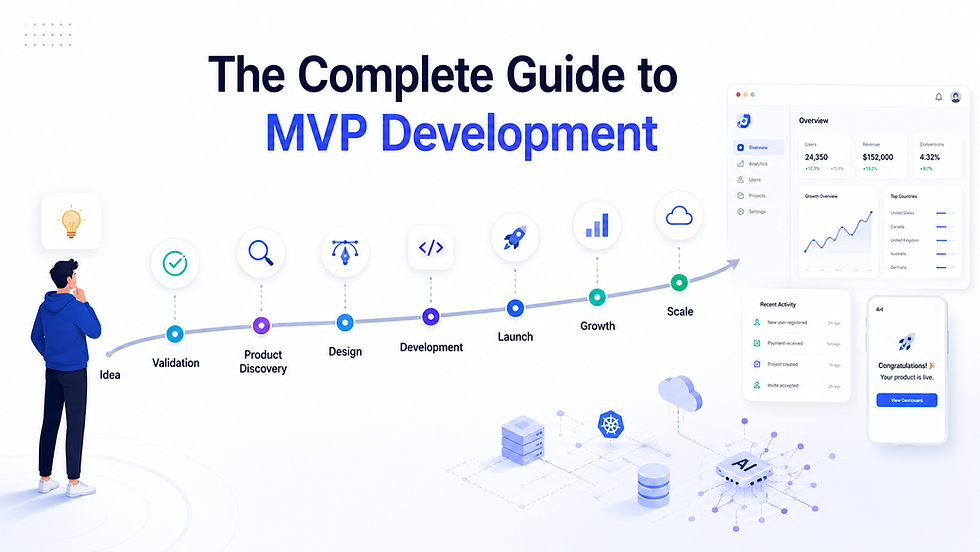
The complete roadmap from idea validation to product launch
Let's begin with the fundamentals.
Chapter 1: What Is MVP Development?
A Minimum Viable Product (MVP) is the simplest version of a product that delivers meaningful value to early users while allowing the team to validate its most important business assumptions.
The definition contains three ideas that are often misunderstood.
Minimum
"Minimum" does not mean low quality.
It means intentionally limiting the scope to only the features required to solve a specific customer problem.
Removing unnecessary functionality reduces complexity, shortens development time, lowers costs, and accelerates learning.
Viable
A product is viable when users can successfully accomplish the core task it was designed for.
An MVP should never feel unfinished or unreliable.
Even with a limited feature set, it should be stable, intuitive, and capable of delivering genuine value.
Product
An MVP is a real product used by real people.
It includes working software, usable interfaces, authentication when required, secure infrastructure, monitoring, and enough operational readiness to support actual customers.
It is not a clickable design prototype.
It is not a presentation.
It is not a collection of mockups.
It is software that solves one important problem exceptionally well.
MVP Development Is Really About Learning
Many founders believe they're building software.
In reality, they're testing assumptions.
Every startup begins with a collection of hypotheses.
For example:
Customers experience a specific problem.
They care enough to solve it.
Existing solutions are inadequate.
They'll adopt a new solution.
They'll pay for it.
The proposed experience is better than existing alternatives.
None of these assumptions are facts until validated by real users.
An MVP exists to transform assumptions into evidence.
That's why the true output of MVP development isn't code.
It's knowledge.
The software simply enables that learning process.
A Practical Example
Imagine you're building an AI-powered meeting assistant.
The long-term vision might include:
Automatic meeting transcription
AI-generated summaries
Action item tracking
Calendar integration
CRM synchronization
Team analytics
Knowledge search
Voice commands
Mobile applications
Building all of this could require twelve months or more.
Instead, an MVP asks a different question:
"What is the smallest experience that proves users actually want this?"
Perhaps the answer is much simpler:
Users upload a meeting recording.
Within one minute they receive:
A summary
Key decisions
Action items
That's enough to test whether customers find the product valuable.
If they do, the product evolves.
If they don't, the company has learned an important lesson before investing hundreds of thousands of dollars.
That's the power of MVP thinking.
Chapter 2: Why Every Startup Should Build an MVP
Startups operate in environments filled with uncertainty.
Unlike established businesses, startups rarely know:
Who their ideal customer really is
Which features matter most
What pricing customers will accept
Which marketing channels will work
How customers will actually use the product
Traditional software projects attempt to eliminate uncertainty through extensive planning.
Startups succeed by reducing uncertainty through experimentation.
An MVP enables those experiments.
Instead of spending a year building fifty features, founders launch the five features that answer the most important business questions.
This approach creates four significant advantages.
1. Faster Validation
Launching earlier means learning earlier.
Real customer feedback consistently provides more valuable insights than internal assumptions.
2. Lower Development Costs
Every unnecessary feature increases engineering effort, testing, maintenance, and future complexity.
By focusing only on essential functionality, founders preserve both time and capital.
3. Better Product Decisions
Customer behavior often contradicts founder expectations.
An MVP reveals what users actually do—not what they claim they'll do.
4. Reduced Business Risk
Every month spent building unvalidated functionality increases financial risk.
Launching sooner reduces uncertainty while creating opportunities to adapt.
Chapter 3: MVP vs Prototype vs Proof of Concept

These terms are frequently used interchangeably, but they solve different problems.
Understanding the distinction helps founders choose the right approach.
Proof of Concept (PoC)
A Proof of Concept answers one question:
Can this technology work?
Examples include:
Testing an AI model
Evaluating a blockchain architecture
Verifying an integration
Measuring system performance
PoCs are technical experiments.
Customers rarely interact with them.
Prototype
A prototype answers another question:
What should the user experience look like?
Prototypes allow teams to explore navigation, workflows, layouts, and usability before development begins.
Most prototypes are interactive designs rather than functional software.
Minimum Viable Product
An MVP answers the most important question:
Will customers actually use this product?
Unlike prototypes or PoCs, an MVP reaches real users and produces measurable business insights.
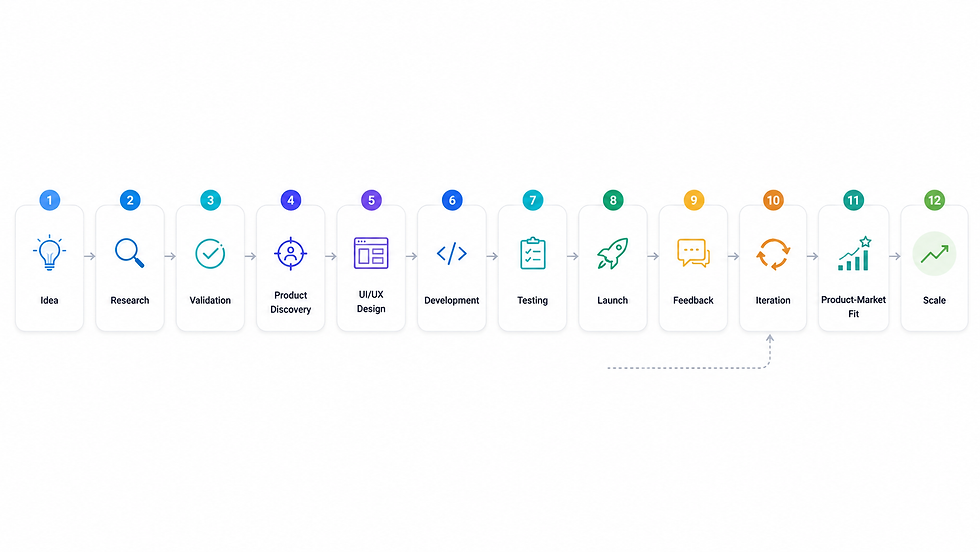
That's why most successful startups progress through this sequence:
Idea
↓
Research
↓
Proof of Concept (if necessary)
↓
Prototype
↓
Minimum Viable Product
↓
Iteration
↓
Product-Market Fit
↓
Scaling
Understanding where you are in this journey helps you invest resources wisely.
Chapter 4: Characteristics of a Great MVP
Not every small product qualifies as an MVP.
A successful MVP shares several characteristics.
It Solves One Core Problem
Great MVPs resist feature creep.
They focus relentlessly on solving one meaningful customer challenge.
It Delivers Immediate Value
Users should benefit within minutes of using the product.
If value requires extensive setup or training, adoption becomes more difficult.
It Is Reliable
Limited functionality is acceptable.
Poor quality is not.
Users often judge the entire company based on their first interaction.
It Measures Everything
Every MVP should collect meaningful data such as:
User activation
Feature adoption
Session duration
Retention
Conversion
Customer feedback
Without measurement, learning becomes impossible.
It Is Built to Evolve
The architecture should support future growth without forcing unnecessary complexity into the first release.
An MVP is Version 1—not the final product.
Chapter 5: When Should You Build an MVP?
An MVP is the right approach when:
You're entering a new market.
You're validating a startup idea.
You're launching a SaaS platform.
You're building an AI application.
You're creating a marketplace.
You're testing customer demand.
You're preparing to raise investment.
You're exploring a new business model.
However, not every software project requires an MVP.
If you're adding a feature to an existing product with well-understood user needs, incremental development may be more appropriate than treating it as a new MVP.
The key question is simple:
Are you validating assumptions, or are you delivering known requirements?
If uncertainty is high, an MVP is usually the smartest investment.
Looking Ahead
Understanding what an MVP is provides only the foundation.
The next challenge is deciding what to build first.
In Part 2, we'll explore how experienced product teams validate startup ideas, conduct product discovery, prioritize features, estimate timelines, and control development costs before writing a single line of production code.
These planning decisions often determine whether an MVP becomes a successful business—or an expensive lesson.
Part 2: Planning & Building Your MVP
Understanding what an MVP is only solves part of the challenge.
The more difficult question is:
What should you build first?
Many startups don't fail because they lack engineering talent. They fail because they build features customers don't need, invest months developing assumptions instead of validating them, or try to solve too many problems at once.
Successful product teams spend more time deciding what not to build than deciding what to build.
This is where product strategy becomes more important than software development.
In this section, we'll walk through the planning process used by experienced product teams—from validating an idea to launching the first version of your MVP.
Chapter 6: Validate the Problem Before Building the Solution
One of the most common mistakes founders make is falling in love with their solution before confirming that the underlying problem actually exists.
Customers don't buy products because they're innovative.
They buy products because they solve meaningful problems.
Before investing in design or development, answer these five questions:
1. Who is the customer?
Be specific.
Avoid broad definitions such as:
Businesses
Students
Healthcare
E-commerce companies
Instead define a narrow audience.
Examples:
Independent financial advisors managing fewer than 500 clients
HR managers at SaaS companies with 50–200 employees
Restaurant owners managing multiple delivery platforms
Sales teams using HubSpot with more than ten representatives
The narrower the audience, the easier it becomes to build the right product.
2. What problem are they experiencing?
Describe the problem—not your feature.
Instead of saying:
"We have an AI chatbot."
Say:
"Customer support teams spend three hours every day answering repetitive questions."
People don't purchase AI.
They purchase faster support, lower costs, and happier customers.
3. How are they solving it today?
Every customer already has an alternative.
That alternative may be:
Excel
Email
WhatsApp
Manual work
Google Sheets
Existing software
Hiring more people
Understanding current behavior is often more valuable than analyzing competitors.
4. How painful is the problem?
A useful framework is to score the problem from 1 to 10.
If the pain is only a 3 or 4, customers are unlikely to change their existing workflow.
If it's an 8, 9, or 10, they're actively looking for a better solution.
The strongest MVPs solve high-frequency, high-impact problems.
5. Will someone pay to solve it?
Validation isn't complete until you understand willingness to pay.
Ask potential customers:
What solution do you currently use?
What does it cost?
How often do you experience this problem?
If a better solution existed, would you pay for it?
These conversations provide far more value than guessing.
Chapter 7: Product Discovery – The Most Underrated Stage of MVP Development
Many founders think development starts with writing code.
In reality, successful MVPs begin with product discovery.
Product discovery is the process of understanding users, business goals, technical constraints, and market opportunities before development begins.
Skipping discovery often leads to:
Unnecessary features
Budget overruns
Delayed launches
Poor user experience
Expensive redesigns
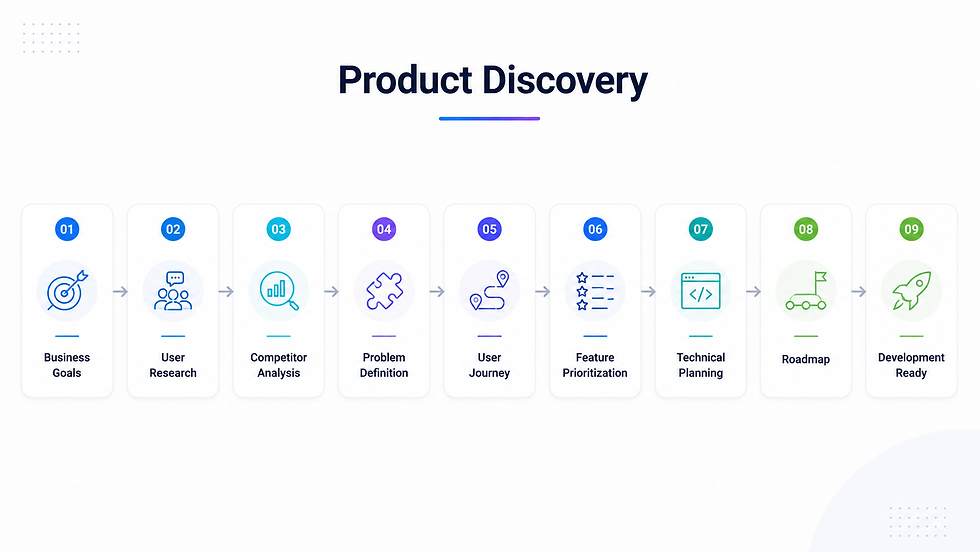
A typical discovery phase includes:
Stakeholder interviews
User research
Competitor analysis
Feature prioritization
User journey mapping
Technical architecture planning
Risk identification
MVP scope definition
Although discovery may take one to three weeks, it often saves months of development effort later.
Chapter 8: The MVP Development Process
Once you've validated the opportunity, development can begin.
A structured process reduces uncertainty and improves delivery quality.
Step 1: Product Strategy
Define:
Business objectives
Success metrics
Target audience
Core problem
Value proposition
Every future decision should align with these foundations.
Step 2: Feature Prioritization
One of the most effective prioritization frameworks is the MoSCoW Method.
Must Have
Essential features without which the MVP cannot function.
Should Have
Important features that improve the experience but are not required for launch.
Could Have
Useful enhancements that can wait until later releases.
Won't Have (For Now)
Features intentionally excluded from the MVP.
This approach prevents feature creep and keeps development focused.
Step 3: User Experience Design
Design the user journey before designing individual screens.
Questions to answer include:
How does a user sign up?
What is the first meaningful action?
Where might users become confused?
How quickly can they experience value?
A simple, intuitive experience usually outperforms a feature-rich interface.
Step 4: Technical Architecture
Choose technologies that balance:
Speed of development
Scalability
Maintainability
Security
Cost
The goal isn't to build the perfect architecture.
It's to build an architecture that supports learning and future growth.
Step 5: Agile Development
Most MVPs are built using short development cycles (sprints).
Each sprint delivers working software that can be tested and improved.
This iterative approach allows founders to adjust priorities based on real feedback.
Step 6: Quality Assurance
Testing should include:
Functional testing
Performance testing
Security testing
Cross-browser compatibility
Mobile responsiveness
User acceptance testing
Even a small MVP should meet professional quality standards.
Step 7: Launch
Launching is not the finish line.
It's the beginning of learning.
The objective is to observe real user behavior, collect feedback, and identify the next set of improvements.
Chapter 9: How to Decide What Features Belong in Your MVP
One of the hardest decisions founders face is deciding what to exclude.
A useful question is:
If we removed this feature, would the core value of the product disappear?
If the answer is no, it probably doesn't belong in Version 1.
A simple prioritization framework looks like this:
Core Features
These directly solve the primary customer problem.
Examples:
User authentication
Dashboard
Core workflow
Payment processing (if required)
Supporting Features
These improve usability but don't define the product.
Examples:
Notifications
User profiles
Search
Reporting
Future Features
These become part of later releases.
Examples:
AI recommendations
Team collaboration
Advanced analytics
Integrations
Mobile apps
Multi-language support
Remember:
Every additional feature increases development time, testing effort, maintenance, and complexity.
Chapter 10: How Long Does MVP Development Take?

The timeline depends on product complexity, team size, and scope.
A typical MVP follows this schedule:
Phase | Estimated Duration |
Product Discovery | 1–2 weeks |
UI/UX Design | 2–3 weeks |
Backend Development | 4–8 weeks |
Frontend Development | 4–8 weeks |
Testing & QA | 2–3 weeks |
Deployment | 1 week |
For many startups, a realistic timeframe is 8–16 weeks.
The biggest factors affecting delivery time are:
Number of features
Third-party integrations
AI capabilities
Regulatory requirements
Team availability
Scope changes during development
Reducing scope almost always accelerates delivery more effectively than adding developers.
Chapter 11: How Much Does MVP Development Cost?
There is no universal price because every product has different requirements.
The overall cost depends on factors such as:
Product complexity
Number of platforms (Web, iOS, Android)
Technology stack
AI or machine learning features
Integrations
Security requirements
Team composition
Project duration
A simple internal dashboard will cost significantly less than a healthcare platform handling sensitive patient data or a marketplace supporting thousands of concurrent users.
Rather than focusing on the lowest development quote, founders should evaluate overall value:
Does the team understand startup products?
Is the scope clearly defined?
Are milestones transparent?
Is product discovery included?
Who owns the intellectual property?
What post-launch support is provided?
The cheapest option often becomes the most expensive if it results in poor architecture, missed deadlines, or a complete rebuild.
An MVP is an investment in learning—not just software development.
Key Takeaways
Successful MVPs don't begin with code.
They begin with understanding customers, validating assumptions, prioritizing the right features, and making thoughtful product decisions.
Before writing a single line of code, make sure you have:
Clearly defined your target customer.
Validated the problem.
Understood existing alternatives.
Prioritized essential features.
Completed a structured discovery process.
Established realistic timelines.
Planned your budget.
Defined measurable success metrics.
These planning activities dramatically increase the likelihood that your MVP will solve a real problem and provide meaningful insights for future growth.
In the next section, we'll explore how to choose the right development team, select an appropriate technology stack, avoid common startup mistakes, launch successfully, and scale your MVP into a production-ready product.
Part 3: Building, Launching, and Scaling Your MVP
By this point, you've validated your idea, defined your MVP scope, and planned the development process.
Now comes the execution phase.
This is where many startups either build momentum or create expensive technical and business problems that slow growth for years.
Choosing the right team, selecting the right technology, launching effectively, and learning from customers are just as important as writing quality code.
This section explores the final steps that transform an MVP into a successful product.
Chapter 12: Choosing the Right Development Team
Every founder eventually faces an important decision:
Who should build the MVP?
There are generally three options:
Freelancers
In-house team
MVP development agency
Each has advantages and trade-offs.
Option 1: Freelancers
Freelancers work well when:
The project is small.
Requirements are clearly defined.
You already have technical leadership.
Budget is extremely limited.
Advantages:
Lower hourly rates
Flexible hiring
Fast onboarding
Challenges:
Managing multiple freelancers
Communication gaps
Limited long-term accountability
Knowledge concentrated in individuals
Variable availability
Freelancers can be a good choice for specific tasks but often require strong project management from the founder.
Option 2: Building an In-House Team
Hiring internally gives founders complete control over development.
Advantages:
Full ownership of the team
Long-term product knowledge
Strong collaboration
Direct communication
Challenges:
Recruiting takes time.
Hiring is expensive.
Salaries continue before revenue exists.
Management overhead increases.
For early-stage startups, building a complete engineering team before validating the product is often unnecessary.
Option 3: Working with an MVP Development Agency
An experienced agency provides a multidisciplinary team that may include:
Product Strategist
Project Manager
UX/UI Designer
Frontend Developer
Backend Developer
QA Engineer
DevOps Engineer
AI Engineer (if required)
Advantages:
Faster delivery
Established processes
Cross-functional expertise
Predictable timelines
Lower hiring risk
Access to specialists
For many founders, an experienced MVP agency offers the fastest path from idea to launch.
The right choice depends on your budget, timeline, internal expertise, and long-term goals.
Chapter 13: How to Choose an MVP Development Company
Not all software agencies specialize in startup products.
When evaluating a development partner, look beyond technical skills.
Consider the following:
Product Thinking
Do they ask questions about your business goals, customers, and validation strategy?
Or do they immediately begin discussing technologies?
Great partners think about products first.
Technology comes second.
Startup Experience
Launching a startup is different from delivering enterprise software.
Look for experience with:
Product discovery
Lean development
Rapid iteration
User feedback cycles
MVP planning
Technical Expertise
Evaluate experience with technologies relevant to your product, such as:
React
Next.js
Node.js
Python
Django
Flutter
React Native
AI frameworks
Cloud platforms
More importantly, ask why they recommend a particular technology.
Good engineers explain trade-offs instead of promoting trends.
Communication
Successful MVP projects rely on consistent communication.
Ask about:
Weekly demos
Sprint planning
Project tracking
Documentation
Progress reporting
Transparency reduces project risk.
Ownership
Your agreement should clearly define ownership of:
Source code
Infrastructure
Documentation
Designs
Databases
APIs
AI models
Intellectual property
Everything should be documented before development begins.
Chapter 14: Protecting Your Startup Idea
One concern almost every founder shares is:
"What if someone steals my idea?"
It's a valid question.
However, experienced founders eventually realize that ideas alone rarely determine startup success.
Execution, customer understanding, product quality, and speed matter far more.
That said, there are sensible steps every founder should take.
Use written contracts.
Sign an NDA if appropriate.
Work with registered companies.
Clarify intellectual property ownership.
Maintain ownership of:
Git repositories
Cloud accounts
Domains
Payment gateways
Most professional development agencies build long-term businesses by helping founders—not by competing with them.
Trust should be supported by good legal agreements and transparent processes.
Chapter 15: Choosing the Right Technology Stack
Technology decisions influence development speed, scalability, maintenance, and future hiring.
The best stack is rarely the newest one.
Instead, choose technologies that balance:
Productivity
Reliability
Community support
Hiring availability
Long-term maintenance
A typical SaaS MVP may include:
Frontend
React
Next.js
Backend
Node.js
Python (Django or FastAPI)
Database
PostgreSQL
Authentication
Clerk
Auth0
Firebase Authentication
Cloud Infrastructure
AWS
Google Cloud
Microsoft Azure
Storage
Amazon S3
Payments
Stripe
Razorpay
Monitoring
Sentry
Grafana
Analytics
PostHog
Google Analytics
If you're building AI products, additional components may include:
OpenAI APIs
Anthropic APIs
Vector databases
Retrieval-Augmented Generation (RAG)
Model monitoring
Prompt management
Technology should support business goals—not define them.
Chapter 16: Common MVP Mistakes
Most startup failures aren't caused by poor engineering.
They're caused by avoidable product decisions.
Here are some of the most common mistakes.
Building Too Many Features
An MVP should validate assumptions.
Every unnecessary feature delays learning.
Ignoring Customer Feedback
Customers often use products differently than founders expect.
Listen carefully.
Observe behavior.
Adapt quickly.
Delaying Launch
Many founders wait until the product feels perfect.
Perfection rarely arrives.
Launch once the core experience delivers meaningful value.
Optimizing Too Early
Complex microservices, advanced infrastructure, and premature scaling often create unnecessary engineering costs.
Build for today's users.
Prepare thoughtfully for tomorrow.
Measuring Nothing
Without analytics, every product decision becomes a guess.
Track:
User activation
Retention
Conversion
Churn
Feature adoption
Customer feedback
Learning should guide every iteration.
Chapter 17: Launching Your MVP
Launching is the beginning—not the end.
A successful launch includes:
Internal Testing
Ensure critical workflows function correctly.
Beta Users
Invite a small group of early adopters.
Observe their behavior closely.
Feedback Collection
Collect both qualitative and quantitative feedback.
Examples include:
Interviews
Surveys
Product analytics
Session recordings
Support conversations
Iteration
Release improvements continuously.
Small improvements made every week outperform major releases every six months.
Chapter 18: Measuring MVP Success
How do you know whether your MVP is working?
Not by counting downloads.
Success depends on meaningful business metrics.
Examples include:
Acquisition
How are users discovering your product?
Activation
Do users experience value quickly?
Retention
Do they return?
Revenue
Will customers pay?
Referral
Do satisfied users recommend the product?
Engagement
Which features create the most value?
Metrics should answer business questions—not simply populate dashboards.
Chapter 19: Scaling Beyond the MVP
Once validation is complete, priorities begin to change.
Instead of asking:
"Should we build this feature?"
You begin asking:
How do we scale?
How do we improve reliability?
How do we grow revenue?
How do we reduce churn?
How do we support larger customers?
Scaling usually involves:
Better infrastructure
Performance optimization
Advanced analytics
Security improvements
Additional integrations
Team collaboration features
Automation
AI enhancements
Growth should be driven by customer evidence—not assumptions.
Frequently Asked Questions
How long should an MVP take to build?
Most MVPs are completed within 8–16 weeks, depending on complexity, team size, and project scope.
How much does MVP development cost?
Costs vary based on functionality, technology, integrations, platforms, and team composition. A well-defined scope and product discovery process are essential for accurate estimation.
Should I build for iOS, Android, and Web simultaneously?
Not necessarily.
Start with the platform your target users use most.
Expand after validating demand.
Can I include AI features in an MVP?
Yes.
Many successful MVPs use AI for:
Chatbots
Document processing
Recommendation systems
Content generation
Workflow automation
The key is ensuring AI supports the core customer problem rather than serving as a novelty.
Should I hire freelancers or an agency?
It depends on your product, timeline, and internal expertise.
Freelancers may work well for small, clearly defined projects.
Agencies typically provide broader expertise, structured delivery processes, and cross-functional teams.
How do I protect my startup idea?
Choose a reputable development partner, use appropriate legal agreements, define intellectual property ownership, and maintain control over key business assets such as source code repositories, cloud infrastructure, and domains.
Final Thoughts
Building an MVP isn't simply about writing software.
It's about reducing uncertainty.
Every feature, design decision, customer interview, and release should help answer one fundamental question:
Are we building something people truly need?
The most successful startups don't begin with perfect products.
They begin with thoughtful assumptions, disciplined experimentation, rapid learning, and continuous improvement.
If you approach MVP development as a learning process rather than a software project, you'll make better decisions, reduce unnecessary risk, and significantly improve your chances of achieving product-market fit.
Remember:
An MVP is not the destination.
It's the beginning of building a sustainable business.
Build Your MVP with Codersarts
At Codersarts, we help founders transform ideas into production-ready MVPs through a structured, transparent, and collaborative development process.
Our approach combines product strategy, UX design, engineering, AI expertise, quality assurance, and cloud infrastructure to help startups launch faster while minimizing technical and business risk.
Whether you're building a SaaS platform, an AI application, a marketplace, a mobile app, or an enterprise product, we focus on delivering an MVP that validates your assumptions, supports future growth, and creates a strong foundation for long-term success.
Our MVP development services include:
Product Discovery Workshops
Technical Architecture Planning
UX/UI Design
Web & Mobile Development
AI & LLM Integration
Cloud Deployment
Quality Assurance
Post-Launch Support
Product Scaling
If you're ready to turn your idea into a successful product, we'd be happy to help you plan, build, launch, and scale your MVP with confidence.

Comments