
Product Engineering Company vs Software Development Agency: A Founder's Guide to Choosing the Right Development Partner

Every successful digital product begins with a critical decision long before the first line of code is written: who should build it?
For many founders, the options appear interchangeable. Terms like software development agency, product development company, and product engineering company are often used interchangeably in marketing, making it difficult to understand what each engagement model actually delivers.
While both can build software, they often approach product development from different perspectives. One may focus primarily on delivering a predefined scope of work, while the other may participate throughout the product lifecycle—from validating ideas and shaping user experiences to engineering, scaling, and continuous improvement. Neither model is inherently better; the right choice depends on your business objectives, internal capabilities, budget, and long-term vision.
Selecting the wrong partner can have lasting consequences. A technically sound product may still struggle if customer problems were never validated. Likewise, an innovative idea can lose momentum if engineering quality, scalability, or delivery processes are overlooked. The cost of changing direction after launch is almost always higher than making the right partnership decision early.
This guide compares Product Engineering Companies and Software Development Agencies across strategy, engineering, collaboration, ownership, scalability, and long-term value. Rather than promoting one approach over the other, it provides an objective framework to help founders choose the engagement model that best aligns with their stage of growth and product ambitions.
Whether you're building your first MVP, modernizing an enterprise platform, or launching an AI-powered SaaS product, understanding these differences will help you make a more informed investment in your product's future.
Practical Takeaway
The best development partner isn't determined by company size or hourly rates—it depends on whether their way of working matches your product goals, business stage, and long-term vision.

What Is a Software Development Agency?
A software development agency is a service provider that designs, develops, tests, and delivers software based on a client's defined requirements. Its primary responsibility is to transform business requirements into working software while meeting agreed timelines, budgets, and technical specifications.
Most agencies operate as execution-focused partners. They extend a client's engineering capacity by providing developers, designers, QA engineers, and project managers to deliver a project or a specific scope of work. Depending on the engagement, they may work on web applications, mobile apps, enterprise software, internal business tools, or system integrations.
Typical Engagement Model
Software development agencies commonly offer:
Fixed-price projects with a predefined scope
Time and Material (T&M) engagements
Dedicated development teams
Staff augmentation for existing engineering teams
The client usually owns the product vision, roadmap, and business decisions, while the agency focuses on implementation and delivery.
Typical Team Composition
A software development agency may include:
Project Manager
Software Engineers
UI/UX Designers
QA Engineers
DevOps Engineers (when required)
Business Analyst (for larger projects)
The exact composition depends on the project's complexity and contract structure.
Strengths
Software development agencies are often a good fit when:
Requirements are clearly documented.
The project scope is well defined.
An internal product or engineering team provides direction.
Additional development capacity is needed quickly.
Budget and delivery timelines are the primary priorities.
Limitations
Because agencies typically execute against predefined requirements, they may be less involved in broader product decisions such as market validation, product strategy, user research, or long-term product evolution. While many agencies offer these capabilities, they are not always central to their engagement model and can vary significantly between providers.
Best Use Cases
A software development agency is often the right choice for:
Building internal business applications
Enterprise software with established requirements
Modernizing legacy systems
Adding engineering capacity to an existing product team
Delivering short- to medium-term development projects
Choosing a software development agency does not necessarily mean sacrificing quality or innovation. Success depends on selecting a partner whose expertise aligns with your project's objectives and whose delivery process matches your team's level of product ownership.
Practical Takeaway
A software development agency is generally best suited for organizations with a clear product vision and defined requirements that need a reliable engineering partner to execute efficiently and deliver on scope.
What Is a Product Engineering Company?
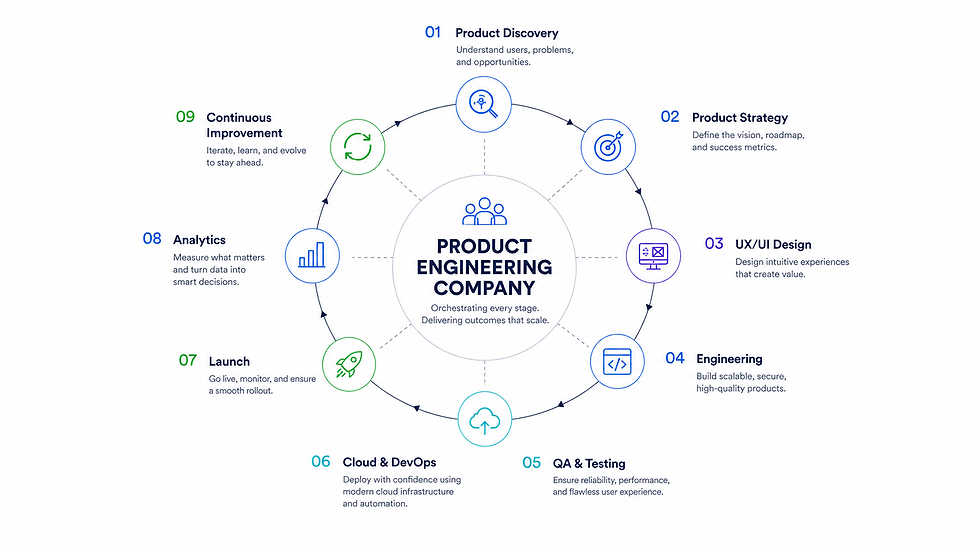
A Product Engineering Company partners with businesses to design, build, launch, and continuously improve digital products throughout their lifecycle. While software development remains a core capability, the engagement extends beyond implementation to include product thinking, engineering strategy, user experience, scalability, and long-term product evolution.
Rather than focusing solely on delivering a predefined scope, product engineering teams work to understand the business problem, user needs, and product goals before making technical decisions. This collaborative approach helps ensure that engineering efforts align with measurable business outcomes.
A Lifecycle-Oriented Approach
Product engineering typically spans multiple stages of product development, including:
Product discovery and requirement validation
Product strategy and roadmap planning
UX research and interface design
Software architecture and engineering
Cloud infrastructure and DevOps
Quality assurance and test automation
Product analytics and performance monitoring
AI and data capabilities, where applicable
Continuous improvement after launch
The level of involvement varies depending on the client's needs. Some organizations engage a product engineering partner for the full lifecycle, while others seek support only in selected areas.
Typical Team Composition
A product engineering team often includes specialists across multiple disciplines, such as:
Product Manager or Product Strategist
UX/UI Designers
Software Architects
Frontend and Backend Engineers
QA and Automation Engineers
DevOps Engineers
Data or AI Engineers (when required)
Technical Project or Delivery Manager
This cross-functional structure enables business, design, and engineering decisions to evolve together rather than in isolation.
Strengths
A Product Engineering Company is particularly valuable when:
The product vision is still evolving.
User validation is an important part of development.
Scalability and long-term maintainability are priorities.
The product will continue to evolve after launch.
Business, design, and engineering decisions need close alignment.
Limitations
Because product engineering often includes discovery, strategy, architecture, and ongoing collaboration, it can require greater founder involvement during the early stages of the engagement. For straightforward projects with fixed requirements, this broader approach may introduce activities that are not always necessary.
Best Use Cases
A Product Engineering Company is commonly chosen for:
Startup MVP development
SaaS platforms
AI-powered products
Customer-facing digital products
Products expected to scale over time
Long-term product modernization and innovation initiatives
The value of a Product Engineering Company lies not only in building software but in helping organizations make better product and engineering decisions throughout the product's lifecycle.
Practical Takeaway
A Product Engineering Company is often the right fit when success depends on more than writing code—particularly when product strategy, user experience, scalability, and continuous improvement are central to achieving business goals.
Product Engineering Company vs Software Development Agency
Both Product Engineering Companies and Software Development Agencies build software, but they often differ in how they approach product development, collaboration, and long-term ownership.
The choice is rarely about which model is better. It's about selecting the engagement model that best fits your product's complexity, business stage, and growth objectives.
Side-by-Side Comparison
Criteria | Software Development Agency | Product Engineering Company |
Primary Focus | Deliver agreed project scope | Build successful digital products |
Engagement | Project-based or team extension | Long-term product partnership |
Product Discovery | Limited or optional | Core part of the engagement |
Product Strategy | Usually client-led | Collaborative planning |
UX Research | Project-specific | User-centered throughout development |
Technical Architecture | Based on current scope | Designed for future scalability |
Engineering | Feature implementation | End-to-end product engineering |
AI & Emerging Technologies | When requested | Integrated where they add value |
Cloud & DevOps | Deployment support | Continuous delivery and operations |
QA & Testing | Functional testing | Quality throughout the lifecycle |
Post-launch Support | Maintenance contracts | Continuous product evolution |
Success Metric | Project delivered | Product outcomes achieved |
Product Philosophy
A software development agency primarily focuses on delivering the software requested by the client. A Product Engineering Company begins by understanding the business problem before determining how technology should solve it.
For example, if a founder requests a feature, an agency may build it as specified. A product engineering team is more likely to first evaluate whether the feature addresses user needs, aligns with product goals, and fits the long-term roadmap.
Ownership and Collaboration
Agencies typically rely on the client to define priorities, requirements, and product direction. Product engineering teams work more collaboratively, contributing to product planning, technical decisions, and continuous improvement alongside the client.
Neither approach is inherently better. Organizations with experienced product teams may only need engineering execution, while early-stage startups often benefit from broader product guidance.
Engineering and Scalability
For products expected to grow, architectural decisions made early can significantly influence future development costs and performance.
Software development agencies generally design systems to satisfy current project requirements. Product engineering teams often evaluate scalability, maintainability, observability, security, and future product evolution from the outset.
Delivery Beyond Launch
Many projects end when the agreed scope is delivered. Digital products, however, continue evolving through user feedback, analytics, experimentation, and new feature development.
This is where the engagement models often diverge. Product engineering emphasizes continuous iteration, while software development engagements are more commonly structured around defined deliverables or ongoing maintenance agreements.
Cost vs Long-Term Value
A software development agency may be the more economical choice for projects with clear requirements and limited long-term evolution.
For products expected to grow over several years, investing in discovery, architecture, and scalable engineering early can reduce technical debt and simplify future expansion. The higher initial investment may result in lower long-term maintenance and redevelopment costs, although the outcome depends on execution and project context.
Practical Takeaway
Choose a Software Development Agency when your requirements are well defined and your primary need is reliable execution. Consider a Product Engineering Company when your product strategy, user experience, and long-term evolution are as important as the software itself.

When Should You Choose a Software Development Agency?
A software development agency is often the right choice when your product direction is already established and your primary need is reliable engineering execution.
You Have Well-Defined Requirements
If your features, workflows, and technical requirements are clearly documented, an agency can efficiently translate those specifications into production-ready software.
You Have an Internal Product Team
Organizations with experienced product managers, designers, or CTOs often don't need external product strategy. Instead, they benefit from an engineering partner that can execute against an existing roadmap.
You Need Additional Engineering Capacity
Many companies engage agencies to accelerate delivery without expanding their in-house engineering team. This is particularly common during product launches or periods of rapid development.
You're Building Internal Business Software
Applications such as CRM systems, ERP integrations, dashboards, workflow automation, and internal portals typically have well-defined objectives, making them a strong fit for an execution-focused engagement.
Budget and Timeline Are Primary Constraints
When the project scope is fixed and long-term product evolution is not a major consideration, a software development agency can provide a predictable delivery model with clear timelines and costs.
Typical Projects
A software development agency is well suited for:
Internal business applications
Enterprise software implementation
Legacy system modernization
Staff augmentation
Fixed-scope development projects
Platform maintenance and enhancements
Choosing a software development agency does not mean compromising on quality. For organizations with a mature product strategy and clearly defined requirements, it can be the most efficient and cost-effective engagement model.
Practical Takeaway
If you already know what to build and primarily need a capable team to build it, a software development agency is often the most appropriate choice.
When Should You Choose a Product Engineering Company?
A Product Engineering Company is often the right choice when building software involves more than implementation. If product strategy, user experience, scalability, and continuous improvement are critical to success, a product engineering approach can provide broader support throughout the product lifecycle.
You're Building an MVP
Early-stage startups often begin with assumptions rather than validated requirements. A product engineering partner can help refine the product vision, prioritize features, and deliver an MVP that focuses on learning rather than simply shipping functionality.
You're Building a SaaS Product
SaaS products evolve continuously after launch. Architecture, usability, security, analytics, and customer feedback all influence future development, making long-term engineering decisions as important as the initial release.
You're Developing an AI Product
AI-powered applications often require expertise beyond traditional software development, including data pipelines, model integration, evaluation, and responsible deployment. A multidisciplinary product engineering team can help align these components with product goals.
Your Product Is Expected to Scale
Products designed for thousands—or millions—of users benefit from early architectural planning. Decisions around cloud infrastructure, security, performance, and maintainability are easier to address before growth introduces additional complexity.
You Need a Long-Term Product Partner
Some businesses prefer working with a partner who remains involved beyond launch, supporting new features, performance improvements, technical modernization, and product evolution as customer needs change.
Typical Projects
A Product Engineering Company is commonly selected for:
Startup MVPs
SaaS platforms
AI-powered applications
Customer-facing digital products
Venture-backed startups
Products with long-term growth roadmaps
Choosing a Product Engineering Company doesn't necessarily mean a larger or longer engagement. It means selecting a partner whose capabilities extend beyond software delivery when your product requires strategic, technical, and operational continuity.
Practical Takeaway
If you're still defining what to build—or expect your product to evolve rapidly after launch—a Product Engineering Company can provide support across strategy, design, engineering, and continuous improvement.
BUILD™ Decision Matrix for Founders
Instead of asking "Which is better?", ask "Which model best fits my business today?"
The BUILD™ Decision Matrix helps founders evaluate their needs before starting conversations with potential development partners.
Dimension | Ask Yourself | Better Fit |
B — Business Stage | Are you validating an idea or scaling an existing product? | Early-stage startups often benefit from a Product Engineering Company, while mature businesses with established processes may prefer a Software Development Agency. |
U — Uncertainty | How clearly are your product requirements defined? | High uncertainty favors product engineering. Well-defined requirements favor an agency. |
I — Internal Capability | Do you have experienced product and technical leadership? | Strong internal leadership can effectively direct an agency. Limited internal expertise often benefits from broader product engineering support. |
L — Long-term Vision | Will this product evolve continuously over the next few years? | Products with ongoing roadmaps generally benefit from a long-term engineering partnership. Short-term initiatives may not require it. |
D — Delivery Ownership | Who will own product decisions during development? | If your team owns strategy, an agency may be sufficient. If you expect your partner to contribute to product decisions, product engineering is typically a better fit. |
The framework isn't intended to produce a single "correct" answer. Instead, it highlights where your current business context aligns most naturally with each engagement model.
For example, a startup validating a new SaaS idea may score toward product engineering because requirements are evolving and strategic input is valuable. In contrast, an enterprise replacing an internal HR system with well-documented specifications may find a software development agency to be the more efficient choice.
Practical Takeaway
Don't choose a partner based on labels or hourly rates. Evaluate your business stage, product uncertainty, internal capabilities, long-term goals, and expected level of collaboration before making a decision.

Founder Evaluation Checklist
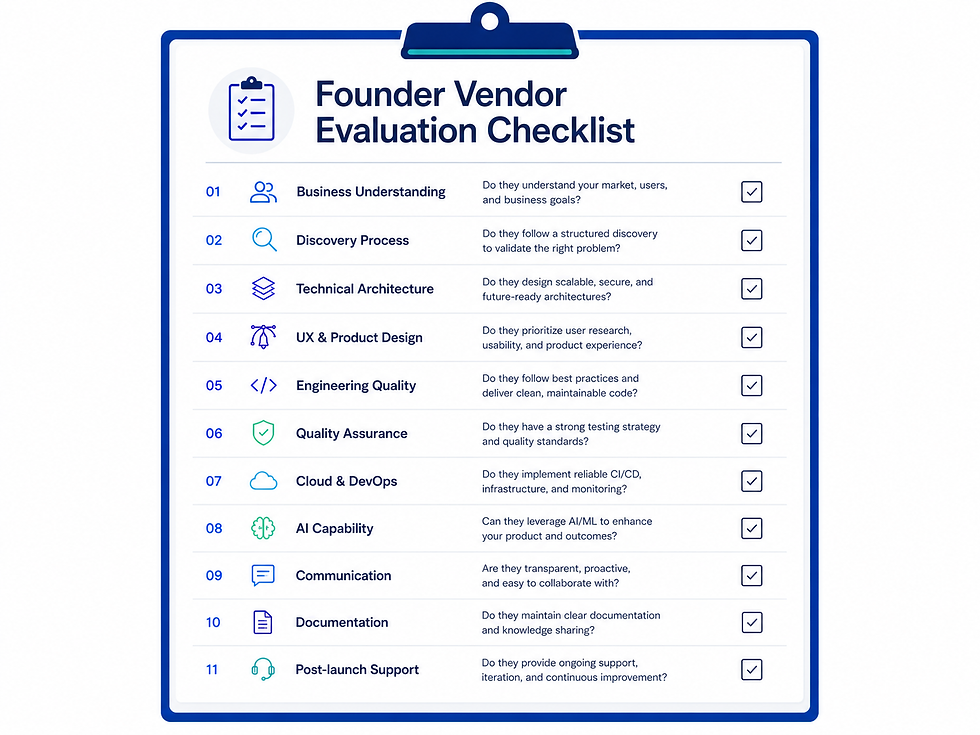
Use this checklist when comparing multiple development partners. The more confidently a partner can address these areas, the easier it becomes to assess whether they're the right fit for your product.
Evaluation Area | Questions to Ask |
Business Understanding | Do they understand your business goals before discussing technology? |
Discovery Process | How do they validate requirements before development begins? |
Technical Architecture | How do they approach scalability, security, and future maintenance? |
UX & Product Design | Who is responsible for user experience and design decisions? |
Engineering Quality | What coding standards, reviews, and development practices do they follow? |
Quality Assurance | What testing strategy ensures software reliability? |
Cloud & DevOps | How are deployments, monitoring, and infrastructure managed? |
AI Capability | If needed, what experience do they have integrating AI or data-driven features? |
Communication | How often will progress, risks, and priorities be reviewed? |
Documentation | Will architecture, APIs, and deployment processes be documented? |
Post-launch Support | What happens after the first production release? |
What Good Answers Look Like
Strong partners don't simply answer these questions—they explain how they work, provide examples of their delivery process, and clearly define responsibilities.
Consistent, transparent responses are often a better indicator of execution quality than polished sales presentations.
Practical Takeaway
Use the same evaluation criteria for every vendor. A structured comparison reduces bias and helps you select a partner based on capability, process, and long-term fit rather than cost alone.
Partner Comparison Scorecard
Not every evaluation criterion has the same impact on project success. Use this weighted scorecard to compare potential partners consistently, especially when evaluating multiple proposals.
Score each criterion on a scale of 1 (Poor) to 5 (Excellent), then multiply it by the assigned weight.
Evaluation Criteria | Weight | Agency Score | Product Engineering Score |
Product & Business Understanding | 15% | ||
Technical Architecture | 15% | ||
Engineering Quality | 15% | ||
UX & Design Capability | 10% | ||
Delivery Process | 10% | ||
QA & Testing | 10% | ||
Cloud & DevOps | 8% | ||
Communication & Transparency | 7% | ||
Documentation | 5% | ||
Post-launch Support | 5% | ||
AI & Emerging Technologies (if applicable) | 5% | ||
Total | 100% |
How to Use the Scorecard
Evaluate every shortlisted partner using the same criteria.
Adjust weights if certain capabilities are more important for your project. For example, AI expertise may carry more weight for an AI startup, while enterprise integration may be more important for internal business systems.
Review the overall score alongside qualitative factors such as team chemistry, communication style, and domain expertise.
A higher score should guide the discussion—not make the decision for you. Cultural fit, trust, and the ability to collaborate effectively remain equally important.
Practical Takeaway
A structured scorecard helps separate marketing claims from measurable capabilities, making partner selection more objective and repeatable.
Frequently Asked Questions
1. What is the difference between a Product Engineering Company and a Software Development Agency?
A software development agency primarily focuses on delivering software based on defined requirements. A Product Engineering Company may also contribute to product strategy, architecture, user experience, and ongoing product evolution. The scope of engagement depends on the project's needs.
2. Which is better for a startup?
It depends on the startup's stage. If the product idea is still evolving, broader product engineering support can be valuable. If requirements are already well defined and the team has strong product leadership, a software development agency may be sufficient.
3. Are Product Engineering Companies more expensive?
Not necessarily. They often include additional activities such as discovery or architecture planning, which can increase the initial investment. Whether this results in better long-term value depends on the product and business goals.
4. Can a Software Development Agency build an MVP?
Yes. Many agencies successfully build MVPs, particularly when founders have validated requirements and a clear product roadmap.
5. Do Product Engineering Companies build MVPs?
Yes. Many specialize in helping startups validate ideas, prioritize features, and launch iterative MVPs before scaling.
6. Which model is better for SaaS products?
SaaS products typically evolve through continuous releases and customer feedback. The most suitable engagement model depends on how much strategic and engineering support your internal team already provides.
7. Which is better for AI products?
AI applications often require expertise beyond traditional software development, including data engineering, model integration, and infrastructure. Evaluate partners based on relevant experience rather than their label.
8. Can I switch from an agency to a Product Engineering Company later?
Yes. Many businesses change partners as their products mature or their requirements evolve. Good documentation and a well-structured codebase make this transition significantly easier.
9. Should I hire locally or offshore?
Location is only one factor. Technical capability, communication, delivery process, and domain expertise usually have a greater impact on project success than geography alone.
10. What should I evaluate before signing a contract?
Review the partner's technical expertise, delivery process, communication model, ownership structure, documentation practices, security approach, and post-launch support—not just pricing.
Conclusion
Choosing between a Product Engineering Company and a Software Development Agency is ultimately a business decision, not just a technical one.
If your requirements are well defined and your team already owns product strategy and roadmap decisions, a software development agency can provide efficient and reliable execution. If you're building a product that will evolve through user feedback, continuous releases, or rapid innovation, a broader product engineering approach may better support those long-term objectives.
Rather than asking which model is universally better, ask which one aligns with your product's current stage, internal capabilities, and future ambitions. The right partnership should complement your team's strengths while helping you deliver value to your users more effectively.
If you're evaluating partners for an MVP, SaaS platform, or AI-powered product, explore Codersarts' Product Engineering Services and MVP Development Services to understand how a collaborative, product-first engineering approach can support your product journey from idea to scale.


Comments