
MVP Development Cost, Timeline & Process: A Founder's Guide
Updated: Aug 23
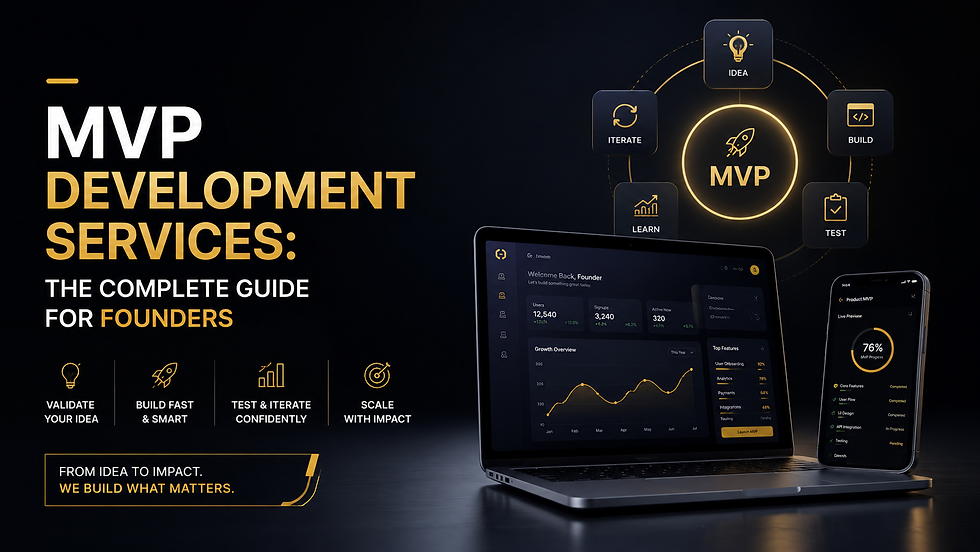
Every founder searching "MVP development" wants the same three answers: what it costs, how long it takes, and who can actually ship it without blowing the budget. This guide gives you real 2026 numbers — pricing by product type, realistic timelines, the process a professional team follows, and the exact questions to ask before you sign a contract.
An MVP Is a Serious Investment — Not a Side Project
Before the pricing and timelines, one thing needs to be said plainly: an MVP is usually the first real money a founder puts behind an idea. It is not a weekend build, a hackathon project, or something you commission because you're inspired. It is a business decision — you are paying to find out, with real evidence, whether a problem is worth solving and whether people will pay you to solve it.
That distinction matters because it changes how you should treat the process. A hobby project can wander — change direction mid-way, add features on a whim, take as long as it takes. An MVP can't. Every dollar and week you spend is capital you're betting on a specific hypothesis. Treating it casually is the single biggest reason MVPs go over budget, miss their window, or ship something nobody asked for.
If you're not yet at the point of committing real budget and time to test a specific assumption, you likely need a prototype or a POC first — not an MVP. The table below shows exactly where that line sits.
Why This Discipline Matters More Than Ever
The data backs up why treating an MVP as a real investment — not a hobby — matters. CB Insights' analysis of 431 failed venture-backed startups found that 43% cited poor product-market fit as a primary cause of death, second only to running out of capital.
But running out of money is usually the symptom, not the root cause — most of those companies spent their capital building something the market never asked for.
The pattern holds across sources: Startup Genome and multiple industry studies consistently place the failure rate from unvalidated demand between 34% and 42%. The founders who avoid this outcome share one trait — they build the smallest possible version of the product before spending on the rest.
This is the whole premise behind the Minimum Viable Product concept, popularized by Eric Ries in The Lean Startup. Ries's framing is simple: an MVP isn't about building a smaller product — it's about building the version that teaches you the most about your customers for the least cost. That's the standard worth holding your own MVP to, not "did we ship something," but "did we learn something we didn't know before."
Before any of that, one confusion trips up almost every founder — knowing whether they actually need an MVP, or something smaller.
MVP vs Prototype vs POC — Which Do You Need?
A Minimum Viable Product (MVP) is the smallest version of your product that delivers real value to real users — a working piece of software people can sign up for, use, and pay for. Not a mockup. Not a pitch deck.
MVP development is the process of scoping, building, and deploying that product — from wireframes to a live URL — as fast and as cheaply as possible without sacrificing quality.
The "minimum" in MVP is the hard part. Most founders want to build everything. The job of a good MVP development team is to cut the feature list until only the core value remains, then build that and nothing else.
What makes a good MVP:
Solves one specific problem for one specific user
Has the minimum features needed to deliver that solution
Can be shipped in weeks, not months
Generates real feedback from real users
Can be iterated on without a full rebuild
The Difference at a Glance
Founders confuse these three constantly. Here is the exact distinction:
Prototype | POC | MVP | |
What it is | Clickable design mockup | Technical feasibility test | Fully functional product |
Has working code? | No | Partial | Yes |
Can users pay? | No | No | Yes |
Used for | UX validation, investor demos | Engineering validation | Market validation |
Timeline | 1–2 weeks | 1–3 weeks | 3–8 weeks |
Cost | $1,500–$3,000 | $2,000–$5,000 | $5,000–$40,000 |
Rule of thumb: Build a prototype to validate the UX. Build a POC to validate the tech. Build an MVP to validate the market.
If you are raising a pre-seed round, a high-fidelity Figma prototype is often sufficient. If you are trying to get your first 10 paying customers, you need an MVP.
MVP is first serious investment to build your product or solving a problem. this is not hobby or inspiration ideas.
6 Types of MVPs Founders Build in 2026
Not all MVPs look the same. The type you build depends on your product, your ICP, and what you are trying to validate.
1. SaaS MVP
The most common type in 2026. A web app with user authentication, a core workflow, and Stripe billing. Examples: AI writing tools, CRM systems, analytics dashboards, scheduling platforms.
2. Marketplace MVP
A two-sided platform connecting buyers with sellers or service providers. Requires Stripe Connect for split payments, a listing system, and a review mechanism. Examples: freelance platforms, service booking apps, rental marketplaces.
3. AI-Native MVP
A product where the core value delivery is AI-powered — not an AI feature added to a standard product. Examples: RAG chatbots trained on proprietary data, AI document intelligence tools, LLM-powered copilots.
4. Mobile App MVP
A React Native app targeting iOS and Android from a single codebase. Best for consumer products where the primary interaction is mobile. Examples: fitness apps, on-demand services, community apps.
5. HealthTech / Regulated MVP
Requires HIPAA-compliant infrastructure from day one — encrypted data, audit logs, role-based access, BAA. Cannot be retrofitted after launch without a full rebuild.
6. POC-to-MVP Transition
A technical proof-of-concept that gets productized — adding auth, UI, billing, and
deployment on top of a working technical foundation. Common in AI and ML products.
Once you know which type fits your product, the next question is how it actually gets built.
The MVP Development Process (Step-by-Step)
A professional MVP development engagement follows a repeatable process. Here is exactly what happens from the first conversation to launch day.
Step 1 — Discovery & Scoping (Week 0)
Before writing a line of code, the scope gets locked. This means:
Defining the ICP (who is this for?)
Mapping the core user flow (what is the single most important thing a user does?)
Writing a feature list and splitting into MVP / Phase 2 / Phase 3
Choosing the tech stack
Producing a fixed-price proposal with a timeline breakdown
A scoping session typically takes 2–5 days. Any team that skips this and jumps straight to quoting is a red flag — they are guessing, not planning.
Step 2 — Wireframes & Prototype (Days 3–7)
High-fidelity Figma wireframes for every screen in the MVP. The client reviews and approves before development starts. This is the last cheap moment to change the product — once code is written, changes cost time and money.
Step 3 — Sprint 1: Foundation (Weeks 1–2)
Database schema and models
Authentication (sign up, login, password reset, email verification)
Core data structures
Basic routing and layout
Step 4 — Sprint 2: Core Product (Weeks 2–4)
Primary user flow built end-to-end
AI feature integrated into core architecture
Payment integration (Stripe)
Email notifications (transactional)
Step 5 — Sprint 3: Completion (Weeks 4–6)
Admin panel
Secondary flows
Mobile responsiveness
QA — manual + automated tests on critical paths
Step 6 — Deployment & Handover
Deployed to the client's own Vercel, Railway, or AWS accounts
DNS configured, domain connected
GitHub repository transferred to client
Admin guide + deployment documentation delivered
30-day post-launch bug fix period begins
That process is also what determines the price — the more sprints a build needs, the more it costs.
How Much Does MVP Development Cost in 2026?
This is the question every founder searches for first. Here are real numbers.
By Tier
Tier | What's included | Timeline | Fixed Price |
Prototype Sprint | Figma wireframes, clickable prototype, core flows only | 1–2 weeks | $1,500–$3,000 |
Core MVP | Auth, payments, 3–5 features, AI feature, deployed | 3–6 weeks | $5,000–$15,000 |
SaaS Build | Multi-tenancy, subscription billing, admin panel, AI features | 8–14 weeks | $15,000–$40,000 |
Mobile App MVP | React Native iOS + Android, core features, AI integrated | 5–8 weeks | $8,000–$20,000 |
By Product Type
Product Type | Typical Fixed Price |
AI Chatbot / RAG Tool | $5,000–$9,000 |
Service Booking Platform | $7,000–$12,000 |
Two-Sided Marketplace | $10,000–$18,000 |
HealthTech (HIPAA) | $12,000–$20,000 |
FinTech (KYC/compliance) | $15,000–$28,000 |
SaaS Platform | $15,000–$40,000 |
What Drives the Price Up
HIPAA / SOC2 / PCI compliance requirements
Real-time features (WebSockets, live chat, video)
Mobile app (adds $8,000–$15,000)
Complex AI pipelines (RAG, agents, fine-tuning)
Third-party API integrations (EHR, banking, logistics)
Why Fixed Price Matters
Most agencies charge hourly. At $100–$200/hour, a 5-week MVP = 200 hours = $20,000–$40,000 with no ceiling. Scope creep is the rule, not the exception.
Fixed-price development forces scope discipline from both sides. The price you see in the proposal is the price you pay. Period.
Cost and timeline move together. Here's what to expect on the clock.
How MVP Pricing Actually Works
Pricing isn't a lookup table — it's a function of three things: scope, risk, and speed.
Scope is the number and complexity of features locked into version one. Every additional screen, integration, or user role adds engineering hours, so the fastest way to lower a quote is almost always to cut scope, not to negotiate the rate.
Risk is what the team is being asked to guarantee. A fixed-price contract means the development team absorbs the risk of scope creep and unknowns — that's why fixed-price is priced higher per feature than open-ended hourly work, but protects you from runaway bills.
Speed is how compressed the timeline is. Asking for a 6-week build in 3 weeks means more engineers working in parallel, which costs more — not because the work changed, but because parallelizing work has real coordination overhead.
A quote is really the answer to: how much of this, guaranteed, by when. Change any one of those three and the number changes.
Where You Can Actually Negotiate
Founders often try to negotiate the price directly — "can you do it for less?" — which rarely moves much on a fixed-price model, since the price already reflects the cost of the guarantee. What actually moves the number:
Cut scope, not corners. Ask which features can move to a Phase 2 without weakening the core hypothesis you're testing. This is the highest-leverage negotiation available.
Loosen the timeline. A 6-week timeline stretched to 8 weeks often reduces cost, since it needs fewer engineers running in parallel.
Bring your own design. If you already have wireframes or a design system, you remove a cost center entirely.
Start with a POC or prototype. If the real question is technical feasibility or UX validation — not "will customers pay" — you may not need full MVP pricing yet.
Finding the Right Time to Build
The best time to commit MVP budget is after you've validated demand as cheaply as possible — through customer conversations, a landing page, or a pre-order test — not before. Building the MVP too early, before you know anyone wants the thing, is the most expensive mistake in this whole process. The MVP should be the step that turns a validated hypothesis into a real product, not the step that tests whether the hypothesis is even worth having.
The market data reinforces this: startups that run structured validation — real customer interviews, willingness-to-pay tests — before building cut their no-market-need failure risk dramatically compared to those who skip straight to development. The cost of that validation is close to $0. The cost of skipping it is the entire MVP budget.
How Long Does MVP Development Take?
The honest answer depends on scope, not on promises.
MVP Type | Realistic Timeline |
Prototype / Clickable wireframe | 1–2 weeks |
Simple SaaS tool (auth + core feature + billing) | 3–4 weeks |
Full MVP with AI (marketplace, booking, SaaS) | 4–6 weeks |
Complex SaaS (multi-tenant, full billing, admin) | 8–12 weeks |
HealthTech / FinTech (compliance layer) | 10–16 weeks |
What kills timelines:
Scope changes mid-sprint (the single biggest delay)
Slow client feedback (delayed approvals block development)
No discovery phase (unclear requirements discovered during build)
Integration dependencies (waiting on third-party API access)
The fix for all of these is a locked scope document and a structured change-request process before any code is written.
AI Features Every MVP Should Include in 2026
Building without an AI feature in 2026 means launching into a market where your competitors already have one. These are the four AI features worth building into an MVP by default — not complex, not expensive, but immediately visible to users.
1. AI-Powered Search
Replace keyword search with semantic search using vector embeddings. Users find what they are actually looking for instead of what they typed. Stack: OpenAI text-embedding-3-small + pgvector or Pinecone.
2. RAG-Based Knowledge Assistant
An AI chatbot trained on your own data — product docs, knowledge base, FAQs. Reduces support tickets by 40–60% for SaaS products. Stack: LangChain + OpenAI + pgvector.
3. AI-Generated Content
Auto-generate descriptions, summaries, emails, or reports from structured data. Saves users the blank-page problem and increases activation. Stack: OpenAI GPT-4o with a structured prompt template per content type.
4. Smart Recommendations
Surface relevant content, products, or actions based on user behavior. The MVP version is a simple embedding-based similarity match — no complex ML needed. Stack: OpenAI embeddings + cosine similarity query.
Each of these adds approximately 1 week to a standard MVP timeline and $1,500–$3,000 to the fixed price. The ROI is immediate — users notice AI features faster than any other product improvement.
Adding AI features well — not just bolting on a chatbot — depends entirely on who's building it. Here's how to tell a team that can do this from one that can't.
What to Look for in an MVP Development Company
Most agencies look the same from the outside. These are the signals that separate the ones that actually ship from the ones that over-promise.
Green Flags
Scope-first approach — they push back on your feature list before quoting
Fixed pricing — not hourly, no caveats
Senior engineers only — ask who specifically will work on your project
Post-launch support — 30-day bug fix period in writing
IP transfer clause — full code ownership on final payment, no exceptions
Async communication — Loom updates + written weekly summaries, not just calls
Red Flags
Quotes a price before understanding the scope
"We'll figure out the details during development"
Junior developers on your project with a senior sales rep on your calls
No fixed timeline, just "estimates"
No post-launch support plan
Hourly billing with no ceiling
Questions to Ask Before Signing
Who exactly will be building my product — names, background?
What happens if we go over timeline?
What is your change-request process?
Can I see the source code of a similar project you built?
Who owns the code from day 1 vs at final payment?
Here's how Codersarts holds up against that checklist.
Why Codersarts for MVP Development
Codersarts is a fixed-price MVP and SaaS development studio built on a senior engineering bench of NIT Raipur-trained engineers. Every build ships AI-native, deployed to your own accounts, with full IP transfer on delivery.
What makes Codersarts different:
Fixed price on every engagement — scope locked before deposit
AI-native by default — real AI features in every build, not generic chatbots
Senior engineers only — NIT Raipur trained, no juniors or freelancer rotation
Ships in 3–6 weeks — not months
35–55% below US agency rates — without sacrificing seniority or accountability
You own everything — full IP transfer, code on your GitHub, deployed to your accounts
Every engagement is fixed-price and AI-native by default, delivered by senior NIT Raipur-trained engineers in 1–14 weeks depending on scope, with full IP transfer on final payment.
Service tiers:
Service | Timeline | From |
Prototype Sprint | 1–2 weeks | $1,500 |
Idea-to-MVP Sprint | 2–6 weeks | $5,000 |
AI MVP Build | 4–8 weeks | $8,000 |
SaaS Build | 8–14 weeks | $15,000 |
Mobile App MVP | 5–8 weeks | $8,000 |
MVP Rescue / Rebuild | 3–6 weeks | $6,000 |
Post-MVP Retainer | Ongoing | $3,000/mo |
Planning Your Next Investment: What Comes After the MVP
Launch is not the end of spending — it's the point where spending should get smarter. Once real users are on the product, the question changes from "what do we think we need" to "what does the data say we need."
How to choose your next features:
Follow usage, not requests. The features users actually engage with — even in a limited way — deserve investment. The features they ask for but never touch usually don't.
Fix friction before adding features. If users are dropping off at a specific step, that's a higher-priority investment than a brand-new feature.
Size the next investment to the signal, not the ambition. A small, clear signal (a handful of users doing the core action repeatedly) justifies incremental spend — a retainer sprint, not a full rebuild. A strong, broad signal (retention, paying customers, waitlist growth) justifies the SaaS-scale investment.
Re-run the same discipline you used for the MVP. Scope, fixed price, locked timeline — the same rules that protected your first investment should protect the second one.
The founders who spend well after launch treat every dollar the same way they treated the MVP budget: as a bet on a specific, testable question — not a wishlist.
A few more questions founders ask before signing.
FAQ
What is the difference between an MVP and a full product?
An MVP includes only the features needed to deliver the core value proposition to early users. A full product includes every feature, integration, and edge case. MVPs are built to validate — full products are built to scale.
Do I need technical knowledge to work with an MVP development company?
No. A good MVP team translates your business idea into technical requirements. You need to know your users and your core value proposition — the engineering team handles everything else.
Can you build my MVP if I only have an idea?
Yes. The discovery sprint takes your idea through user flow mapping, feature scoping, wireframes, and stack selection — producing a fully scoped, priced proposal before any code is written.
What if I need to change a feature mid-build?
Changes outside the locked scope are handled as Change Requests — a quick estimate (cost + time) is produced, you approve, then it is built. No surprise charges.
How do weekly updates work?
Every Friday, a Loom video walkthrough of what shipped that week is delivered alongside a written summary of next week's sprint plan and any open questions.
Who owns the code?
You do — 100% IP transfer on final payment, pushed to your GitHub, deployed to your cloud accounts.
What happens after the MVP launches?
A 30-day post-launch bug fix period is included in every engagement. Ongoing feature development is available via monthly retainer sprints from $3,000/month.
Can you build HIPAA-compliant MVPs?
Yes. HealthTech builds use AWS HIPAA-eligible services, AES-256 encryption at rest, TLS 1.3 in transit, immutable audit logs, and role-based access control. A Business Associate Agreement (BAA) is signed before any Protected Health Information is handled.

Get a Fixed-Price MVP Quote
Scope your MVP in 48 hours — fixed price, fixed timeline, AI-native from day one.


Comments