
Playwright End-to-End Testing for Enterprise: Architecture, Flaky-Test Control, and Scaling to Thousands of Tests (2026 Guide)
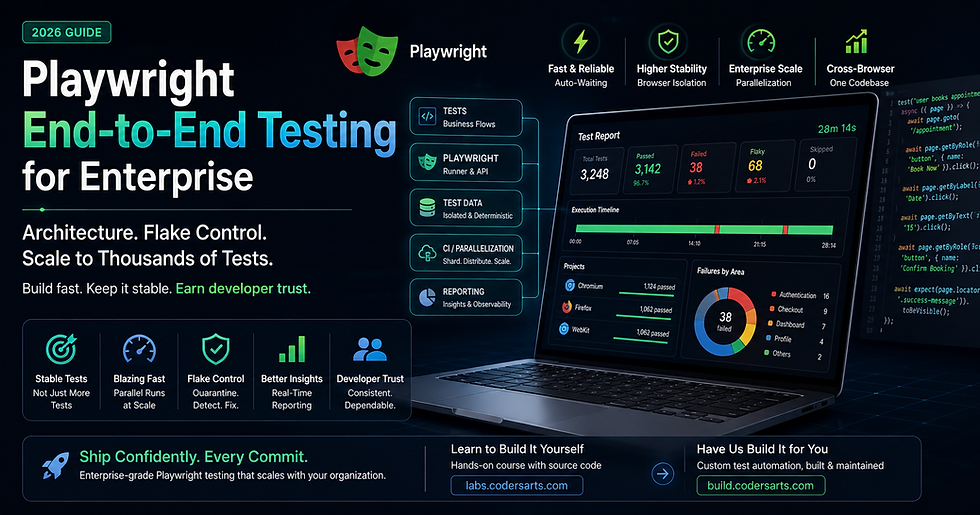
At enterprise scale, Playwright end-to-end testing succeeds or fails on one thing: whether engineers trust the suite. A hundred tests are easy. Three thousand tests running across six teams, twelve environments, and every pull request where a 2% flake rate means dozens of false failures a day is a different discipline entirely. This guide covers how to build Playwright E2E testing that stays fast, stable, and trusted as it scales: the architecture, the flaky-test controls, CI parallelization, migration from legacy tools, and what it costs.
TL;DR - Key Takeaways
At enterprise scale, the bottleneck is never writing tests it's keeping thousands of them fast, stable, and trusted. Flakiness, not coverage, is what kills E2E programs.
Playwright's auto-waiting, browser isolation, and native parallelism make it the strongest choice for large suites in 2026 but only with the right architecture around it.
A production enterprise setup needs five layers: framework, fixtures/auth, test data, CI parallelization, and reporting/observability not just test files.
Flaky tests are an engineering problem, not a QA nuisance. Auto-retries hide them; the fix is deterministic tests, controlled test data, and quarantine-plus-triage.
Migrating from Selenium or Cypress is common and worth it — but it's a phased program, not a rewrite weekend.
Need it built or rescued? Book a discovery call — we design, build, and stabilize enterprise Playwright suites.
Why Playwright for Enterprise E2E Testing in 2026
Playwright has become the default choice for new enterprise test-automation programs, and teams on Selenium or Cypress are actively migrating. The reasons are structural, not hype:
Auto-waiting kills a whole class of flakiness. Playwright waits for elements to be actionable before interacting, eliminating the sleep()-and-pray pattern that makes Selenium suites brittle.
Real browser isolation. Each test runs in a fresh browser context a lightweight, isolated session. No state bleeds between tests, which is exactly what breaks large suites run in parallel.
Native parallelism and sharding. Playwright parallelizes out of the box and shards across CI machines, so a 3,000-test suite finishes in minutes, not hours.
Cross-browser from one API. Chromium, Firefox, and WebKit the same test code, which matters when enterprise customers use everything.
One toolchain, many languages. TypeScript/JavaScript, Python, Java, and .NET bindings let a polyglot enterprise standardize on one tool.
But and this is the part that matters for a decision-maker — the tool is 20% of the outcome. Playwright doesn't make a suite trustworthy; architecture and discipline do. A badly built Playwright suite flakes exactly like a badly built Selenium suite. The rest of this guide is the other 80%.
The Real Enterprise Problem: Trust at Scale
Small suites fail quietly. Large ones fail expensively. Here's what actually goes wrong as an E2E program scales past a few hundred tests:
  AS THE SUITE GROWS...                WHAT BREAKS
  ------------------------------       ---------------------------------
  hundreds -> thousands of tests  -->  runtime balloons; CI becomes the
                                       bottleneck for every merge
  2% flake rate x 3000 tests      -->  ~60 false failures/day; engineers
                                       stop trusting red builds
  shared test data across teams   -->  tests corrupt each other's state
  each team writes its own way    -->  no reuse, 5x maintenance cost
  "just add a retry"              -->  real bugs hidden behind retries
The failure mode that ends E2E programs is loss of trust. Once a red build is assumed to be "probably just flaky," engineers start ignoring failures and the one time it was a real bug, it ships. At that point the suite is worse than no suite, because it costs money and provides false confidence. Every decision below is in service of keeping the suite trusted.
Architecture: An Enterprise Playwright Suite, End to End
A production enterprise setup is five layers. Skipping any one of them is where programs stall.
        ENTERPRISE PLAYWRIGHT E2E — ARCHITECTURE

  TEST LAYER            EXECUTION            VISIBILITY
  ----------            ---------            ----------
 +------------------+
 | Test specs       |
 | (business flows) |
 +--------+---------+
          |
 +--------v---------+   +------------------+
 | Page objects /   |   | CI orchestrator  |
 | components +     |-->| (GitHub Actions/ |
 | fixtures (auth,  |   |  GitLab/Jenkins) |
 | test data)       |   |                  |
 +--------+---------+   |  - shard across  |
          |             |    N machines    |
 +--------v---------+   |  - parallel      |
 | Test data layer  |   |    workers       |
 | (seed/reset via  |   |  - retry policy  |
 |  API, isolated   |   +--------+---------+
 |  per test)       |            |
 +------------------+            v
                        +---------------------------+
                        | Reporting & observability |
                        |  - HTML + trace viewer    |
                        |  - flaky-test dashboard   |
                        |  - failure triage / owner |
                        |  - historical trends      |
                        +---------------------------+
Layer 1 — Test specs. Written around business flows (checkout, onboarding, claim submission), not UI mechanics. Readable by a QA lead, not just the author.
Layer 2 — Page objects + fixtures. The reuse layer. Page Object Models and shared fixtures for authentication, setup, and teardown are what stop maintenance cost from multiplying across teams. Auth handled once (via stored session state) instead of logging in on every test — a major speed and stability win.
Layer 3 — Test data. The most-skipped and most-important layer. Each test must control its own data and not depend on a shared, mutable database. Seed via API before the test, isolate it, tear it down after. Shared test data is the #1 cause of enterprise flakiness.
Layer 4 — CI parallelization. Sharding the suite across many CI machines with parallel workers, a sane retry policy, and fail-fast where appropriate. This is what keeps a 3,000-test suite inside a pull-request feedback loop.
Layer 5 — Reporting & observability. At enterprise scale you must see the suite's health: which tests flake, who owns a failure, whether stability is trending up or down. Playwright's trace viewer plus a flaky-test dashboard turns failures from mysteries into triageable tickets.
🎯 Building or scaling an enterprise Playwright suite? We design the architecture above, build the suite, wire it into your CI, and critically stabilize flaky tests so your team trusts the results. Whether you're starting fresh, migrating off Selenium/Cypress, or rescuing a suite everyone's learned to ignore. → Book a free discovery call →email contact@codersarts.com Delivered by working QA engineers. Framework, CI integration, and full handover with documentation.
The Hard Parts (Where Enterprise Suites Break)
Anyone can write a passing test. These are the problems that separate a suite the enterprise trusts from one it quietly abandons.
1. Flaky tests: the silent program-killer
A flaky test passes and fails without code changes. At scale, even a low flake rate produces daily false failures that erode trust. The wrong fix is blanket auto-retries they hide flakiness and let real regressions slip through. The right approach is a system:
Make tests deterministic — no shared mutable state, no reliance on timing, controlled test data.
Quarantine, don't ignore — move a flaky test out of the blocking path and file it as a tracked ticket with an owner, so it gets fixed instead of forgotten.
Measure flake rate as a first-class metric — a flaky-test dashboard makes stability visible and improvable.
2. Test data management
The difference between a suite that scales and one that doesn't. Tests must not share a mutable database, or they corrupt each other under parallel execution. The pattern: seed exactly the data a test needs via API, keep it isolated, tear it down after. This is unglamorous and it's where most homegrown suites fail.
3. Authentication and environments
Enterprise apps have SSO, MFA, and role-based access. Logging in through the UI on every test is slow and brittle. Authenticate once, store the session state, and reuse it — reserving full login flows for the handful of tests that actually test login. Add multiple environments (dev, staging, pre-prod) and clean config management becomes essential.
4. Parallelization and CI cost
Running thousands of tests on every PR is only viable if they're sharded across machines and run in parallel. Get this wrong and either CI takes an hour (engineers stop running it) or your CI bill explodes. Right-sizing shards, workers, and what runs on PR vs nightly is an optimization problem worth real attention.
5. Cross-team standards
The moment more than one team writes tests, you need shared conventions, shared page objects, and shared fixtures — or you get five incompatible frameworks and 5× the maintenance. This is governance, not code, and it's what a platform/DevEx team or an external partner brings.
Playwright vs Cypress vs Selenium — The Enterprise Lens
Playwright | Cypress | Selenium | |
Auto-waiting | ✅ Built-in | ✅ Built-in | ❌ Manual waits |
True parallelism | ✅ Native + sharding | Paid dashboard for scale | ✅ Via Grid (heavy) |
Cross-browser | ✅ Chromium/Firefox/WebKit | Limited | ✅ Broad |
Multi-language | ✅ TS/JS/Python/Java/.NET | JS/TS only | ✅ Many |
Browser isolation | ✅ Contexts (fast) | Per-run | Per-session (slow) |
Trace/debugging | ✅ Trace viewer | ✅ Good | Basic |
Best for | New large-scale suites, migrations | Component/mid-size FE tests | Legacy/broad-language shops |
Honest guidance: if you already have a large, stable Selenium suite that works, Playwright isn't a mandatory rewrite. But for new programs, or suites drowning in flakiness and slow runtimes, Playwright is the strongest 2026 choice and migrating off a brittle Selenium suite usually pays for itself in recovered engineering time.
Migrating to Playwright (Without a Big-Bang Rewrite)
The failed migrations try to rewrite everything at once. The successful ones run a phased program:
Pilot. Rebuild the 20–30 highest-value flows in Playwright. Prove stability and speed against the old suite.
Establish the framework. Page objects, fixtures, test-data patterns, CI integration, reporting. This is the foundation everything else reuses.
Migrate by priority. Move critical-path flows first; retire equivalent old tests as you go. Run both suites in parallel during transition.
Standardize and hand over. Conventions, docs, and training so the internal team owns it.
Trying to skip the framework phase (step 2) is the single most common migration mistake you end up with Playwright tests that flake as badly as the Selenium ones they replaced.
Build In-House vs Consultancy vs Codersarts
Approach | Time to value | Cost | Risk | Best for |
Build in-house | Slow (competes with product roadmap) | High (senior QA/SDET salaries) | Framework mistakes are expensive to unwind | Teams with a dedicated test-platform group |
Staff-aug contractors | Fast to start | Ongoing hourly | Quality varies; often leaves undocumented | Extra hands under your architecture |
Big consultancy | Slow (ramp + process) | Very high | Over-engineered, heavy handover | Regulated giants needing a big-name vendor |
Codersarts | Medium (4–10 weeks) | Fixed project scope | Framework + stabilization + handover | Teams that want it built right and owned in-house after |
Timeline & Investment
Indicative ranges. We scope fixed-price after a discovery call no open-ended hourly.
Engagement | What you get | Timeline | Indicative (USD) |
Framework + pilot | Architecture, framework, CI integration, 20–30 critical flows, reporting | 4–6 weeks | $8,000 – $18,000 |
Full suite build | Framework + broad coverage of core journeys + flaky-test controls | 8–12 weeks | $18,000 – $45,000 |
Migration (Selenium/Cypress → Playwright) | Phased migration, parallel-run, retire legacy | 8–14 weeks | $20,000 – $50,000+ |
Flaky-suite rescue | Audit, stabilize, re-architect an existing suite the team distrusts | 3–6 weeks | $10,000 – $25,000 |
Ongoing QA / test-platform support | New coverage, maintenance, CI optimization | Monthly | $2,000 – $6,000 / mo |
Framed as ROI: one production incident that a solid E2E suite would have caught a broken checkout, a failed signup flow routinely costs more than a full suite build in lost revenue and engineering firefighting. Test automation is insurance that also makes you ship faster.
Case Study: Rescuing a Suite Nobody Trusted
For a client.
A B2B SaaS company had ~1,800 E2E tests and a red build on nearly every PR. The team had learned to merge over failures because "it's probably flaky." Confidence in the suite was effectively zero, and a real regression had shipped to production two sprints earlier.
The engagement (5 weeks): audit the flake sources (shared test data and UI-based login were the biggest), re-architect the fixture and test-data layers so each test owned its data, move authentication to stored session state, add sharded parallel CI, and stand up a flaky-test dashboard with owners and quarantine.
The outcome pattern: flake rate dropped to a level where a red build again meant "something is actually broken," CI runtime came down enough to run on every PR, and the real prize engineers started trusting and acting on failures again. Figures illustrative of the pattern, not audited client numbers.
Frequently Asked Questions
Q: What is Playwright end-to-end testing?
Playwright end-to-end testing uses Microsoft's Playwright framework to automate real user journeys through a web application in a real browser logging in, navigating, submitting forms, checking results to verify the whole system works together. Its auto-waiting, browser isolation, and native parallelism make it well-suited to large enterprise suites.
Q: Is Playwright good for enterprise-scale test automation?
Yes it's one of the strongest 2026 choices for large suites, thanks to native parallelism and sharding, cross-browser support, browser-context isolation, and multi-language bindings. But the tool alone isn't enough; enterprise reliability comes from the surrounding architecture: fixtures, test-data isolation, CI parallelization, and flaky-test controls.
Q: Playwright vs Cypress vs Selenium which is best for enterprise?
For new large-scale programs and migrations, Playwright generally wins on parallelism, cross-browser support, and speed. Cypress is strong for component and mid-size front-end testing. Selenium remains viable for legacy or broad-language environments. If your Selenium suite is flaky and slow, migrating to Playwright usually pays for itself.
Q: Why are my Playwright tests flaky, and how do I fix them?
The usual causes are shared mutable test data, reliance on timing, and UI-based login. The fix is making tests deterministic (each test owns its data), authenticating via stored session state, and treating flakiness as a tracked engineering problem quarantine and fix flaky tests rather than hiding them behind blanket retries.
Q: How long does it take to build an enterprise Playwright test suite?
A framework plus a pilot of critical flows takes about 4–6 weeks. A broad suite with flaky-test controls takes 8–12 weeks. A migration off Selenium or Cypress typically runs 8–14 weeks as a phased program. The framework foundation is the part you can't skip.
Q: How much does enterprise Playwright test automation cost?
Indicatively, $8,000–$18,000 for a framework and pilot, $18,000–$45,000 for a full suite build, and $20,000+ for a phased migration. A flaky-suite rescue runs $10,000–$25,000. Codersarts scopes fixed-price after a discovery call.
Q: Can you integrate Playwright with our CI/CD pipeline? Yes we integrate with GitHub Actions, GitLab CI, Jenkins, Azure DevOps, and others, including sharding across machines, parallel workers, retry policy, and reporting. CI integration and a sane parallelization strategy are core to every engagement.
Get Your Playwright Testing Built Right
🚀 Book a free discovery call Tell us where your testing stands greenfield, mid-migration, or a suite the team has stopped trusting. We'll come back with an architecture, a stabilization plan, a timeline, and a fixed quote. → Book a discovery call at build.codersarts.com → Or email contact@codersarts.com Enterprise Playwright suites designed, built, and stabilized by working QA engineers with full source code and documentation handover.
About Codersarts
Codersarts builds custom software, QA automation, and data/AI systems for startups and enterprises worldwide including production Playwright test suites delivered with full source-code handover. Start a project at build.codersarts.com or email contact@codersarts.com.


Comments