
Attention Is All You Need: The Paper That Changed AI Forever
Published by Codersarts · AI Research Paper Series
The Paper at a Glance
Title | Attention Is All You Need |
Authors | Vaswani, Shazeer, Parmar, Uszkoreit, Jones, Gomez, Kaiser, Polosukhin |
Institution | Google Brain / Google Research |
Published | 2017 |
arXiv | |
Citations | 100,000+ |

What This Paper Introduced
In 2017, a team at Google published a paper with a bold claim in its title: attention is all you need. No recurrence. No convolutions. Just attention.
Before this paper, the dominant approach to sequence modeling was recurrent neural networks (RNNs) and their variants — LSTMs and GRUs. These processed tokens one at a time, left to right. They worked, but they had two critical problems:
Sequential processing made them slow to train — you couldn't parallelize across time steps
Long-range dependencies were hard to learn — information from early tokens faded as sequences got longer
The Transformer solved both problems in one architecture. It replaced recurrence entirely with a mechanism called self-attention, which allows every token in a sequence to directly attend to every other token — in parallel, in a single pass.
The result was faster training, better performance, and an architecture that scaled remarkably well with more data and compute.
Every large language model you use today — GPT-4, Claude, Gemini, LLaMA — is a Transformer.
Need a Transformer implemented for your project? Codersarts builds production-ready implementations from scratch. → Get Implementation Help
The Core Architecture
The original Transformer is an encoder-decoder architecture designed for sequence-to-sequence tasks like machine translation.
Input Sequence
      ↓
[Input Embeddings + Positional Encoding]
      ↓
┌─────────────────────────┐
│        ENCODER          │  × N layers
│  Multi-Head Attention   │
│  Feed-Forward Network   │
│  Layer Norm + Residual  │
└─────────────────────────┘
      ↓
[Encoder Output]
      ↓
┌─────────────────────────┐
│        DECODER          │  × N layers
│  Masked Multi-Head Attn │
│  Cross-Attention        │
│  Feed-Forward Network   │
│  Layer Norm + Residual  │
└─────────────────────────┘
      ↓
[Linear + Softmax]
      ↓
Output Sequence
The Three Key Components
1. Self-Attention (Scaled Dot-Product Attention)
This is the heart of the paper. For each token, the model computes three vectors:
Q (Query) — what this token is looking for
K (Key) — what each token offers
V (Value) — what each token actually contains
Attention scores are computed as:
Attention(Q, K, V) = softmax(QKᵀ / √dₖ) × V
The √dₖ scaling factor prevents the dot products from becoming too large in high dimensions, which would push softmax into regions with very small gradients.
The result: each token produces a weighted sum of all other tokens' values, where the weights reflect how relevant each token is. A word like "it" can directly attend to "the animal" five tokens back — no degradation, no vanishing gradients.
2. Multi-Head Attention
Instead of running attention once, the Transformer runs it h times in parallel with different learned projections:
MultiHead(Q, K, V) = Concat(head_1, ..., head_h) × W_O

where head_i = Attention(Q × W_Q_i, K × W_K_i, V × W_V_i)
Each head learns to attend to different aspects of the sequence — one head might capture syntactic relationships, another semantic ones, another long-range dependencies. The outputs are concatenated and projected back to the model dimension.
The paper used h = 8 heads with d_model = 512.
3. Positional Encoding
Self-attention is permutation-invariant — it treats the sequence as a set, not an ordered list. To give the model information about token positions, the paper adds positional encodings to the input embeddings using sine and cosine functions:
PE(pos, 2i)   = sin(pos / 10000^(2i/d_model))
PE(pos, 2i+1) = cos(pos / 10000^(2i/d_model))
Each dimension of the encoding corresponds to a different frequency, allowing the model to learn to attend by relative position.
4. Feed-Forward Sublayer
After attention, each position passes through a two-layer feed-forward network independently:
FFN(x) = max(0, xW₁ + b₁)W₂ + b₂
With inner dimension d_ff = 2048 in the base model (4× the model dimension). This is where most of the model's "memory" and transformation capacity lives.
5. Residual Connections + Layer Normalization
Every sublayer (attention and FFN) is wrapped with:
x = LayerNorm(x + Sublayer(x))
This allows gradients to flow cleanly through deep networks and stabilizes training.
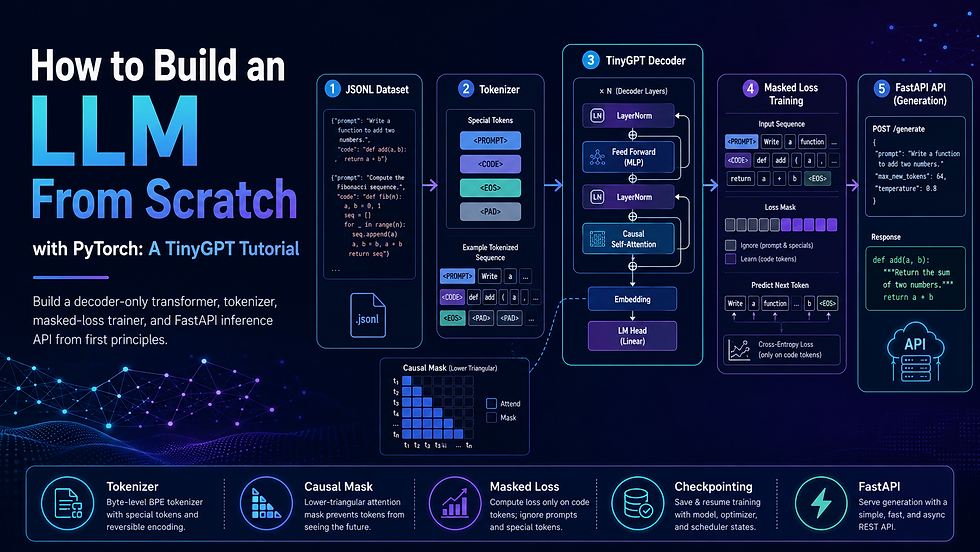
Minimal Implementation in PyTorch
Here is a clean, annotated implementation of the core self-attention mechanism:
import torch
import torch.nn as nn
import math

class MultiHeadAttention(nn.Module):
    def __init__(self, d_model, num_heads):
        super().__init__()
        assert d_model % num_heads == 0

        self.d_model = d_model
        self.num_heads = num_heads
        self.d_k = d_model // num_heads

        # Learned projections for Q, K, V and output
        self.W_q = nn.Linear(d_model, d_model)
        self.W_k = nn.Linear(d_model, d_model)
        self.W_v = nn.Linear(d_model, d_model)
        self.W_o = nn.Linear(d_model, d_model)

    def scaled_dot_product_attention(self, Q, K, V, mask=None):
        # Q, K, V: (batch, heads, seq_len, d_k)
        scores = torch.matmul(Q, K.transpose(-2, -1)) / math.sqrt(self.d_k)

        if mask is not None:
            scores = scores.masked_fill(mask == 0, -1e9)

        attn_weights = torch.softmax(scores, dim=-1)
        return torch.matmul(attn_weights, V), attn_weights

    def forward(self, Q, K, V, mask=None):
        batch_size = Q.size(0)

        # Project and reshape to (batch, heads, seq_len, d_k)
        Q = self.W_q(Q).view(batch_size, -1, self.num_heads, self.d_k).transpose(1, 2)
        K = self.W_k(K).view(batch_size, -1, self.num_heads, self.d_k).transpose(1, 2)
        V = self.W_v(V).view(batch_size, -1, self.num_heads, self.d_k).transpose(1, 2)

        # Attention
        x, attn_weights = self.scaled_dot_product_attention(Q, K, V, mask)

        # Concatenate heads and project
        x = x.transpose(1, 2).contiguous().view(batch_size, -1, self.d_model)
        return self.W_o(x)


class TransformerEncoderLayer(nn.Module):
    def __init__(self, d_model=512, num_heads=8, d_ff=2048, dropout=0.1):
        super().__init__()
        self.attention = MultiHeadAttention(d_model, num_heads)
        self.feed_forward = nn.Sequential(
            nn.Linear(d_model, d_ff),
            nn.ReLU(),
            nn.Linear(d_ff, d_model)
        )
        self.norm1 = nn.LayerNorm(d_model)
        self.norm2 = nn.LayerNorm(d_model)
        self.dropout = nn.Dropout(dropout)

    def forward(self, x, mask=None):
        # Self-attention + residual
        attn_out = self.attention(x, x, x, mask)
        x = self.norm1(x + self.dropout(attn_out))

        # Feed-forward + residual
        ff_out = self.feed_forward(x)
        x = self.norm2(x + self.dropout(ff_out))
        return x
Original Paper Results
The paper evaluated on WMT 2014 English-to-German and English-to-French translation benchmarks:
Model | EN→DE BLEU | EN→FR BLEU | Training Cost |
Previous SOTA (ensemble) | 26.0 | 41.2 | High |
Transformer (base) | 27.3 | 38.1 | 0.5× SOTA cost |
Transformer (big) | 28.4 | 41.8 | Much lower cost |
The Transformer not only beat previous state-of-the-art — it did so at a fraction of the training cost.
Why It Still Matters in 2025
The Transformer is not a historical artifact. It is the active foundation of production AI:
GPT-4, Claude, Gemini, LLaMA — decoder-only Transformers
BERT, RoBERTa, DeBERTa — encoder-only Transformers
T5, BART — encoder-decoder Transformers
ViT (Vision Transformer) — Transformers applied to image patches
Whisper — Transformer for speech recognition
AlphaFold 2 — Transformer for protein structure prediction
Every major AI system built in the last five years traces its architecture directly to this paper.
Common Implementation Pitfalls
If you are implementing a Transformer from scratch, watch out for these:
1. Forgetting the scaling factor Omitting / √dₖ causes softmax to receive large values → extremely peaked distributions → vanishing gradients in early training.
2. Wrong mask shape Padding masks and causal masks have different shapes. Padding: (batch, 1, 1, seq_len). Causal: (1, 1, seq_len, seq_len). Getting this wrong produces silent incorrect results.
3. Positional encoding added after embedding, not before Positional encodings must be added to the token embeddings before the first encoder layer, not after.
4. Not tying input/output embeddings In the original paper, the input embedding, output embedding, and pre-softmax linear transformation share weights. Forgetting this increases parameter count and hurts performance.
5. Learning rate warmup The paper uses a custom schedule with linear warmup followed by inverse square root decay. Training without warmup often diverges.
# Paper's learning rate schedule
def get_lr(step, d_model=512, warmup_steps=4000):
    return d_model**(-0.5) * min(step**(-0.5), step * warmup_steps**(-1.5))
Real-World Applications
Understanding the Transformer opens the door to building:
Custom NLP pipelines — classification, NER, summarization, translation
Domain-specific LLMs — fine-tuned on medical, legal, financial, or code data
Multimodal systems — combining text and vision (ViT, CLIP, Flamingo)
Sequence prediction — time series, genomics, music generation
Code generation — Copilot-style tools built on decoder Transformers
How to Go Deeper
Read next from this series:
Recommended resources:
The Annotated Transformer — Harvard NLP, line-by-line walkthrough
Illustrated Transformer — Jay Alammar's visual explanation
HuggingFace Transformers — production implementations of every variant
Need Help Implementing the Transformer?
Reading the paper is one thing. Building a production-ready implementation — with the right architecture for your use case, your data, your compute — is another.
At Codersarts, we help engineers, researchers, and founders:
✅ Implement the Transformer architecture from scratch in PyTorch or TensorFlow
✅ Reproduce paper results on standard benchmarks
✅ Adapt the architecture for custom domains (medical, legal, finance, code)
✅ Fine-tune pre-trained Transformer models on your dataset
✅ Consult on architecture decisions for Transformer-based systems
This post is Part 1 of the Codersarts AI Research Paper Series. Next: BERT — Bidirectional Pre-training for Language Understanding →


Comments