
When Classic ML Beat an LLM for Our Client
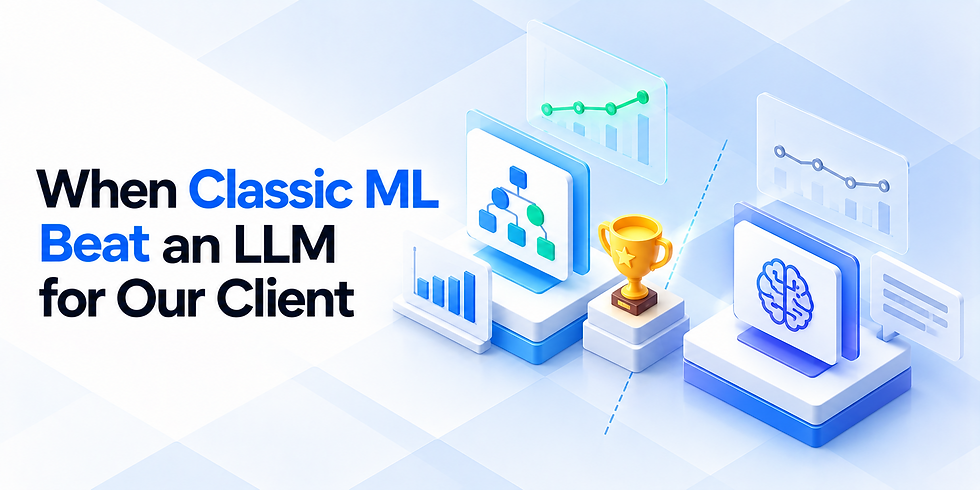
Large language models are impressive, and many teams reach for one first. For a surprising number of business problems, a smaller and older approach does the job better, faster, and for far less money.
Classic machine learning means models such as gradient boosted trees, logistic regression, and random forests, trained on structured data for one specific task. They are not glamorous, and in the right setting they are hard to beat.
This blog explains when classic ML wins over an LLM, how to compare the two fairly, and how to choose for your own problem. It reflects the approach of the CodersArts when advising clients on the right tool for the job. The patterns here are general, and the example is illustrative, so test any conclusion on your own data.
Classic ML Versus LLMs at a Glance
What Is the Difference?
Classic ML learns a narrow task from labeled examples, usually on structured data. An LLM is a general language model trained on huge text collections and guided with prompts or fine-tuning.
Where Does Classic ML Tend to Win?
On structured, numeric, or categorical data with a clear target, such as predicting churn, scoring risk, forecasting demand, or flagging fraud. Speed, cost, and consistency also favor it.
Where Do LLMs Tend to Win?
On open-ended language tasks such as summarizing, drafting, answering questions over documents, and extracting meaning from messy text.
The Short Answer
Match the tool to the data and the task. Start with the simplest approach that meets the goal, compare on your own examples, and combine the two when each does what it does best.
Why Teams Reach for an LLM First
The pull toward LLMs is understandable, and it can lead to expensive choices.
They Are Easy to Start With
A prompt and an API call can produce a demo in an afternoon, with no labeled data and no training.
They Handle Many Tasks
One model can classify, summarize, and answer questions, which makes it feel like a universal solution.
The Hype Is Loud
Leaders ask for AI and hear LLM. Projects are framed around the tool instead of the problem.
The Costs Appear Later
Per-request fees, latency, variability, and monitoring needs show up when volume grows, long after the demo impressed everyone.
Where Classic ML Wins
Classic models have clear strengths that matter in production.
Structured and Tabular Data
For rows and columns of numbers and categories, tree-based models are often among the strongest performers, and an LLM adds little.
Cost at Scale
A trained model that scores a record in milliseconds on a small server costs a tiny fraction of an LLM call. At millions of predictions, the gap is large.
Speed
Low latency makes classic models suitable for real-time decisions such as fraud checks and recommendations.
Consistency
The same input gives the same output. This matters for auditing, testing, and customer trust.
Explainability
Simpler models offer feature importance and clear decision paths, which helps in regulated settings.
Data Privacy and Control
They can run entirely inside your own environment, without sending data to an outside provider.
Measurable Accuracy
With labeled outcomes, performance is easy to measure and track over time.
Where LLMs Win
LLMs are the better choice for a different set of problems.
Unstructured Language
Summarizing long documents, extracting facts from free text, and drafting replies depend on language understanding that classic models lack.
Little or No Labeled Data
When you cannot collect thousands of labeled examples, an LLM can still produce useful results from instructions and a few examples.
Open-Ended Questions
Answering varied questions over a knowledge base is a natural fit for retrieval plus an LLM.
Rapidly Changing Tasks
Changing a prompt is faster than retraining a model when requirements shift often.
Flexible Interfaces
Conversational assistants let people ask in plain language instead of filling forms and filters.
Signs That Classic ML May Be the Better Fit
These questions help you spot the cases.
Is the Input Mostly Structured?
If your data is columns of values, such as transactions, sensor readings, or customer attributes, start with classic ML.
Is the Output a Label or a Number?
Predicting a category, a probability, or a quantity is a classic ML task.
Do You Have Historical Outcomes?
Past examples with known results are exactly what classic models learn from.
Does the Decision Need to Be Fast and Cheap?
High volume and low latency point toward a compact model.
Must the Decision Be Explained or Audited?
Simpler models make explanations and reviews easier.
Does the Task Repeat the Same Way Every Time?
Stable, repetitive tasks reward a model trained for exactly that job.
How to Compare Them Fairly
A fair test avoids favoring one side by accident.
Use the Same Real Data and the Same Split
Hold out examples neither approach has seen, ideally from a later time period to mimic production.
Choose Metrics That Match the Business
Accuracy alone can mislead. Consider precision, recall, cost per error, and calibration. Our machine learning development team can help you pick measures that reflect real business cost.
Build a Simple Baseline First
A logistic regression or a small tree model is quick to build and sets the bar any complex option must beat.
Give the LLM a Fair Chance
Use clear prompts, relevant examples, and structured output. A weak prompt makes an LLM look worse than it is.
Compare Cost, Latency, and Consistency
Measure the price per thousand predictions, the response time, and how stable the outputs are on repeated runs.
Compare Maintenance Effort
Ask who will retrain, re-prompt, and monitor each option over the next year. A model that is cheap to run but hard to maintain can cost more in the end.
Test Failure Modes
Look at what each approach gets wrong, and how costly those mistakes are.
A Worked Example: Predicting Customer Churn
To make this concrete, imagine a hypothetical subscription business that wants to find customers likely to cancel. This example is illustrative, not a customer case.
The Data
A table of usage, billing, support history, and plan details, plus a label showing who cancelled in the following months.
The LLM Attempt
The team feeds customer summaries into an LLM and asks it to rate churn risk. It produces fluent reasons, but the scores vary between runs and cost more per customer than the budget allows.
The Classic ML Attempt
The team trains a gradient boosted model on the historical table. It scores every customer in seconds, gives stable results, and shows which features drive risk.
The Comparison
On a held-out period, the classic model ranks customers more accurately and costs far less to run. The LLM remains useful for a different task: drafting the retention message.
The Decision
The team uses the classic model for scoring and the LLM for writing personalized outreach, so each tool does what it does best.
Combining Classic ML and LLMs
The best systems often use both.
Classic ML for Prediction, LLM for Communication
Use a trained model to decide who needs attention and an LLM to explain or write to them.
LLM to Prepare Features, Classic ML to Decide
An LLM can turn free text, such as support tickets, into structured features that a classic model uses alongside numeric data.
Classic ML as a Router
A fast classifier can decide which requests need an LLM and which can be handled by simple rules.
LLM for Labeling, Classic ML for Serving
An LLM can help label training data, and a small trained model then serves predictions cheaply.
Classic ML as a Guardrail
Trained detectors can check LLM inputs and outputs for risk, at low cost.
Bringing the Right Approach Into Your Organization
A short process avoids costly detours.
Define the Decision and the Measure
State what the system decides, who uses it, and how success is measured in business terms.
Inspect the Data
Check volume, quality, labels, and whether the key information is structured or buried in text.
Build a Baseline and a Candidate
Create a simple classic model and an LLM approach, and test both on held-out examples.
Compare on Quality, Cost, and Risk
Include operating cost, latency, consistency, and the cost of errors, not just accuracy.
Decide, Deploy, and Monitor
Choose the approach or combination, release in stages, and watch for drift and changing costs.
Common Mistakes When Choosing Between ML and LLMs
Starting With the Tool Instead of the Problem
Choosing an LLM first leads to forcing every task into a prompt.
Skipping the Simple Baseline
Without a baseline, you cannot tell whether complexity is paying off.
Judging Only by Demo Quality
A fluent demo hides variability and cost that appear at scale.
Ignoring Operating Cost
Per-call fees and long responses can overwhelm a budget at volume.
Underrating Classic ML
Dismissing older methods as outdated ignores how strong they remain on structured data.
Never Revisiting the Choice
Costs, models, and data change. Review the decision from time to time.
Special Cases Worth Planning For
Some situations call for extra thought before choosing a path.
Very Small Datasets
With only a few hundred labeled examples, a classic model may be unstable, and an LLM with a few examples may do better. Collect more data if you can.
Mixed Data
Many problems combine tables and text, such as orders plus support notes. Convert the text into features and use both.
Changing Environments
If customer behavior shifts quickly, plan frequent retraining and monitoring for classic models, or frequent prompt reviews for LLMs.
Regulated Decisions
Credit, hiring, and health decisions often require clear explanations and documented validation. Simpler models make this easier.
Edge and Offline Use
Small trained models can run on devices with limited connectivity, where calling an LLM may not be practical.
Advantages and Limitations of Classic ML
Where Classic ML Delivers the Most Value
Advantage | Details |
Low running cost | Predictions are cheap, even at very high volume. |
Fast responses | Suitable for real-time decisions. |
Consistent results | The same input gives the same output. |
Explainable | Feature importance and clear logic support reviews. |
Runs in your environment | Data stays under your control. |
What Are the Trade-Offs of Classic ML?
Limitation | Details |
Needs labeled data | You need enough historical examples with known outcomes. |
Narrow scope | Each model solves one task and does not generalize to new ones. |
Feature engineering effort | Preparing and selecting inputs takes skill and time. |
Weak on raw text | Free text needs conversion before a classic model can use it. |
Needs retraining | Models drift as behavior changes and must be refreshed. |
How Much Does Each Approach Cost?
The cost profiles differ. Classic ML has higher setup effort, because data must be prepared, features built, and models trained and validated. Once deployed, running costs are low and predictable.
LLM projects often start cheaply, since a prompt works quickly. Running costs scale with usage, driven by the number of calls, the length of inputs and outputs, and the model chosen. Monitoring, evaluation, and guardrails add further work.
The right comparison covers the full lifetime: build effort, running cost at your expected volume, maintenance, and the cost of mistakes.
Approaches Compared
Teams usually consider four paths.
Rules and Simple Logic
Best when the logic is clear and stable. Cheap and transparent, and limited in handling complexity.
Classic Machine Learning
Best for structured data with historical outcomes. Efficient, consistent, and explainable.
An LLM With Prompting
Best for language tasks with little data. Fast to start, and costlier and less consistent at scale.
A Hybrid System
Combines classic models for prediction and routing with LLMs for language. Often the strongest option for complex workflows.
Which Organizations Get the Most Value From Classic ML?
Classic ML helps organizations that:
Hold large amounts of structured historical data
Need fast, low-cost predictions at scale
Operate in regulated or audited settings
Want consistent, explainable decisions
Prefer to keep data inside their own environment
Did Classic ML Really Beat the LLM?
For the right kind of problem, yes. Structured data, a clear target, and high volume tend to favor classic models on accuracy, cost, and consistency. For language-heavy tasks with little labeled data, an LLM is usually the better tool.
The point is not that one is better in general. It is that the choice should come from a fair comparison on your own data. Our AI consulting team can run that comparison and recommend the right approach.
How CodersArts Helps You Choose and Build the Right AI Approach
CodersArts helps businesses pick the right tool for each problem and build it well.
Problem and Data Review
We assess your decision, your data, and the success measure before recommending a path.
Baselines and Comparisons
We build simple classic baselines and LLM prototypes and compare them on your held-out data.
Machine Learning Development
We develop, validate, and deploy classic models for prediction, scoring, and forecasting.
Hybrid Solutions
We design systems that combine classic ML and LLMs where each fits best.
Ongoing Support and Maintenance
We monitor drift, cost, and quality and refresh models as your data changes.
How Does a CodersArts Model Selection Engagement Work?
Most engagements follow four stages. A discovery session covers your decision, data, and constraints. A baseline stage builds a simple classic model and a quick LLM prototype.
A comparison stage scores both on held-out examples for quality, cost, latency, and consistency. A recommendation stage proposes the best approach or combination, with a rollout plan. Each stage ends with measured results.
Start with a conversation. Email contact@codersarts.com with a short description of your problem, and we will suggest where to begin.
Frequently Asked Questions
When Is Classic ML Better Than an LLM?
Usually when your data is structured, the target is a label or number, you have historical outcomes, and you need fast, cheap, consistent predictions.
Can an LLM Replace a Traditional ML Model?
Sometimes, mainly for language tasks. For prediction on structured data, a trained model is often more accurate, cheaper, and more stable.
What Is the Main Cost Difference?
Classic ML costs more to set up and little to run. LLMs cost less to start and more per request as volume grows.
Do I Need a Lot of Labeled Data for Classic ML?
You need enough labeled examples for the task. The amount depends on the problem. An LLM can help when labels are scarce.
Can I Use Both Together?
Yes. Many strong systems use classic models for prediction and routing and LLMs for language tasks such as explanation and drafting.
How Do I Compare Them Fairly?
Use the same held-out real data, choose business-relevant metrics, build a simple baseline, and compare cost, speed, and consistency.
What Should a Business Evaluate Before Choosing?
Evaluate the type of data, the form of the output, available labels, volume, latency needs, explainability requirements, privacy rules, and total cost over time.
What Services Does CodersArts Offer?
Beyond choosing between classic ML and LLMs and other AI and RAG specific delivery and partnership work, CodersArts offers a wider range of services that agencies, businesses, and individual developers regularly rely on, whether as part of a partnership or on their own.
AI and RAG Development
Custom AI and RAG development, starting from proof of concept through to full production builds, along with broader LLM and generative AI development for businesses building AI-powered products and internal tools.
Consultation
Project consultation for businesses and agencies evaluating an AI or machine learning initiative, helping assess feasibility, recommend the right technical approach, and scope a project before committing to full development.
One-on-One Mentorship
Personalized, expert-led mentorship for developers and teams looking to build hands-on AI, machine learning, or AI engineering skills, with guidance tailored to individual or team goals and current experience level.
Dedicated Team and Team Augmentation
Dedicated AI and machine learning engineering teams, or engineers who work as an extension of an existing in-house or agency team, scaling up or down based on project needs.
Ongoing Support and Maintenance
Post-launch monitoring, optimization, and maintenance for AI and machine learning systems already in production, helping ensure performance and reliability do not degrade over time.
Job Support Services
Remote job support for developers and engineers working on live AI, machine learning, or LLM projects, including pair programming, code reviews, workflow setup, debugging, and help meeting sprint deadlines under expert guidance.
Corporate and Team Training
Structured training and workshops for teams looking to build internal AI and machine learning capability, covering hands-on implementation as well as best practices for evaluation and production readiness.
White-Label and Partnership Delivery
CodersArts also partners with agencies, consultancies, and technology companies to deliver AI and machine learning development on their behalf, whether white-label, co-branded, or embedded alongside an existing team.
Whether you are a business weighing machine learning against LLMs, an agency looking for a delivery partner, or a developer seeking hands-on mentorship, CodersArts offers services to support your AI journey.
Reach out at contact@codersarts.com or visit www.codersarts.com to discuss your choosing between classic ML and LLMs or broader AI project.
Continue Exploring Enterprise Resources
If you found this blog helpful, explore more AI, RAG, and enterprise AI resources from CodersArts AI to see how organizations are applying these systems to real world applications.
Build a Cost-Efficient Writing Quality Checker with Tiered Model Routing and OpenAI
Build Your First A2A Agent: An Email Drafting Pipeline Using Python and OpenAI
Building an AI Interview Prep Agent with Qwen 3.7 Max and Streamlit
https://www.codersarts.com/post/building-an-ai-interview-prep-agent-with-qwen-3-7-max-and-streamlit
Academic Research Assistance and Literature Review Automation Using RAG
Clinical Decision Support Systems Using RAG: Intelligent Diagnostic Assistance for Healthcare
Financial Decision Making with RAG Powered Market Intelligence
https://www.codersarts.com/post/financial-decision-making-with-rag-powered-market-intelligence


Comments