
Technology Audit Solutions
Audit Solutions for Technology, Applications & Business Systems
Assess applications, infrastructure, cloud, data, security, architecture, costs, and operations to identify risks, gaps, and opportunities for improvement.
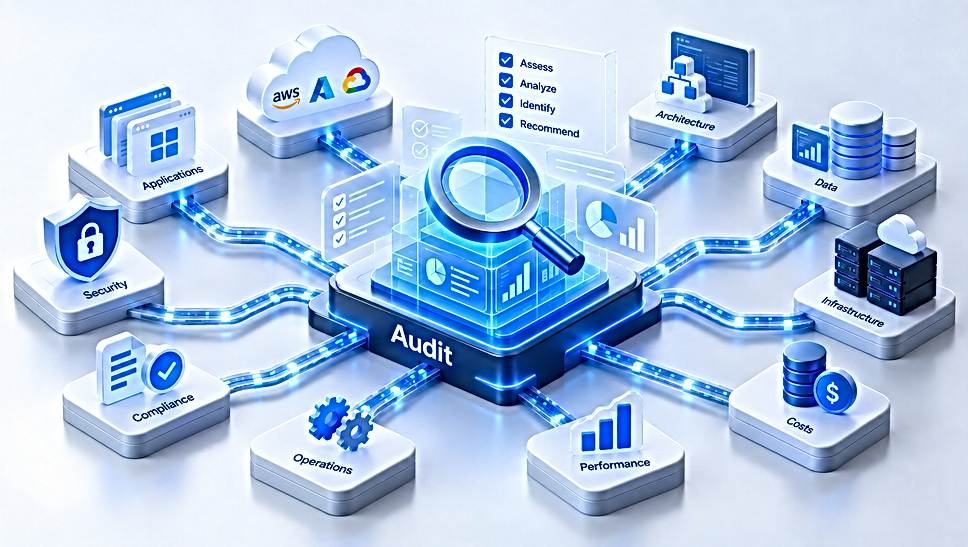
Assess your technology, applications, infrastructure, data, security, architecture, costs, and operations to identify risks, gaps, inefficiencies, and opportunities for improvement.
Codersarts provides technology audit services that give organizations an objective understanding of their existing technology environment. We examine how systems are structured, configured, performing, secured, operated, and aligned with business requirements.
The result is not simply an audit report. We provide evidence-based findings, prioritized recommendations, and a practical roadmap for what to address next.
Understand Your Technology Before You Change It
Technology environments evolve continuously. Applications accumulate technical debt, cloud environments become increasingly complex, security controls change, infrastructure expands, data platforms grow, and operational practices develop around changing business requirements.
Without a structured assessment, organizations may not know:
Which systems create the greatest technical risk
Where performance problems originate
Whether infrastructure is appropriately configured
Where cloud and technology costs can be reduced
Whether security controls are sufficient
How much technical debt exists
Whether architecture can support future growth
Which systems should be modernized or replaced
Where operational processes are creating unnecessary risk
Which technology investments should receive priority
An audit establishes a current-state view before major technology decisions are made.
What Is a Technology Audit?
A technology audit is a structured assessment of an existing technology environment to understand its current condition, identify risks and gaps, evaluate effectiveness, and recommend practical improvements.
Depending on the engagement, an audit may examine:
Audit Dimension | What We Assess |
Technology | Technology stack, platforms, dependencies, versions, configurations, and technology choices. |
Applications | Application architecture, code quality, dependencies, performance, maintainability, security, and operational condition. |
Infrastructure | Servers, networks, storage, compute, environments, availability, capacity, configuration, and operational readiness. |
Cloud | Cloud architecture, services, configurations, security, costs, utilization, resilience, and governance. |
Data | Data architecture, pipelines, quality, storage, governance, security, accessibility, and operational processes. |
Security | Identity, access, vulnerabilities, controls, monitoring, configuration, and security practices. |
Architecture | System structure, dependencies, integration patterns, scalability, resilience, and architectural risks. |
Performance | Application, infrastructure, database, API, and system performance characteristics. |
Costs | Cloud, infrastructure, licensing, tooling, resource utilization, and technology spending. |
Operations | Monitoring, incident management, deployment, backup, recovery, support, and operational processes. |
Compliance | Technology controls, policies, governance, documentation, and applicable compliance requirements. |
The scope can be focused on one technology domain or expanded across the organization's complete technology ecosystem.
Comprehensive Audit Services Across Your Technology Ecosystem
Codersarts can audit individual systems or conduct broader technology assessments across applications, infrastructure, cloud, data, security, architecture, and operations.
Application Audit
Assess application architecture, code quality, dependencies, maintainability, performance, security, technical debt, deployment practices, and long-term sustainability.
Cloud Audit
Review cloud architecture, resource configuration, security, utilization, costs, resilience, governance, networking, identity, and cloud operating practices.
Infrastructure Audit
Assess compute, servers, networking, storage, virtualization, capacity, configuration, availability, resilience, monitoring, and operational readiness.
Database Audit
Evaluate database architecture, configuration, queries, indexing, security, availability, backup practices, capacity, performance, and maintainability.
Data Audit
Assess data architecture, pipelines, quality, governance, lineage, accessibility, security, storage, processing, and operational data practices.
Security Audit
Evaluate security controls, identity management, access policies, vulnerabilities, configurations, monitoring, application security, and infrastructure protection.
Architecture Audit
Analyze application and technology architecture, system dependencies, integration patterns, scalability, resilience, technology choices, and architectural risks.
Performance Audit
Identify application, API, database, infrastructure, network, and system-level performance constraints and determine their underlying causes.
Cost Audit
Review cloud infrastructure, software licensing, services, resources, tooling, utilization, and technology spending to identify unnecessary or poorly utilized expenditure.
Compliance Audit
Assess technology environments against defined regulatory, organizational, security, governance, and compliance requirements.
Operations Audit
Review deployment processes, monitoring, incident management, backup, recovery, support practices, operational controls, and production readiness.
These audits can be conducted independently or combined into a broader technology assessment.
Application & Software Audits
Applications are often the largest source of accumulated technical complexity.
An application audit can examine:
Area | Assessment Scope |
Architecture | Application structure, service boundaries, dependencies, patterns, and architectural consistency. |
Codebase | Code quality, maintainability, complexity, duplication, dependencies, and technical debt indicators. |
Performance | Response times, throughput, resource utilization, bottlenecks, and performance behavior. |
Security | Authentication, authorization, dependencies, secrets, vulnerabilities, and application security practices. |
APIs | API design, performance, reliability, authentication, documentation, versioning, and dependencies. |
Database | Queries, schema design, indexes, connections, transactions, performance, and data access patterns. |
Testing | Test coverage, automation, quality gates, regression protection, and testing practices. |
Deployment | Build, release, deployment, environments, rollback, and production practices. |
Maintainability | Complexity, documentation, dependencies, ownership, technical debt, and future changeability. |
The objective is to understand what condition the application is in and what risks or opportunities exist before deciding what should happen next.
Cloud & Infrastructure Audits
Cloud environments can become difficult to manage as resources, accounts, teams, workloads, and services grow.
A cloud or infrastructure audit can assess:
Cloud architecture
Compute resources
Storage
Databases
Networking
Identity and access
Security configuration
Resource utilization
High availability
Disaster recovery
Backup configuration
Monitoring
Logging
Infrastructure as Code
Kubernetes environments
Container workloads
Environment management
Cloud governance
Resource tagging
Cost allocation
Capacity management
The assessment can identify configuration issues, operational risks, underutilized resources, architectural concerns, and areas requiring further investigation.
Security & Compliance Audits
Security audits provide an evidence-based assessment of how technology environments are protected and where weaknesses may exist.
We can evaluate:
Security Domain | Audit Focus |
Identity | User identities, roles, authentication, privileged access, and access lifecycle. |
Access Control | Permissions, authorization models, least-privilege practices, and access reviews. |
Infrastructure | Server, network, cloud, container, and infrastructure security configurations. |
Applications | Application security controls, vulnerabilities, dependencies, authentication, and authorization. |
APIs | Authentication, authorization, exposure, credentials, rate controls, and security configuration. |
Data | Data access, encryption, storage, transmission, retention, and sensitive-data handling. |
Monitoring | Security logging, alerting, event visibility, and incident detection capabilities. |
Governance | Policies, controls, documentation, ownership, and security operating practices. |
An audit identifies areas requiring attention; remediation, implementation, or optimization can then be planned based on the findings.
Data & Analytics Audits
Data environments can contain hidden complexity across databases, warehouses, lakes, pipelines, analytics systems, and business applications.
A data audit can examine:
Data architecture
Data sources
Data pipelines
ETL and ELT processes
Data warehouses
Data lakes
Lakehouses
Data quality
Data governance
Data lineage
Data security
Data accessibility
Data duplication
Data retention
Data transformation
Analytics environments
Business intelligence
Machine-learning data
Data platform costs
The outcome is a clearer understanding of the organization's data environment and the areas where quality, governance, reliability, architecture, or operational practices need attention.
AI & Machine Learning Audits
As AI becomes part of software and business operations, organizations need visibility into how AI systems are designed, deployed, used, and maintained.
AI audits can examine:
AI Area | Assessment |
AI Architecture | Model architecture, application components, data flows, dependencies, and infrastructure. |
LLM Applications | Model usage, prompts, context handling, retrieval, orchestration, and application architecture. |
RAG | Retrieval architecture, data sources, indexing, chunking, retrieval quality, and knowledge pipelines. |
AI Agents | Tools, permissions, workflows, orchestration, observability, and operational controls. |
Model Operations | Deployment, versioning, monitoring, evaluation, and lifecycle management. |
AI Security | Access, data exposure, model interaction, credentials, and security controls. |
AI Costs | Model consumption, infrastructure usage, token costs, and resource utilization. |
AI Reliability | Failure modes, observability, evaluation, fallback mechanisms, and operational resilience. |
AI audit findings can inform subsequent AI optimization, implementation, security, or architecture initiatives.
Architecture Audits
An architecture audit evaluates whether the current technology architecture remains appropriate for the organization's present and future requirements.
We assess:
Application architecture
Software architecture
Cloud architecture
Infrastructure architecture
Data architecture
API architecture
Integration architecture
Microservices architecture
Monolithic applications
Distributed systems
Event-driven architectures
Security architecture
Deployment architecture
Scalability
Availability
Resilience
Technology dependencies
Architectural technical debt
The goal is not automatically to redesign the architecture. It is to determine where the current architecture creates risk, limitation, cost, or future constraints.
Performance Audits
Performance problems are often symptoms rather than root causes.
Our performance audits can investigate:
Application response times
API latency
Database performance
Query performance
CPU utilization
Memory utilization
Network latency
Infrastructure capacity
Concurrent workloads
Throughput
Resource contention
Caching
Service dependencies
Performance monitoring
Scalability constraints
The audit identifies where performance issues appear, what factors contribute to them, and what areas should be investigated or addressed next.
Cost & Technology Spend Audits
Technology spending can increase without a corresponding increase in business value.
A technology cost audit can assess:
Cloud spending
Infrastructure costs
Compute utilization
Storage costs
Database costs
Software licenses
SaaS subscriptions
Developer tooling
Monitoring costs
AI and model costs
Third-party services
Resource utilization
Environment duplication
Unused resources
The purpose is to establish visibility into current technology expenditure and identify areas that warrant optimization or further analysis.
Operational Audits
Technology can be technically functional while still being operationally fragile.
An operations audit can assess:
Operational Area | What We Review |
Monitoring | Metrics, logs, dashboards, alerting, and system visibility. |
Incident Management | Detection, response, escalation, resolution, and incident processes. |
Deployment | Release processes, environments, approvals, rollback, and deployment reliability. |
Backup | Backup configuration, coverage, retention, testing, and recovery readiness. |
Disaster Recovery | Recovery objectives, dependencies, procedures, and resilience capabilities. |
Documentation | Technical documentation, operational runbooks, architecture records, and ownership. |
Support | Support workflows, responsibilities, escalation paths, and operational coverage. |
Reliability | Availability, failure handling, redundancy, resilience, and operational risk. |
The result provides a current-state view of how effectively the technology environment can be operated and supported.
Technical Debt Audits
Technical debt can accumulate across code, architecture, infrastructure, dependencies, data, and engineering processes.
A technical debt audit can identify:
Outdated frameworks
Unsupported dependencies
Legacy components
Complex code
Architectural limitations
Duplicate systems
Fragile integrations
Manual operational processes
Testing gaps
Documentation gaps
Infrastructure inconsistencies
Security weaknesses
Difficult-to-maintain components
We help categorize technical debt by risk, business impact, urgency, effort, and strategic relevance rather than simply producing a long list of technical issues.
What an Audit Delivers
An effective audit should produce information that supports decisions.
Typical deliverables include:
Deliverable | Purpose |
Current-State Assessment | Document the existing technology environment and its major characteristics. |
Findings Report | Present identified issues, risks, gaps, inconsistencies, and observations. |
Risk Assessment | Classify findings according to technical, operational, security, financial, or business impact. |
Technology Inventory | Establish visibility into applications, platforms, infrastructure, dependencies, and technology components. |
Architecture Review | Document architectural strengths, limitations, dependencies, and potential risks. |
Performance Findings | Identify performance constraints and areas requiring deeper investigation or remediation. |
Cost Findings | Highlight potentially inefficient spending, utilization issues, and cost-related opportunities. |
Security Findings | Identify security weaknesses, control gaps, configuration concerns, and areas requiring remediation. |
Prioritized Recommendations | Convert observations into practical actions ordered by importance and impact. |
Roadmap | Establish potential next steps, sequencing, dependencies, and implementation priorities. |
The exact deliverables depend on the scope and objectives of the audit.
Our Audit Approach
We structure audits around evidence rather than assumptions.
1. Define the Audit Scope
We establish the systems, environments, technologies, business objectives, and assessment criteria included in the engagement.
2. Collect Evidence
We review architecture information, configurations, technical documentation, application components, infrastructure, data, logs, metrics, processes, and other available evidence.
3. Analyze the Environment
We evaluate the current state against technical requirements, operational expectations, security practices, architectural principles, performance characteristics, cost considerations, and business objectives.
4. Identify Findings
We document risks, gaps, inconsistencies, inefficiencies, technical debt, limitations, and opportunities supported by the assessment.
5. Prioritize Issues
Not every finding deserves immediate action. We help prioritize findings according to impact, risk, urgency, effort, dependencies, and business relevance.
6. Recommend Actions
We translate findings into practical recommendations rather than simply identifying problems.
7. Establish the Roadmap
Where appropriate, we organize recommendations into potential short-, medium-, and long-term initiatives.
This gives decision-makers a structured basis for determining what to address next.
Audit by Business Objective
Organizations rarely conduct an audit simply because they want an audit. There is usually a business decision behind it.
Business Objective | Relevant Audit |
Prepare for growth | Architecture, scalability, infrastructure, application, and performance audits |
Reduce technology risk | Security, architecture, infrastructure, application, and operations audits |
Control technology costs | Cloud, infrastructure, licensing, SaaS, and cost audits |
Prepare for modernization | Application, architecture, infrastructure, and technical debt audits |
Prepare for migration | Application, infrastructure, data, cloud, and dependency audits |
Improve performance | Application, database, API, infrastructure, and performance audits |
Improve security | Security, cloud, application, infrastructure, and compliance audits |
Improve data reliability | Data architecture, data quality, pipeline, and governance audits |
Prepare for AI adoption | Data, architecture, security, infrastructure, and AI readiness audits |
Evaluate technology investments | Technology, architecture, application, cost, and operational audits |
The audit scope should follow the decision the organization needs to make, not simply the technology that happens to be available.
Audit Engagement Models
Choose the Audit Scope That Fits Your Decision
Start with one focused area, or assess your full technology environment. Every engagement has a fixed scope, a defined timeline, and prioritized findings you can act on.
Focused Audit
Starting at $499 · 5–7 business days
A deep review of one area of your technology: code, security, cloud, database, or AI costs.
Best for: Startups, founders with AI-built or vibe-coded apps, and teams with one specific concern.
Choose one area:
Code quality audit
Application security audit
Cloud cost audit
Database audit
LLM / AI cost audit
You receive:
Findings report with severity ratings
Top 10 prioritized recommendations
30-minute findings walkthrough call
Application Audit
Starting at $1,499 · 2 weeks
A complete assessment of one application across code, security, performance, and architecture.
Best for: SaaS products before a launch, funding round, scale-up, or handover to a new team.
Covers:
Code quality and technical debt
Application and API security
Performance and database bottlenecks
Architecture and scalability
Deployment and production readiness
You receive:
Full findings report with risk ratings
Prioritized remediation plan with effort estimates
60-minute findings walkthrough call
14 days of follow-up Q&A
Get an Application Audit → (Most Popular)
Full Technology Assessment
Custom pricing · 3–6 weeks
A multi-domain audit across applications, cloud, infrastructure, data, security, and operations.
Best for: Growing companies, enterprises, and teams preparing for modernization, migration, acquisition, or technical due diligence.
Covers:
Multiple applications and systems
Cloud and infrastructure
Data platforms and pipelines
Security and compliance controls
Engineering and operational processes
Technology costs
You receive:
Executive summary for leadership
Detailed technical findings by domain
Risk register with business impact
3–6–12 month improvement roadmap
Stakeholder presentation session
Included in Every Audit
NDA signed before access: your code and data stay confidential
Read-only access: we assess without changing your systems
Evidence-based findings: every issue is backed by what we observed
Prioritized by impact: critical risks come first, not a long unsorted list
Fixed scope and price: agreed in writing before work starts
Optional Add-Ons
Add-On | What You Get |
Remediation Sprint | Our engineers fix the critical issues found in the audit |
Re-Audit | Verification that fixes were implemented correctly |
Architecture Roadmap | Target-state architecture design based on the findings |
Ongoing Review | Monthly or quarterly audits to catch new risks early |
Not Sure Which Audit You Need?
Tell us what you're concerned about: security, performance, costs, or a decision you have to make. We'll recommend the right scope and give you a fixed quote within 24 hours.
Final pricing depends on codebase size, number of systems, and access requirements. Your quote is confirmed after a free scoping call.
Audit for Different Organizations
Startups
Evaluate technology foundations, application architecture, cloud environments, security, technical debt, and engineering practices before rapid growth makes changes more expensive.
SaaS Companies
Assess product architecture, infrastructure, cloud costs, application performance, security, reliability, data platforms, and engineering operations.
Enterprises
Conduct structured audits across complex application portfolios, infrastructure, cloud environments, data platforms, security controls, architecture, and operational processes.
SMBs
Identify technology risks, unnecessary costs, security gaps, outdated systems, and opportunities to improve technology reliability and maintainability.
Product Companies
Assess software architecture, engineering environments, infrastructure, data, AI capabilities, performance, security, and scalability.
Technology Companies
Evaluate technology platforms, product architecture, infrastructure, engineering processes, cloud environments, and technical investments.
Agencies
Use technical audits to assess client environments, identify delivery risks, establish project requirements, and create evidence-based recommendations before implementation or modernization work.
Digital Businesses
Evaluate the technology systems supporting digital operations, customer experiences, data, infrastructure, security, and business processes.
Audit Services for Technology Due Diligence
Technology assessments can also support strategic and commercial decisions.
Codersarts can assist with technical assessments related to:
Technology acquisitions
Product acquisitions
Software due diligence
Technology investment decisions
Vendor evaluation
Platform evaluation
Application portfolio assessment
Technical partnership evaluation
Outsourcing decisions
Technology modernization planning
Cloud strategy decisions
Technology risk assessment
The objective is to provide technical evidence that supports a larger business or investment decision.
Audit Technologies & Environments
Our audit capabilities can span diverse technology environments, including:
AWS
Microsoft Azure
Google Cloud
Kubernetes
Docker
Terraform
CI/CD platforms
Cloud-native infrastructure
Virtualized environments
Linux
Windows
PostgreSQL
MySQL
MongoDB
Redis
Data warehouses
Data lakes
Lakehouses
BI platforms
SaaS platforms
CRM systems
ERP systems
REST APIs
GraphQL
Microservices
Monolithic applications
Serverless systems
AI and LLM applications
Machine-learning environments
Web applications
Mobile backends
Enterprise systems
The technology stack does not determine the audit objective. We select the assessment methods and evidence appropriate to the environment being reviewed.
Audit Outcomes
A successful audit should help answer practical questions:
What do we have?
Understand the current technology landscape, architecture, infrastructure, applications, data, dependencies, and operational environment.
How well is it working?
Evaluate performance, reliability, scalability, security, operational effectiveness, and technology utilization.
Where are the risks?
Identify technical, security, operational, financial, architectural, and business risks.
What should we improve?
Translate findings into actionable recommendations.
What should we do first?
Prioritize initiatives based on business impact, risk, urgency, effort, and dependencies.
What comes next?
Create a roadmap for remediation, optimization, modernization, migration, implementation, or other future initiatives.
Audit vs. Related Solutions
An audit is often the starting point for another technology initiative, but it has a distinct purpose.
Solution | Primary Question |
Audit | What is the current state, what is wrong or risky, and what should we consider doing? |
Optimization | How can we make the existing environment perform better or operate more efficiently? |
Migration | How do we move the existing environment, workload, or data to another environment? |
Integration | How do we connect separate systems and make them work together? |
Implementation | How do we put a selected technology or solution into operation? |
Architecture | How should the technology solution be structured? |
Development | How do we create or extend the software? |
Automation | How do we make repeatable activities happen automatically? |
Modernization | How do we transform an existing legacy or outdated technology environment? |
An audit can therefore precede almost any of these activities, but it should remain focused on assessment and decision support rather than execution.
From Audit Findings to Action
An audit creates value when findings lead to informed decisions.
Depending on the results, the next initiative may involve:
Audit → Optimization
When the existing environment is fundamentally sound but needs better performance, efficiency, reliability, or cost management.
Audit → Migration
When an existing workload or environment should move to a different platform, provider, or infrastructure.
Audit → Integration
When disconnected systems or data sources are limiting operations.
Audit → Implementation
When a new selected technology needs to be introduced and operationalized.
Audit → Architecture
When the current architecture requires deeper redesign or structural evaluation.
Audit → Development
When existing technology cannot satisfy requirements without new software capabilities.
Audit → Automation
When manual processes are creating unnecessary operational effort or risk.
The audit provides the evidence needed to determine which path makes the most sense.
Why Codersarts for Technology Audits?
Engineering-Led Assessment
Our audits are grounded in practical software engineering, cloud, infrastructure, data, security, AI, DevOps, and technology experience.
Technology Ecosystem Perspective
We assess dependencies and relationships between systems rather than examining every technology component in isolation.
Actionable Findings
We focus on findings that can inform real technical and business decisions.
Prioritized Recommendations
We help distinguish critical issues from lower-priority improvements so organizations can focus resources where they matter most.
Flexible Scope
Conduct a focused application, cloud, security, data, performance, or architecture audit—or combine multiple domains into a broader technology assessment.
Foundation for Future Work
Where appropriate, audit findings can become the foundation for subsequent optimization, migration, integration, implementation, modernization, development, or automation initiatives.
Start Your Technology Audit
If you are planning a major technology decision, experiencing recurring technical problems, preparing for growth, evaluating risk, controlling technology costs, or simply need a clearer understanding of your existing environment, an audit can provide the evidence required to move forward confidently.
Codersarts can assess your applications, infrastructure, cloud environment, data platforms, security controls, architecture, performance, costs, and operations and translate the findings into practical next steps.
Audit = assessing an existing technology environment to understand its current state, identify risks and gaps, uncover opportunities, and establish evidence-based recommendations for what should happen next.