
Software Architecture & Engineering Services
Design and engineer the technical foundation for software products with practical architecture, system engineering, APIs, distributed systems, and scalable application structures.
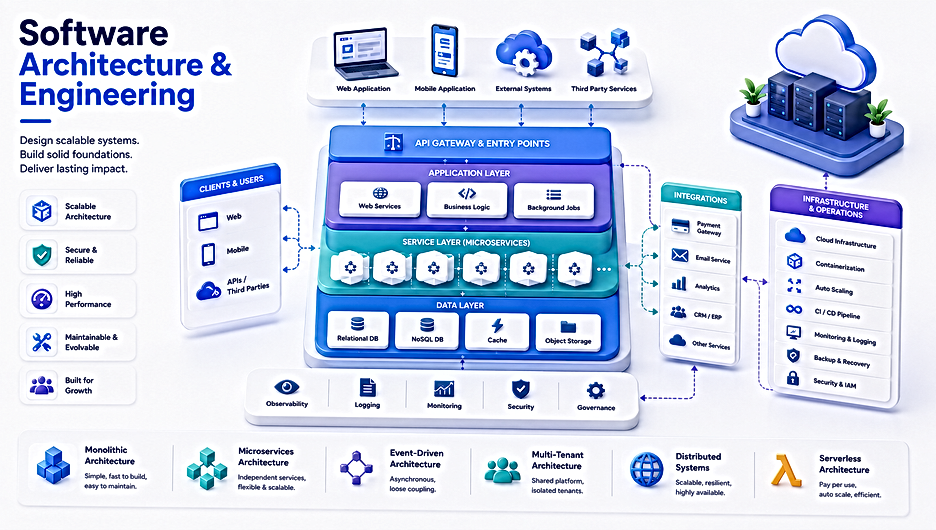
Design and engineer scalable software foundations with practical architecture, system engineering, APIs, distributed systems, and multi-tenant architecture.
Design the Technical Foundation for Products That Need to Evolve
Software architecture determines how the major parts of a product fit together and how the system behaves as requirements, users, data, and workloads change.
Codersarts helps design and engineer technical foundations for new products, growing applications, and existing systems that have become difficult to change or scale.
The focus is on choosing an architecture that fits the product today while providing a practical path for future growth.
What Is Software Architecture & Engineering?
Software architecture defines the structure and relationships between the major components of a software system. Engineering turns those decisions into a working, maintainable product.
Good architecture creates clear boundaries between responsibilities while considering the realities of the product, team, data, infrastructure, and expected growth.
Architecture Area | What It Defines |
Application Structure | Components, modules, services, and responsibilities |
System Boundaries | How different parts of the system interact |
Data Architecture | Data ownership, storage, access, and movement |
API Architecture | Interfaces between applications, services, and systems |
Integration Architecture | Communication with external platforms and services |
Deployment Architecture | How software runs across environments |
Scalability | How the system responds to increasing workloads |
Reliability | How the system handles failures and operational issues |
Architecture is therefore not just a diagram. It is a set of engineering decisions that shape how a product can be built, operated, and changed.
When Does Architecture Need Deliberate Attention?
Architecture becomes particularly important when a product is entering a new stage of complexity.
Situation | Architecture Focus |
New Product | Establish a suitable technical foundation |
MVP → Production | Strengthen structure, reliability, and operational readiness |
Growing Application | Manage increasing users, data, and feature complexity |
Performance Problems | Identify architectural and system bottlenecks |
Multiple Services | Establish clear service and communication boundaries |
Multi-Tenant Product | Design tenant isolation and shared platform capabilities |
AI Integration | Connect AI, data, applications, and workflows |
Legacy Constraints | Restructure systems that are limiting product development |
The appropriate architecture depends on the actual product requirements. A simple product does not automatically need a distributed system, and a growing platform may eventually need more deliberate separation and scaling strategies.
Architecture Capabilities
Software Architecture
We define the structure of applications around their functional and technical requirements.
This can include:
Application decomposition
Component boundaries
Module design
Service boundaries
Dependency management
Data ownership
Communication patterns
Architecture evolution
The goal is to create a structure that makes the system easier to understand, maintain, test, and extend.
System Engineering
Software products rarely operate in isolation.
A complete system may include applications, APIs, databases, external services, cloud infrastructure, users, data pipelines, and operational tooling.
We design how these components interact as one system.
Users
  ↓
Product Application
  ↓
Application Services
  ↓
APIs & Business Logic
  ↓
Data & External Systems
  ↓
Infrastructure & Operations
The architecture needs to account for the relationships between these layers rather than optimizing each component independently.
API Engineering
APIs create the interfaces through which applications and systems communicate.
We help define:
API boundaries
Resource models
Request and response structures
Authentication and authorization
Service communication
Integration patterns
Versioning considerations
Error handling
API reliability
Well-designed APIs provide stable boundaries between product components while allowing individual systems to evolve.
Microservices Engineering
Microservices can allow different product capabilities to be developed, deployed, and scaled independently.
However, separating everything into services can also increase operational and architectural complexity.
We consider microservices when there is a meaningful reason for service separation, such as:
Independent scaling requirements
Clear domain boundaries
Independent deployment needs
Team ownership boundaries
Different operational characteristics
Large or distributed product requirements
The objective is not to use microservices because they are popular. It is to determine where service separation creates a practical engineering benefit.
Distributed Systems
As products grow, workloads may need to operate across multiple services, processes, machines, or environments.
Distributed system engineering considers:
Concern | Engineering Question |
Communication | How should components exchange information? |
Consistency | How should distributed data remain reliable? |
Failure | What happens when a component becomes unavailable? |
Latency | How does network communication affect the product? |
Scalability | Which components need to scale independently? |
Resilience | How does the system recover from failures? |
Observability | How can system behavior be understood in production? |
These considerations become increasingly important as system boundaries multiply.
Multi-Tenant Architecture
Multi-tenant products serve multiple organizations or customers through a shared platform.
Architecture needs to account for:
Tenant identification
Data isolation
Access control
Organization-level configuration
Resource allocation
Tenant-specific workflows
Administration
Scaling
The architecture should balance isolation, operational complexity, product requirements, and expected growth.
Architecture Decisions Are Trade-Offs
There is rarely one universally correct architecture.
A decision that improves scalability may increase operational complexity. A highly distributed design may improve independent deployment while making debugging and system coordination harder.
We evaluate architecture decisions across the requirements that actually matter to the product.
Consideration | Question |
Simplicity | Can the team understand and operate the system? |
Scalability | Can the architecture handle expected growth? |
Reliability | Can important failures be contained and recovered from? |
Performance | Can the system meet required response and processing times? |
Security | Are data and system boundaries appropriately protected? |
Maintainability | Can engineers safely change the product? |
Development Velocity | Does the architecture support efficient product development? |
Operational Cost | Is the complexity justified by the product requirements? |
The right architecture is the one that fits the product.
Architecture should support the business and product rather than become an engineering objective in itself.
Architecture for Different Product Stages
A product's architecture should evolve as the product evolves.
Early Product
Prioritize:
Simplicity → Development Speed → Clear Structure
Avoid introducing infrastructure and architectural complexity before it is justified.
Growing Product
Prioritize:
Modularity → Performance → Reliability → Clear Boundaries
As usage and product complexity increase, stronger architectural boundaries become more valuable.
Scaling Product
Prioritize:
Independent Scaling → Resilience → Observability → Operational Control
At higher scale, the system may require more deliberate distribution, asynchronous processing, caching, service separation, and infrastructure design.
Mature Product
Prioritize:
Evolution → Modernization → Reliability → Long-Term Maintainability
Architecture becomes an ongoing engineering concern rather than a one-time design activity.
Architecture for New Products
For a new product, architecture should provide enough structure to support the first release without unnecessarily predicting every future requirement.
A practical sequence is:
Product Requirements → System Boundaries → Application Structure → Data Model → APIs → Infrastructure → Engineering
This creates a technical foundation that can be implemented incrementally.
Architecture for Existing Products
Existing products require a different approach because architecture is constrained by the system that already exists.
We can examine:
Current application structure
Dependencies
Data flows
Service boundaries
Performance characteristics
Infrastructure
Deployment processes
Technical debt
Integration constraints
From there, architectural improvements can be introduced incrementally rather than assuming that a complete rewrite is always the best answer.
Improve the architecture without losing the product
A modernization path may look like:
Assess → Identify Constraints → Prioritize → Restructure → Validate → Expand
This allows engineering improvements to happen alongside ongoing product development.
From Architecture to Engineering
Architecture only creates value when engineering teams can implement and operate it.
The transition from architecture to implementation can follow:
Product Requirements
        ↓
Architecture Decisions
        ↓
System Design
        ↓
Component & API Design
        ↓
Engineering
        ↓
Testing & Validation
        ↓
Production
        ↓
Architecture Evolution
Each stage provides feedback to the next. Engineering discoveries may reveal that an architectural decision needs to change, making architecture an iterative activity rather than a fixed document.
Architecture & Engineering Process
01 — Understand
Understand the product, users, workloads, business requirements, existing systems, and constraints.
02 — Assess
Examine the current or proposed technical structure and identify important architectural concerns.
03 — Design
Define system boundaries, components, data flows, APIs, and important architectural decisions.
04 — Validate
Test critical assumptions through prototypes, technical experiments, performance testing, or targeted implementation.
05 — Engineer
Implement the architecture through application, backend, data, integration, and infrastructure engineering.
06 — Operate
Observe the system in production and identify reliability, performance, and maintainability issues.
07 — Evolve
Adapt the architecture as product requirements, workloads, and engineering needs change.
Understand → Assess → Design → Validate → Engineer → Operate → Evolve
Architecture is continuous
The first architecture is rarely the final architecture.
As the product grows, new requirements expose new constraints. Continuous architectural improvement keeps the system aligned with the product rather than allowing technical complexity to accumulate unchecked.
Build a Foundation That Can Evolve
Whether you are designing architecture for a new product, preparing an MVP for production, addressing scalability problems, introducing distributed services, or restructuring an existing system, Codersarts can help translate product requirements into practical architecture and engineering decisions.