
AI Product Engineering Services
Build AI-native products and integrate intelligent capabilities into existing software through AI product development, generative AI, RAG, AI agents, machine learning, and automation.
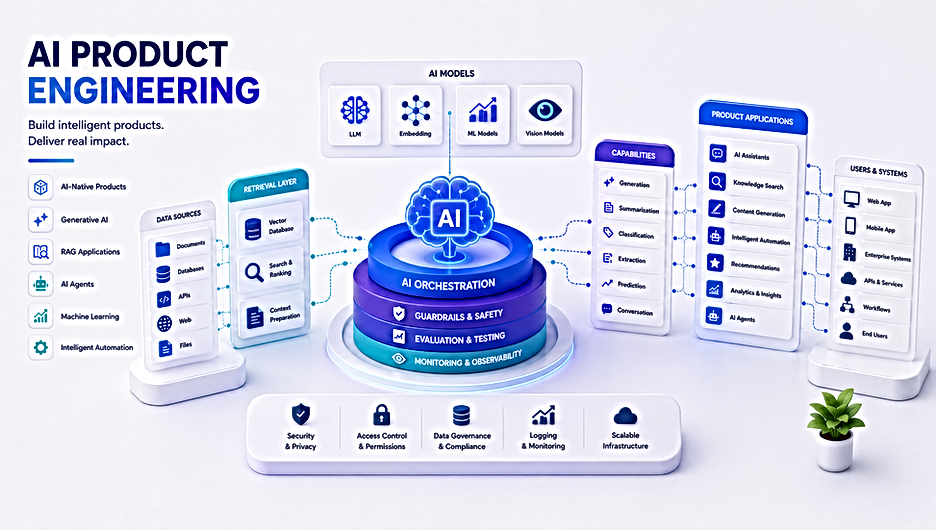
Build AI-native products and integrate practical AI capabilities into existing software through product-focused AI engineering, from prototype to production.
Build AI Into Products, Not Just Prototypes
AI product engineering is the process of turning artificial intelligence capabilities into useful, reliable product experiences.
Codersarts helps businesses build AI-native products and integrate AI into existing software products, workflows, and applications. This can range from generative AI and RAG applications to AI agents, machine learning systems, intelligent automation, and AI-powered features.
The focus is not simply on connecting an application to an AI model. It is on engineering the product experience, data flow, application logic, AI capability, evaluation, and production system around a real use case.
What Is AI Product Engineering?
AI product engineering combines product engineering with AI and machine learning capabilities.
A conventional software product generally follows predefined rules and workflows. AI-enabled products can introduce systems that interpret information, generate content, make predictions, retrieve knowledge, recognize patterns, or execute tasks.
That creates a different engineering problem.
Product Layer | AI Product Engineering Focus |
Product | Where AI creates meaningful user or business value |
Experience | How users interact with AI capabilities |
Application | How AI connects with product workflows and business logic |
Data | What information AI needs and how it is accessed |
AI System | Models, retrieval, reasoning, prediction, or generation |
Evaluation | Whether AI outputs are useful, accurate, and reliable |
Operations | How the AI capability runs and improves in production |
The goal is to make AI a useful part of the product rather than an isolated technical experiment.
Where AI Fits Into a Product
AI does not need to be the entire product. In many cases, its greatest value comes from adding intelligence to an existing product or workflow.
AI Role | Product Example |
Core Capability | AI-native applications and intelligent platforms |
Assistant | Conversational support, research, productivity, or workflow assistance |
Knowledge Layer | Search and question answering across organizational information |
Automation | Classification, extraction, routing, and workflow execution |
Recommendation | Personalized content, products, actions, or next steps |
Prediction | Forecasting, risk scoring, demand prediction, or anomaly detection |
Agent | Multi-step task execution using tools and connected systems |
Decision Support | AI-assisted analysis and recommendations |
The right approach depends on the product problem, the available data, the expected user experience, and the level of automation required.
AI Product Capabilities
AI Product Development
Build products where AI is a central part of the user experience or business model.
This can include:
AI-native applications
AI assistants
Intelligent platforms
AI-powered business applications
AI-enabled customer experiences
AI-driven workflow products
The product is designed around the AI capability from the beginning rather than adding it as an afterthought.
Generative AI
Build applications that use generative models to work with content, knowledge, language, code, documents, and other information.
Typical product experiences include:
Capability | Example Experience |
Generation | Create text, content, summaries, or responses |
Transformation | Rewrite, classify, extract, or structure information |
Conversation | Interact with users through natural language |
Analysis | Understand and analyze large amounts of information |
Content Assistance | Help users create or improve work |
Multimodal AI | Work with combinations of text, images, documents, or other inputs |
RAG Applications
Retrieval-Augmented Generation connects AI models with relevant external knowledge.
Instead of relying only on information contained within a model, a RAG product can retrieve relevant information from application data or knowledge sources and use it as context for generating responses.
A typical flow is:
User Question → Retrieval → Relevant Context → AI Generation → Product Response
RAG can support:
Enterprise knowledge assistants
Document question answering
Research applications
Internal knowledge systems
Customer support
Product search
Information discovery
The retrieval system and product experience are as important as the generation layer.
AI Agents
AI agents extend AI beyond generating responses by allowing systems to perform actions through tools and connected services.
An agent may:
Understand a user's objective.
Determine the steps required.
Select appropriate tools.
Retrieve or process information.
Execute actions.
Evaluate the result.
Continue or request human input when necessary.
This can support complex workflows involving multiple systems and steps.
Agent Engineering
Agent Component | Purpose |
Reasoning | Determine the next appropriate step |
Tools | Interact with applications and services |
Context | Maintain relevant information during execution |
Memory | Preserve useful information across interactions |
Workflow | Control multi-step execution |
Evaluation | Check whether actions and outputs are appropriate |
Human Oversight | Introduce review where autonomous execution is not appropriate |
Machine Learning Products
AI product engineering also includes conventional machine learning systems where prediction or pattern recognition provides product value.
Examples include:
Recommendation systems
Forecasting
Classification
Fraud or anomaly detection
Demand prediction
Ranking
Computer vision
Natural language processing
Predictive analytics
The model is only one component. A useful ML product also requires data processing, model integration, application workflows, evaluation, and production operation.
Intelligent Automation
AI can automate workflows that previously required manual interpretation or repetitive decision-making.
A typical workflow can connect:
Input → AI Processing → Decision → Business Logic → Action
Examples include:
Document processing
Information extraction
Ticket classification
Lead qualification
Content processing
Workflow routing
Data enrichment
Customer support automation
The objective is not simply to automate a task, but to make the overall workflow more effective.
Designing the AI Product Experience
AI changes how users interact with software.
Instead of navigating a fixed sequence of screens, users may ask questions, provide natural-language instructions, review generated results, or delegate multi-step tasks.
That means the product experience needs to account for both AI behavior and user expectations.
Important Product Decisions
Experience Area | Questions to Resolve |
Interaction | How does the user invoke AI? |
Context | What information should AI know? |
Control | What can AI decide or execute? |
Transparency | How should results and limitations be presented? |
Review | When should a user approve an action? |
Failure | What happens when AI is uncertain or incorrect? |
Feedback | How can users correct or improve the result? |
This is where AI engineering and product engineering need to work together.
From AI Prototype to Product
An AI demo can prove that something is technically possible. A product needs to make that capability useful and dependable.
The transition typically involves:
Prototype → Validate → Productize → Integrate → Evaluate → Deploy → Improve
Prototype
Test whether the underlying AI approach can solve the intended problem.
Validate
Evaluate whether the results are useful enough for the intended workflow.
Productize
Turn the experiment into a structured product capability with defined inputs, outputs, workflows, and user interactions.
Integrate
Connect the AI system with application logic, data, APIs, and other product components.
Evaluate
Establish ways to measure the quality and reliability of AI behavior.
Deploy
Operate the capability as part of the production product.
Improve
Use evaluation, user feedback, and product requirements to continuously improve the system.
Production AI Requires More Than a Model
A model alone does not make an AI product.
A production AI capability may need several connected layers:
Layer | Purpose |
Data | Provide relevant and usable information |
Retrieval | Find relevant context when required |
Model | Generate, classify, predict, or reason |
Orchestration | Coordinate models, tools, workflows, and context |
Application Logic | Connect AI behavior to product rules |
Evaluation | Measure output quality and system behavior |
Controls | Manage permissions, review, and appropriate usage |
Operations | Run, monitor, and improve the system |
This is why AI product engineering extends beyond model integration.
AI for Existing Products
AI can also be introduced into products that already have users, data, workflows, and established application infrastructure.
Instead of rebuilding the product, AI capabilities can be introduced where they provide clear value.
Existing Product
↓
Identify AI Opportunity
↓
Prototype AI Capability
↓
Integrate With Product
↓
Validate With Real Workflow
↓
Production AI Feature
Potential areas include:
AI search
Intelligent assistants
Recommendations
Document intelligence
Workflow automation
Predictive features
AI agents
Content generation
Intelligent analytics
This allows organizations to introduce AI incrementally while keeping the existing product at the center.
AI Product Engineering Process
01 — Identify
Understand the product problem and determine where AI can provide meaningful value.
02 — Define
Define the AI capability, user experience, data requirements, workflow, and expected outcome.
03 — Prototype
Test the underlying approach before committing to full implementation.
04 — Engineer
Build the AI capability and connect it with the product, data, APIs, and workflows.
05 — Evaluate
Measure AI behavior against meaningful product and quality criteria.
06 — Deploy
Move the capability into the production product with appropriate operational controls.
07 — Improve
Use evaluation results, user feedback, and changing product requirements to continuously improve the system.
Identify → Define → Prototype → Engineer → Evaluate → Deploy → Improve
From AI capability to product capability
The process is deliberately iterative. What is learned during prototyping and evaluation can change the product design, system architecture, or AI approach before the capability becomes a permanent part of the product.
AI Across the Product Lifecycle
AI requirements can change significantly as a product matures.
Product Stage | AI Engineering Focus |
Idea | Identify meaningful AI opportunities |
Prototype | Test AI feasibility and user experience |
MVP | Introduce the core AI capability |
Early Product | Improve quality and integrate AI deeper into workflows |
Growth | Expand AI capabilities and automation |
Scale | Improve reliability, evaluation, performance, and operational control |
Mature Product | Continuously evolve AI capabilities with the product |
The important principle is to introduce AI according to actual product value and maturity, rather than adding complexity simply because a technology is available.
From AI Engineering to Continuous Product Evolution
AI systems are not static.
Models change. Data changes. User expectations change. Product workflows change. New capabilities become available.
A production AI product therefore needs an engineering cycle that can continuously evaluate and improve the system.
AI Product Opportunity
        ↓
Prototype
        ↓
Product Integration
        ↓
Production
        ↓
Evaluation
        ↓
User Feedback
        ↓
AI & Product Improvement
        ↓
New Capabilities
The objective is to create an AI capability that becomes a useful part of the product—not simply a successful technical demonstration.
Build AI Into the Product
Whether you are building an AI-native product, adding generative AI to an existing application, developing an RAG system, creating an AI agent, or introducing machine learning into a business workflow, Codersarts can support the product engineering required to move from AI concept to production capability.