
Building a Legal AI Assistant That Backs Every Answer With Real Cases
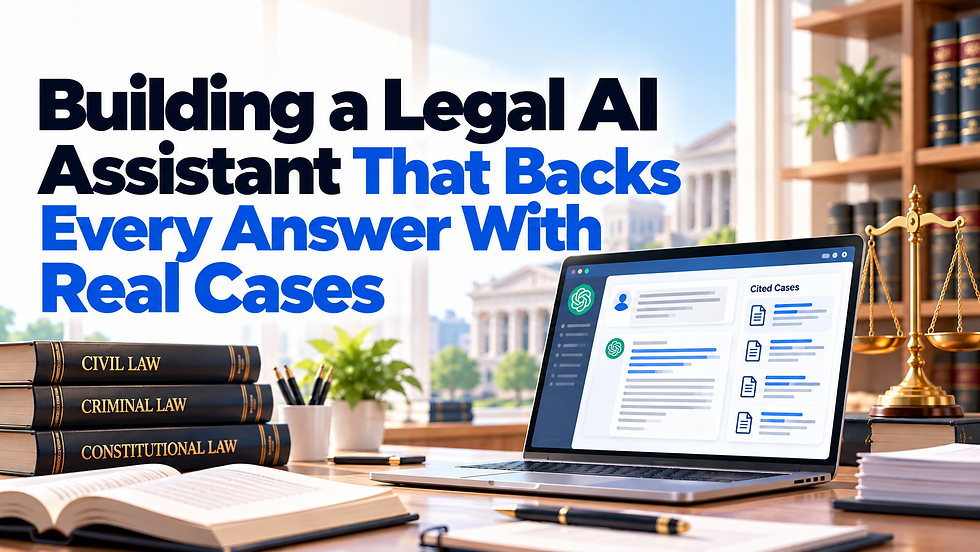
Picture two lawyers using AI for the same research task. The first receives a confident, well-formatted answer with five case citations and files it without checking. Two of the cases do not exist, and the lawyer ends up explaining the mistake to a judge. The second uses an assistant that finds the relevant cases in minutes, shows the exact passage behind every claim, and flags the one point it could not support. A task that once took hours takes a fraction of the time, and every citation has been checked against a real source.
Both lawyers used AI. The difference is how the tool was built. Courts and law firms around the world are embracing AI for legal work, and early failures have taught the industry what a trustworthy tool needs. This blog explains what a legal AI assistant that backs every answer with real cases looks like, how it works, where it helps, and where it still falls short.
The News Behind the Need
The news around legal AI is a mix of encouraging progress and clear warnings. Both explain why grounded, verifiable assistants matter.
Courts are embracing AI where it helps
Singapore's courts worked with Harvey AI to build tools for the Small Claims Tribunals, including translation of court documents into several languages and summaries of case files for magistrates and people representing themselves. Senior Singapore judges have also observed that legal AI tools can work very well when they draw on curated databases, which is exactly the principle behind a grounded assistant.
Responsible use is being made easier
Singapore's Ministry of Law issued a guide on the use of generative AI in the legal sector, and the courts have published guidance for court users. The Law Society of Singapore has reminded lawyers to protect client confidentiality when using AI tools. The courts have said that the concern is not AI use itself but careless use that introduces inaccuracies, fabrications or fake citations. In other words, the door is open for tools that are built with care.
Adoption is spreading worldwide
India's Supreme Court uses SUVAS to translate judgments into regional languages and SUPACE to help judges find precedents, and platforms such as Adalat AI are spreading across Indian courts, with some courts reporting faster case handling. Brazil's Supreme Federal Court uses a system called Victor to help screen incoming appeals.
Judges in England and Wales have training and a private AI tool available through their secure accounts, and many judges in the United States report using AI in their own work. UNESCO published guidelines for AI in courts in December 2025 to help courts adopt the technology safely.
The risks are real, and they can be reduced
Lawyers in Singapore, the United States, the United Kingdom and elsewhere have been sanctioned for filing fake cases generated by AI. Courts have been consistent that the lawyer remains responsible for every submission. Studies have also found that even specialised legal research tools can produce errors, and that marketing promises of error-free citations can be overstated. A retrieval system helps, but it does not remove the need for verification.
The shared message is clear
AI can assist with legal work, and courts are welcoming that help, but the human who signs the document must verify it.
For anyone building legal AI, the opportunity and the standard are both clear. Lawyers and courts want tools that save time, and they expect those tools to show their sources and prove that those sources are real.
What Does "Backing Every Answer With Real Cases" Mean?
It means that every legal claim in an answer is tied to a specific, checkable source, and that the system verifies those sources before the user ever sees them. In practice, an assistant of this kind follows four rules.
It answers only from retrieved material. The model does not rely on memory for case law. It reads passages pulled from a trusted collection of cases, statutes and documents, and writes its answer from those passages.
It cites the exact passage. Each claim points to a case, a paragraph and a quote that the user can open and read.
It verifies the citation. A separate step confirms that the case exists in the database, that the quoted text appears in it, and that the case is still good law.
It says so when it does not know. If the collection does not contain support, the assistant says that clearly and does not invent an answer.
This pattern is usually built with retrieval-augmented generation, often shortened to RAG. In a RAG system, the AI first searches a knowledge base, then uses what it finds to write the answer. The result is not perfect, but it moves the system from "trust me" to "check for yourself".
How AI Can Be Used in Legal Research
A grounded legal assistant can support many everyday tasks.
Case law search. Instead of matching keywords alone, the assistant understands the meaning of a question and finds cases that discuss the same legal issue in different words.
Question answering over legal documents. Lawyers can ask questions about a large set of judgments, statutes or internal documents and receive answers with links to the exact passages.
Summarising and comparing cases. The assistant can condense a long judgment into its facts, issues, holding and reasoning, or compare how different courts treated the same point.
Drafting support. It can help draft a research memo or a section of a brief, with each statement linked to a source for the lawyer to check.
Citation checking. Teams can run a filed or draft document through the same verification step to confirm that every cited case is real and accurately quoted.
Multilingual access. Where law is published in more than one language, the assistant can help users search and understand material across languages, with the original text always available for checking.
Support for people without lawyers. With careful limits, a grounded assistant can explain procedures and point to the relevant public material in plain language, without giving personal legal advice.
How It Works
The design can be understood as a pipeline. Each stage has one job, and the checks at the end are what separate a trustworthy system from a convincing one.
Question → Retrieve → Rerank → Generate from sources → Verify → Human review
Build a trusted knowledge base
Everything starts with the data. A legal assistant should draw only from collections the team trusts, such as official law reports, statutes, regulations and the firm's own documents. Each item is stored with metadata that matters in law, including the court, the date, the jurisdiction, the area of law and whether the decision has since been overruled or criticised. If the collection is incomplete or out of date, the assistant will be too, so keeping it current is part of the product.
Split documents in a way that respects legal structure
Long judgments are broken into smaller passages so the system can find the relevant part. Cutting a document into arbitrary fixed-size blocks can separate a rule from its reasoning or a quote from its context. A better approach follows the structure of the document, such as headnotes, numbered paragraphs, holdings and dissents, and keeps the case name and paragraph number attached to every passage. This is what later allows a citation to point to an exact paragraph.
Retrieve with both meaning and keywords
Legal language is precise. A question may involve a statute number, a party name or a specific phrase where exact matching matters, and also a concept where meaning matters. Combining keyword search with semantic search usually works better than either alone. Filters for jurisdiction, court level and date keep the assistant from mixing in material that does not apply.
Rerank the results
The first set of retrieved passages is often broad. A second step reorders them by how closely they answer the actual question, so the model sees the strongest material first. This reduces the chance that a loosely related case ends up supporting an answer.
Generate an answer only from the sources
The model is instructed to write its answer using only the passages provided, to attach a citation to each legal claim, and to say when the passages are not enough. The output is structured, so each claim is stored together with its case, paragraph and supporting quote. That structure makes automatic checking possible in the next step.
Verify every citation
This is the step that matters most. A verification layer takes each citation and checks it against the knowledge base.
Does the case exist, with this name, court and year?
Does the quoted text appear in the cited paragraph?
Does the passage actually support the claim, or only share some of its words?
Has the decision been overruled, reversed or distinguished since?
Anything that fails is removed or flagged before the answer reaches the user. Recent sanctions in the United States contain a useful warning here. One lawyer wrote a document with an AI chatbot and then asked a different chatbot to verify the citations, and opposing counsel still found six false ones. An AI checking another AI's memory is not verification. The check must compare against real source text.
Keep a human in the loop
The final stage is a person. The interface should make checking easy by placing the quoted passage next to each claim, linking to the full case, and showing a confidence or support indicator. The system should keep a log of what was asked, what was retrieved and what was shown, so that any answer can be reviewed later.
Where MCP fits
The Model Context Protocol, known as MCP, is a standard way for AI assistants to connect to outside tools and data sources. In a legal setting, it can let the assistant call a case database, a citation checker, a document store or a court filing system as separate tools, each with its own permissions. This keeps the architecture modular.
A firm can add a new data source or swap a verification service without rebuilding the assistant, and it can control exactly which sources the assistant is allowed to touch.
A Worked Example
The following walkthrough is illustrative and uses placeholders instead of real cases.
A user asks, "How have courts treated a seller's refusal to refund a faulty product bought online?"
Retrieve. The system searches the knowledge base for passages about consumer sales, defective goods and refunds, filtered to the user's jurisdiction. It returns, say, twelve candidate passages from different decisions.
Rerank. It reorders the passages and keeps the five that most directly address refund rights for defective goods.
Generate. The model writes a short answer. Each sentence carries a reference, such as "Case A, paragraph 24" or "Statute B, section 12", with the supporting quote.
Verify. The verification layer checks that Case A exists, that the quote appears in paragraph 24, that the paragraph supports the sentence, and that no later decision overturned it. One sentence cites a passage that only mentions refunds in passing, so the system flags it as weakly supported and removes it.
Review. The lawyer sees a clean answer with three solid citations, one flagged item, and a clear note that the knowledge base contained no direct authority on one sub-question.
That last note matters. A trustworthy assistant is one that can say "no support found" as readily as it can produce an answer.
The Benefits
Time saved on research. Finding and reading relevant authority is slow. A good assistant narrows the search and surfaces the relevant passage in seconds, so lawyers spend their time on analysis.
Answers that can be traced. Every claim links to a source, which makes review faster and builds trust with clients, partners and courts.
Fewer fabricated cases. Grounding and verification sharply reduce invented citations, which are the failures that lead to sanctions.
Consistent quality. The same process runs every time. This is helpful for junior staff, and for firms that want a repeatable standard.
Better access to law. With plain-language explanations and multilingual support, more people can understand the legal material that affects them.
Auditability. Logs of questions, sources and answers help firms meet professional and regulatory expectations, and help courts and clients see how a conclusion was reached.
The Limits and Risks
The answer is only as good as the data. If the knowledge base is missing cases, contains outdated decisions or lacks a jurisdiction, the assistant will give incomplete answers. Coverage gaps can be hard to notice.
Retrieval can still miss the right case. A system that finds plausible passages may overlook the one decision that changes the answer. Grounding reduces fabrication, but it does not guarantee completeness.
A real citation can still be misused. The case may exist and the quote may be accurate, yet the passage may not support the proposition. Checking meaning is harder than checking existence, which is why human review stays essential.
Legal reasoning is not retrieval. Weighing competing authorities, distinguishing facts and predicting how a court will rule take judgment. The assistant can support that work but should not replace it.
How to Measure Whether It Can Be Trusted
A legal assistant should be tested like any other professional tool, with real questions and measurable results.
Citation accuracy. What share of citations point to real cases with correctly quoted text?
Support accuracy. What share of cited passages genuinely support the claim attached to them?
Coverage. When a relevant authority exists in the knowledge base, how often does the system find it?
Abstention quality. When the database lacks an answer, how often does the system say so, instead of guessing?
Currency. How often does the system rely on a decision that has since been overruled?
Build a test set from real research questions with answers checked by lawyers, run it before every release, and track the results over time. Include difficult cases on purpose, such as questions with no good answer, questions that cross jurisdictions, and questions where two courts disagree.
Design Principles for Trustworthy Legal AI
Ground first. Answers come from retrieved sources, never from the model's memory.
Verify against source text. Check existence, quotation and support with a deterministic comparison, not another model's opinion.
Show the evidence. Put the passage beside the claim and link to the full case.
Be willing to say "I do not know". Reward abstention over confident guessing.
Keep humans accountable. The lawyer who signs the document remains responsible for it.
Protect confidentiality. Use secure environments and clear access controls.
Log and audit. Record what was asked, retrieved and shown, and review it regularly.
Measure and publish limits. Track accuracy openly and update the system as the law changes.
What Comes Next
Expect three shifts. First, courts and regulators will keep tightening expectations, so verification will move from a nice feature to a baseline requirement. Second, assistants will take on more steps of the research workflow, such as checking whether a case is still good law or drafting a first-pass research memo, while keeping a person in charge of the final result. Third, evaluation will become a selling point, with firms asking vendors for measured citation accuracy and not only for demos.
The direction is steady. Legal AI earns trust through evidence, and the assistants that survive will be the ones that can show their work.
Key Takeaways
Courts and law firms around the world are embracing AI for legal work, and well-built tools can save significant research time.
Fake citations are a real risk, but they are a known problem with a practical fix, which is to ground every answer in real sources.
A trustworthy assistant retrieves from a trusted collection, generates only from those sources, and verifies every citation against the source text.
Clear guidance from courts and bodies such as UNESCO gives builders a standard to design for, and gives users confidence to adopt the tools.
Humans remain responsible, and a good interface makes checking quick and easy.
Measure citation accuracy, support accuracy, coverage and abstention, and be honest about the limits.
Build Trustworthy Legal AI With Codersarts
Ready to transform legal research with AI-powered case discovery and intelligent legal analysis?
Codersarts is here to turn your legal research vision into a working system. Whether you are a law firm seeking to enhance research efficiency, a legal technology company improving case analysis, or a legal organization building research solutions, we have the expertise and experience to deliver systems that are accurate, traceable and kept under human control.
Get Started Today
Schedule a Legal Technology Consultation: Book a 30-minute discovery call with our AI engineers and legal technology experts to discuss your legal research needs and explore how MCP and RAG-powered systems can improve your research capabilities.
Request a Custom Legal Research Demo: See AI-powered legal research in action with a personalised demonstration using examples from your own research workflows, practice areas and jurisdictions.
Reach out at contact@codersarts.com or visit www.codersarts.com to get started.
Exploring AI Resources
If you found this blog helpful, explore AI resources from CodersArts AI to see how organizations are applying these systems to real world applications.
Build a Cost-Efficient Writing Quality Checker with Tiered Model Routing and OpenAI
Build Your First A2A Agent: An Email Drafting Pipeline Using Python and OpenAI
Building an AI Interview Prep Agent with Qwen 3.7 Max and Streamlit
https://www.codersarts.com/post/building-an-ai-interview-prep-agent-with-qwen-3-7-max-and-streamlit
Academic Research Assistance and Literature Review Automation Using RAG
Clinical Decision Support Systems Using RAG: Intelligent Diagnostic Assistance for Healthcare
Financial Decision Making with RAG Powered Market Intelligence
https://www.codersarts.com/post/financial-decision-making-with-rag-powered-market-intelligence



Comments