
Building Sovereign GovTech: Deploying Multilingual Voice Bots with Sarvam AI
As the Indian government pushes for broader digital inclusion, a massive challenge remains: the linguistic divide. With over 22 official languages and thousands of dialects, traditional text-based portals and English-first IVR systems are failing the "Next Half Billion" internet users.
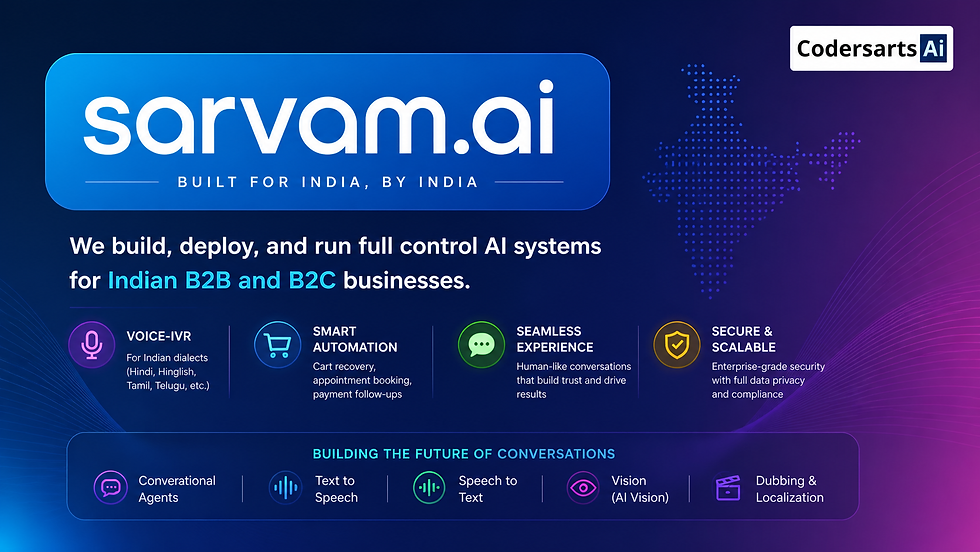
To bridge this gap, GovTech integrators and enterprise IT firms are shifting to Voice-First AI Architecture. By leveraging Sarvam AI’s sovereign stack, B2B clients are now building "Citizen Assistants"—highly scalable, low-latency multilingual voice and WhatsApp bots capable of handling millions of scheme discovery queries, grievance redressals, and civic services in regional dialects.
Here is a deep dive into how these systems are being deployed, the real-world proof of their efficacy, and how your technical team can integrate them today.
The Product: Multilingual Voice-IVR & WhatsApp Agents
For transactional clients and system integrators, the core deliverable is a fully automated, voice-driven pipeline that replaces legacy call centers.
Core Capabilities You Can Build:
Zero-UI Scheme Discovery: Citizens call a toll-free number or send a WhatsApp voice note asking, "Mere gaon mein kisan loan kaise milega?" (How can I get a farmer loan in my village?). The bot understands the dialect, queries the government database via RAG (Retrieval-Augmented Generation), and replies with human-like, empathetic voice audio in the same language.
Dynamic Code-Switching: Seamlessly handling Hinglish, Tanglish, or users who mix regional dialects with English technical terms.
Voice Biometrics & Fraud Prevention: Analyzing audio streams to detect synthetic voices, deepfakes, or unauthorized account access.
Real-World Business Proof: Who is Using This Today?
Building with Sarvam AI isn't an experimental phase; it is already powering critical national infrastructure. If you are pitching these integrations to government bodies or large enterprises, these case studies validate the architecture:
1. UIDAI (Aadhaar Services)
Managing identity services for over 1.4 billion residents requires unprecedented scale. UIDAI has partnered with Sarvam AI to overhaul its citizen grievance and inquiry systems.
The Integration: AI-driven voice interaction bots that handle routine queries (e.g., "How do I update my address?") across multiple regional languages.
The ROI: Drastic reduction in human call center wait times, combined with real-time fraud detectionlayers that analyze caller voice patterns to prevent social engineering attacks.
2. Government of Odisha & Tamil Nadu
State governments are deploying Sarvam AI's stack beyond simple customer service, pushing into industrial safety and specialized training.
Mining Safety (Odisha): Voice-first, localized AI agents deployed in rural mining sectors to deliver real-time safety protocols and emergency training to workers who may not be digitally literate.
Digital Sangam: A massive sovereign AI initiative where state governments are utilizing Sarvam’s infrastructure to build secure, localized AI models where data never leaves Indian borders—a critical compliance requirement for GovTech.
The Integration Blueprint: How to Build a Citizen Assistant
If you are an IT consultancy or software vendor looking to build this for your clients, here is the architectural breakdown of a Sarvam-powered GovTech Bot.
Component | Technology / Integration Layer | Function in the Pipeline |
Ingestion Layer | Twilio Voice, Meta WhatsApp Business API, Cisco IVR | Captures the incoming phone call or voice note from the citizen. |
Ear (STT) | Sarvam Speech-to-Text API | Transcribes the low-fidelity, noisy telecom audio (in regional languages) into text with sub-500ms latency. |
Brain (LLM & RAG) | Sarvam-1 (Indic LLM) + Vector DB (Pinecone/Milvus) | Processes the text, retrieves accurate government scheme data from secure internal servers, and generates a culturally nuanced response. |
Mouth (TTS) | Sarvam Bulbul V3 | Converts the text response back into highly expressive, human-sounding localized audio. |
Why Integrators Must Choose Sarvam AI over Global LLMs
When bidding for government contracts or building B2B enterprise systems in India, using global models (like OpenAI or Anthropic) often leads to failure in three specific areas:
Data Sovereignty: Government mandates strictly prohibit citizen data (PII) from being routed through servers in the US or Europe. Sarvam AI provides India-based localized deployments.
Latency Constraints: Global TTS/STT pipelines over telecom networks result in 3 to 5-second delays, leading to awkward silences and dropped calls. Sarvam’s telecom-optimized APIs operate at sub-second latencies.
Indic Fluency: Global models treat Indian languages as an afterthought, resulting in robotic translations. Sarvam’s models are trained on native Indian datasets, ensuring local idioms, cultural empathy, and code-switching are handled flawlessly.
🤝 Next Steps for Builders & Integrators
The market for replacing legacy GovTech systems with generative AI is actively contracting right now. For B2B clients looking to capitalize on this wave, the time to build POCs (Proof of Concepts) is today.
Are you looking to build a secure, multilingual Voice-IVR for a government or enterprise client? Explore the technical documentation, API wrappers, and deployment guides in our Sarvam AI Integrations Category to get your architecture off the ground.
Need this Built for Production? This lab shows the basics, but enterprise deployment requires DPDP compliance, VAD (Voice Activity Detection), and auto-scaling. Hire Codersarts to build, secure, and maintain your Sarvam AI GovTech or FinTech integration. Get a Custom Development Quote Today


Comments