
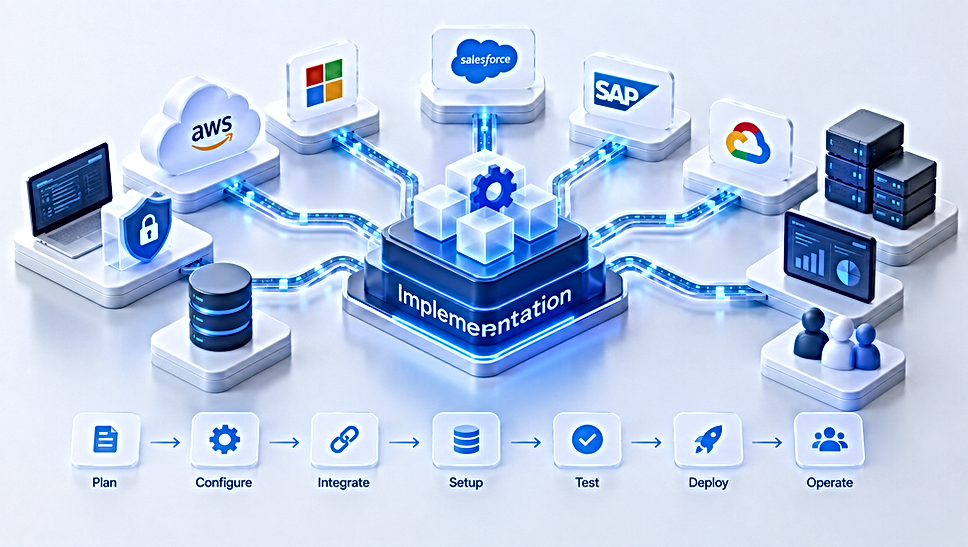
Implementation Solutions for Technology, Platforms & Business Systems
Implement selected technologies, platforms, applications, data environments, and business systems in your real operating environment with structured planning, configuration, integration, deployment, testing, and go-live support.
Codersarts helps organizations turn technology decisions into working operational capabilities. From SaaS and cloud platforms to AI, CRM, ERP, DevOps, data, security, and enterprise systems, we manage the engineering work required to move from a selected solution to a functioning environment.
Technology Implementation That Moves Beyond Selection
Selecting a platform, technology, or software solution is only the beginning. Organizations still need to configure it, connect it with existing systems, establish data flows, adapt it to operational requirements, test it, deploy it, and make it usable by teams.
Codersarts provides implementation services across the technology lifecycle, helping businesses operationalize solutions without treating every implementation as a completely new software-development project.
Our implementation work can include:
Solution Planning | Technical Setup | Operational Enablement |
Requirements and implementation planning | Environment configuration | User and team enablement |
Solution architecture | Platform configuration | Documentation |
Implementation roadmap | Infrastructure setup | Training support |
Technical assessment | Application configuration | Go-live preparation |
Integration planning | Data configuration | Stabilization |
Deployment planning | Security configuration | Post-launch support |
The objective is simple: turn a selected solution into a functioning capability that fits your technology environment and business operations.
What Can We Implement?
Implementation can apply to almost any technology or business solution that has already been selected, designed, licensed, purchased, or defined.
Implementation Area | What We Implement |
Software Implementation | Configure, deploy, customize, and operationalize software applications within your existing technical and business environment. |
SaaS Implementation | Implement SaaS platforms, configure workflows and users, establish integrations, migrate required information, and prepare teams for adoption. |
Cloud Implementation | Establish cloud environments, configure services, implement workloads, security controls, networking, monitoring, and operational processes. |
AI Implementation | Put AI capabilities, models, assistants, agents, RAG systems, and machine-learning solutions into production environments. |
Data Platform Implementation | Implement data warehouses, data lakes, lakehouses, analytics platforms, pipelines, governance capabilities, and reporting environments. |
CRM Implementation | Configure CRM platforms, customer workflows, data structures, integrations, automation, permissions, reporting, and operational processes. |
ERP Implementation | Implement enterprise resource planning systems around business processes, organizational structures, data, integrations, reporting, and user requirements. |
DevOps Implementation | Establish development, delivery, infrastructure, monitoring, release, and operational practices using modern DevOps technologies. |
Security Implementation | Implement identity, access control, security tooling, monitoring, compliance controls, application security, and infrastructure protection capabilities. |
Enterprise System Implementation | Deploy and operationalize large-scale systems across departments, environments, users, integrations, and organizational processes. |
Application Implementation | Configure and deploy existing or newly selected applications into production-ready environments. |
Platform Implementation | Establish technology platforms and configure their services, environments, access controls, integrations, and operational capabilities. |
These implementation areas allow the page to cover both technology-specific requirements and broader enterprise implementation needs.
SaaS Implementation
SaaS implementation requires more than creating user accounts. The platform must fit the organization's processes, data structures, permissions, integrations, reporting requirements, and operating model.
Codersarts can support SaaS implementation across:
SaaS Capability | Implementation Support | Operational Outcome |
Platform configuration | Configure platform settings, modules, workflows, roles, permissions, and organization-specific requirements. | A SaaS environment aligned with business operations. |
Data setup | Structure, import, transform, validate, and organize the information required by the platform. | Usable and consistent operational data. |
Integrations | Connect the SaaS platform with applications, APIs, databases, identity systems, and business tools. | Connected technology workflows. |
Workflow configuration | Translate business processes into platform workflows, approvals, rules, and operational sequences. | Processes that work inside the selected platform. |
User enablement | Configure users, roles, permissions, documentation, and operational guidance. | Teams prepared to use the solution. |
Go-live | Validate production configuration, resolve implementation issues, and coordinate launch activities. | Controlled transition into production use. |
Cloud Implementation
Cloud adoption frequently requires implementation across multiple technical layers rather than simply creating cloud resources.
We can implement:
Cloud infrastructure
Cloud applications
Cloud networking
Cloud databases
Cloud storage
Container platforms
Kubernetes environments
Serverless workloads
Cloud security
Identity and access management
Monitoring and observability
Backup and disaster recovery
Infrastructure as Code
Cloud-native services
DevOps environments
Data and analytics platforms
Cloud implementation can also follow a migration project when workloads are being moved from an existing environment. The distinction remains clear: migration moves the workload; implementation establishes and operationalizes the target environment.
AI Implementation
AI implementation turns an AI capability from a technical concept or selected technology into something that can operate inside a real business environment.
Implementation can include:
AI Implementation | Example Scope |
AI Assistants | Deploy AI assistants connected to approved business information, applications, workflows, and user experiences. |
AI Agents | Implement agentic systems capable of interacting with tools, APIs, data sources, and defined business processes. |
RAG Systems | Implement retrieval-augmented generation environments connecting language models with organizational knowledge. |
LLM Applications | Operationalize language-model capabilities within applications, products, internal systems, or customer experiences. |
Machine Learning | Implement model-serving, inference, feature, monitoring, and operational environments for machine-learning workloads. |
AI Platforms | Establish the infrastructure, services, access controls, observability, and governance needed for AI workloads. |
AI APIs | Implement model APIs and AI services into existing applications and technology workflows. |
AI Governance | Implement controls for access, monitoring, data handling, model usage, evaluation, and operational oversight. |
AI implementation may involve development or integration, but those activities support the larger goal of putting the AI capability into operational use.
Data Platform Implementation
Modern organizations often need to implement data environments before they can fully use analytics, business intelligence, machine learning, or AI.
Codersarts can implement:
Data warehouses
Data lakes
Lakehouse platforms
ETL and ELT environments
Data pipelines
Analytics platforms
Business intelligence environments
Data catalogues
Data governance capabilities
Data quality systems
Data APIs
Real-time data platforms
Machine-learning data environments
Implementation covers the technical foundation, configuration, data structures, connectivity, security, validation, and operational readiness required for production use.
CRM Implementation
CRM implementation brings customer-management technology into alignment with the organization's sales, marketing, service, and customer-success operations.
Implementation can cover:
CRM environment configuration
Customer and account structures
Sales pipelines
Lead-management workflows
Customer-service processes
User roles and permissions
Data import and preparation
Application integrations
Reporting and dashboards
Workflow configuration
Notifications and business rules
Testing and validation
User enablement
Production deployment
Post-launch stabilization
The focus is not simply installing a CRM. It is making the selected CRM usable within the organization's actual operating model.
ERP Implementation
ERP implementations require coordination across technology, data, processes, users, and organizational requirements.
Codersarts can support ERP implementation activities involving:
Business-process configuration
Enterprise data structures
Finance workflows
Procurement
Inventory
Supply chain
Sales operations
Human resources
Reporting
User permissions
Third-party integrations
Data preparation
Testing
Deployment
Operational support
ERP implementation can therefore combine technical configuration with engineering, integration, data, and deployment expertise.
DevOps Implementation
DevOps implementation establishes the engineering and operational capabilities required to develop, test, release, deploy, monitor, and maintain software efficiently.
DevOps Area | Implementation Scope |
CI/CD | Establish automated build, test, release, and deployment pipelines around engineering workflows. |
Infrastructure as Code | Implement repeatable infrastructure provisioning and environment configuration through code-based practices. |
Containers | Implement containerized application environments using appropriate container technologies and operational patterns. |
Kubernetes | Establish Kubernetes environments, workloads, networking, security, observability, and deployment capabilities. |
Observability | Implement logging, metrics, tracing, alerting, dashboards, and operational visibility. |
Release Management | Establish repeatable release processes, deployment strategies, environment controls, and rollback capabilities. |
Cloud DevOps | Implement cloud-native engineering, infrastructure, deployment, monitoring, and operational practices. |
Implementation establishes the capability. Optimization can subsequently improve its performance, cost, reliability, or efficiency.
Security Implementation
Security solutions often fail to deliver their intended value when they are not correctly configured and operationalized.
We can implement:
Identity and access management
Single sign-on
Multi-factor authentication
Role-based access control
Application security controls
Cloud security
Infrastructure security
API security
Data security
Security monitoring
Vulnerability-management tooling
Compliance controls
Security logging
Backup and recovery controls
Implementation includes configuration, environment setup, integration, validation, documentation, and operational enablement.
Application & Platform Implementation
Organizations frequently select an application or platform because it already provides most of the capabilities they need. The challenge becomes adapting that solution to their environment.
Implementation can involve:
Application Layer | Implementation Work |
Frontend | Configure application experiences, environments, access, and user-facing capabilities. |
Backend | Establish application services, configurations, runtime environments, and supporting components. |
APIs | Configure endpoints, credentials, access policies, connections, and required service interactions. |
Database | Establish schemas, connections, access, data structures, and operational configuration. |
Infrastructure | Configure compute, networking, storage, environments, and supporting infrastructure. |
Security | Establish authentication, authorization, secrets, permissions, and security controls. |
Monitoring | Configure logs, metrics, alerts, dashboards, and operational visibility. |
Deployment | Prepare environments and release the application into production. |
Implementation Services
Codersarts can support implementation projects from initial planning through production stabilization.
Service | Description |
Implementation Consulting | Assess implementation requirements, clarify technical dependencies, define scope, and establish an execution strategy around the selected solution. |
Implementation Planning | Translate business and technical requirements into implementation phases, milestones, dependencies, responsibilities, environments, and deployment plans. |
Solution Configuration | Configure platforms, applications, infrastructure, workflows, permissions, environments, and technical settings for operational requirements. |
Implementation Architecture | Define how the selected solution should fit into the organization's existing applications, infrastructure, data, security, and operational ecosystem. |
Implementation Integration | Connect the implemented solution with required applications, APIs, databases, identity providers, data platforms, and business systems. |
Implementation Customization | Adapt the selected solution where configuration alone cannot satisfy specific business or technical requirements. |
Data Implementation | Prepare, structure, transform, load, validate, and operationalize the data required by the implemented solution. |
Testing & Validation | Validate functionality, integrations, security, data, workflows, performance, and production readiness before launch. |
Deployment & Go-Live | Coordinate production deployment, release activities, configuration verification, launch readiness, and controlled transition into operation. |
Implementation Support | Provide post-launch troubleshooting, stabilization, documentation, technical assistance, and improvements following implementation. |
Implementation Partner Services | Extend internal teams with implementation engineering capacity for complex technology, platform, application, and enterprise projects. |
Implementation Lifecycle
A successful implementation requires more than technical installation. We structure implementation around the complete transition from selected solution to operational capability.
1. Discovery & Requirements
We understand the selected solution, business objectives, technical environment, users, dependencies, constraints, and implementation requirements.
2. Implementation Assessment
We evaluate the existing environment and identify configuration requirements, integration dependencies, data requirements, infrastructure needs, security considerations, and potential implementation risks.
3. Implementation Architecture
We define how the solution will operate within the existing technology ecosystem, including environments, integrations, data, security, infrastructure, and operational responsibilities.
4. Configuration & Setup
We configure the selected platform, software, infrastructure, services, workflows, permissions, environments, and supporting components.
5. Integration & Customization
Where required, we connect the solution to surrounding systems and develop targeted customizations needed to satisfy specific operational requirements.
6. Data Preparation
We prepare and establish the data required for the solution, including structures, mappings, transformations, imports, validation, and data-quality checks.
7. Testing & Validation
We validate functionality, integrations, security, workflows, data, environments, and operational behavior before production deployment.
8. Deployment & Go-Live
We coordinate the production release, validate the production environment, address launch issues, and support the transition into operational use.
9. Stabilization & Support
Following go-live, we resolve implementation issues, document the environment, support users and technical teams, and stabilize the solution for ongoing operation.
This lifecycle can be scaled from a focused SaaS implementation to a complex enterprise technology program.
Implementation by Technology Ecosystem
Implementation requirements vary according to the surrounding technology environment.
Ecosystem | Implementation Examples |
Cloud | AWS, Microsoft Azure, Google Cloud, cloud-native services, Kubernetes, serverless, storage, networking, security, and monitoring. |
Enterprise | ERP, CRM, business applications, enterprise platforms, identity systems, data environments, and internal technology systems. |
SaaS | SaaS applications, business platforms, productivity tools, customer platforms, analytics products, and operational software. |
AI & Data | LLM applications, RAG, AI agents, machine learning, data warehouses, data lakes, analytics, and data pipelines. |
Software Engineering | CI/CD, DevOps, infrastructure as code, containers, testing, observability, and developer platforms. |
Security | IAM, SSO, MFA, security platforms, monitoring, compliance controls, and application security. |
Digital Products | Applications, APIs, backend platforms, customer-facing systems, web products, and supporting infrastructure. |
Implementation Across the Technology Lifecycle
Implementation frequently sits between technology selection and ongoing operation.
Strategy → Selection → Architecture → Implementation → Operation → Optimization → Transformation
This makes implementation different from the other solution categories.
Solution | Primary Role |
Strategy | Decide what technology direction the organization should pursue. |
Architecture | Define how the technology solution should be structured. |
Development | Create or extend software capabilities. |
Integration | Connect separate systems and services. |
Migration | Move existing systems, workloads, or data to another environment. |
Implementation | Put the selected solution into operational use. |
Optimization | Improve an existing operational solution. |
Automation | Make repeatable activities happen automatically. |
Audit | Assess an existing environment and identify issues or opportunities. |
Implementation may therefore include development, integration, migration, or automation activities when those activities are necessary to operationalize the selected solution.
Implementation for Different Organizations
Implementation needs differ according to organizational size, technology maturity, and operating model.
Startups
Implement cloud platforms, SaaS products, analytics, AI capabilities, engineering environments, and business applications without creating unnecessary infrastructure complexity.
SaaS Companies
Implement customer-facing platforms, internal engineering systems, cloud infrastructure, data environments, DevOps capabilities, AI features, and enterprise integrations.
Enterprises
Support complex implementations involving multiple applications, departments, environments, data sources, security requirements, governance processes, and organizational stakeholders.
SMBs
Implement practical business systems and technology platforms with focused scope, controlled costs, and minimal operational disruption.
Product Companies
Operationalize engineering platforms, cloud environments, AI capabilities, data platforms, customer systems, and supporting product infrastructure.
Technology Companies
Provide specialized implementation engineering for new platforms, technologies, cloud services, data environments, AI systems, and enterprise technology initiatives.
Agencies
Extend delivery capabilities with implementation engineering that can operate behind the agency brand or alongside internal teams.
Digital Businesses
Implement the technology systems required to operate, scale, integrate, and improve digital products and business operations.
Implementation Delivery Models
Implementation projects can be delivered through different engagement structures depending on project complexity and internal resources.
Model | Best Fit |
Project Engagement | Clearly defined implementation projects with defined scope and outcomes. |
Fixed-Price Project | Well-understood implementations with stable requirements and deliverables. |
Milestone-Based Project | Larger implementations delivered through measurable implementation stages. |
Dedicated Team | Long-running implementation programs requiring sustained engineering capacity. |
Staff Augmentation | Internal teams that need additional implementation specialists. |
Extended Team | Organizations looking to extend an existing technology or implementation team. |
Engineering Pod | Complex implementation work requiring a cross-functional engineering group. |
Retainer | Ongoing implementation assistance and technical support. |
Managed Service | Continuous operational responsibility for an implemented technology capability. |
Consulting | Implementation planning, architecture, assessment, and technical guidance. |
On-Demand Engineering | Flexible implementation support for specific technical requirements. |
White-Label Delivery | Agencies and technology providers requiring implementation delivery under their own brand. |
Subcontracted Delivery | Organizations outsourcing implementation execution to an engineering partner. |
Capacity Extension | Teams requiring additional implementation capacity during critical delivery periods. |
Implementation Technologies
Our implementation capabilities can span technology ecosystems including:
AWS
Microsoft Azure
Google Cloud
Kubernetes
Docker
Terraform
GitHub
GitLab
Jenkins
Salesforce
Microsoft Dynamics
SAP
HubSpot
Snowflake
Databricks
PostgreSQL
MySQL
MongoDB
Redis
REST APIs
GraphQL
Python
Java
JavaScript
TypeScript
Node.js
React
.NET
AI and LLM platforms
Data and analytics platforms
Identity and security platforms
SaaS platforms
Enterprise applications
Technology selection depends on the solution being implemented rather than forcing every project into a predetermined stack.
Implementation Challenges We Help Solve
Technology implementation can become difficult when the selected solution does not automatically fit the surrounding environment.
Codersarts helps address challenges such as:
Unclear implementation requirements
Complex technical dependencies
Legacy environments
Multiple technology platforms
Difficult integrations
Inconsistent data
Environment differences
Security and access requirements
Configuration complexity
Limited internal engineering capacity
Incomplete deployment processes
Testing gaps
Production-readiness concerns
User adoption challenges
Post-go-live instability
Documentation gaps
The goal is to reduce the distance between buying or selecting a solution and actually getting value from it.
Why Codersarts for Implementation?
Implementation sits at the intersection of technology, engineering, infrastructure, data, integration, and operations. Codersarts brings these capabilities together so organizations do not have to coordinate every technical component separately.
Engineering-Led Implementation
Our implementation work is supported by software engineering, cloud, data, DevOps, AI, integration, infrastructure, and application expertise.
Technology-Agnostic Approach
We work around the technology and platform your organization has selected rather than forcing implementation into a predefined product ecosystem.
Full Implementation Lifecycle
From discovery and architecture through configuration, testing, deployment, go-live, and stabilization, we can support the complete implementation journey.
Integration-Aware Delivery
We consider the surrounding technology ecosystem rather than treating the selected platform as an isolated system.
Flexible Delivery
Engage us for a defined implementation project, additional engineering capacity, specialized implementation expertise, or ongoing technical support.
Implementation vs. Related Solutions
Implementation often overlaps with other technical services, but the intended outcome is different.
If You Need To... | The Relevant Solution |
Make repetitive activities happen automatically | Automation |
Improve performance or efficiency | Optimization |
Move a system or workload to another environment | Migration |
Connect independent applications or systems | Integration |
Put a selected technology into operational use | Implementation |
Create or extend software | Development |
Define the structure of a technology solution | Architecture |
Evaluate an existing technology environment | Audit |
Design a user or product experience | Design |
Validate an idea before building it | Prototyping |
Create a complete new product or capability | Build |
This separation keeps implementation focused on its core commercial intent: operationalizing a selected solution.
From Technology Selection to Operational Capability
Choosing a technology does not automatically create business value.
The selected solution must be configured, connected, secured, populated with the right data, tested, deployed, adopted, and operated.
Codersarts helps bridge that gap.
Whether you are implementing a SaaS platform, cloud environment, CRM, ERP, AI capability, data platform, DevOps environment, security solution, enterprise application, or specialized technology, we can provide the engineering expertise required to turn the selection into an operational capability.
Start Your Implementation Project
Have you already selected a technology, platform, application, or solution and need help putting it into operation?
Codersarts can help assess the implementation scope, define the technical approach, configure the environment, handle required engineering work, coordinate integrations, validate readiness, and support the transition into production.
Discuss Your Implementation Project →
Implementation = taking a selected or defined technology, platform, system, or solution and making it operational within a real business and technology environment.