
Build Software and Application
Build Solutions for Digital Products, Platforms & Technology
Turn ideas, requirements, and business opportunities into complete working products, platforms, applications, and technology capabilities
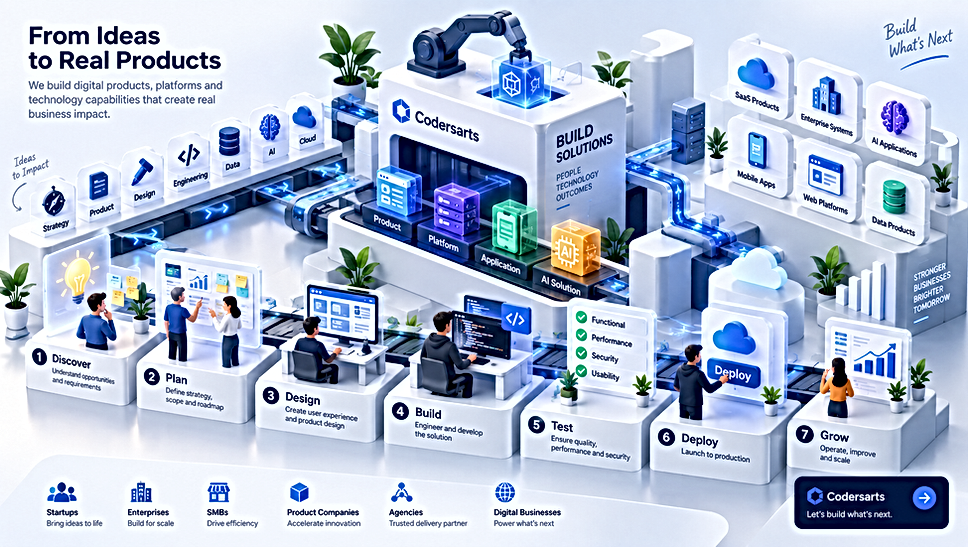
Build Solutions for Digital Products, Platforms & Technology Capabilities
Turn ideas, requirements, and business opportunities into complete working products, platforms, applications, and technology capabilities.
Codersarts brings together product, architecture, design, engineering, data, AI, integration, testing, cloud, and deployment capabilities to help organizations move from a defined opportunity to operational technology.
What We Build
Organizations come to us with different starting points—from a new product idea to an existing business process that needs to become a scalable digital capability.
Digital Products | Business Applications |
SaaS products, customer platforms, marketplaces, portals, subscription products, and industry-specific digital products. | Internal applications, workflow systems, operational platforms, administrative tools, employee portals, and business software. |
AI-Powered Products | Technology Platforms |
AI assistants, copilots, agents, RAG applications, intelligent search, recommendation systems, and AI workflows. | APIs, developer platforms, data platforms, cloud capabilities, infrastructure services, and reusable technology foundations. |
Data Products | Enterprise Solutions |
Analytics applications, data products, reporting platforms, data services, ML systems, and operational intelligence solutions. | Enterprise applications, portals, business platforms, integrated systems, and technology capabilities spanning departments and processes. |
These solutions often combine several technology disciplines. The next step is therefore to look at what a complete build can bring together.
Build the Complete Technology Solution
A complete build may combine multiple capabilities rather than treating development as an isolated activity.
Product | Technology |
Product definitionUser journeysRequirementsPrioritizationSuccess criteria | ArchitectureApplication engineeringDataAICloud infrastructure |
Experience | Delivery |
UXUIWorkflowsDesign systemsInteraction design | IntegrationTestingSecurityDeploymentOperations |
Idea → Product Definition → Architecture → Design → Engineering → Testing → Deployment → Production
Not every project requires every stage. We assemble the capabilities around the actual product, technology environment, and desired outcome.
With that foundation established, organizations can engage us for a specific type of product or technology build.
Build Services
Product Development | Application Development | SaaS Development |
Turn a product concept into a working digital product with the technology, workflows, and capabilities required for launch and continued evolution. | Build customer-facing, internal, operational, or specialized applications around defined business requirements. | Build subscription-based products with users, organizations, permissions, billing, administration, integrations, and scalable product capabilities. |
AI Product Development | Platform Development | Enterprise Development |
Build AI-native products, assistants, agents, RAG systems, intelligent workflows, and AI-enabled applications. | Create reusable technology platforms, APIs, data services, developer capabilities, and infrastructure foundations. | Build complex applications and platforms that operate across enterprise users, systems, data, workflows, and security requirements. |
Data Product Development | Mobile Product Development | Digital Experience Development |
Create data-driven applications, analytics products, data services, and intelligent data capabilities. | Build mobile products for consumer, customer, field, operational, and business use cases. | Create portals, self-service experiences, dashboards, customer platforms, and digital service interfaces. |
Different builds require different combinations of capabilities. The following view shows the broader technology foundation that can sit behind these services.
What a Build Can Include
Product | Architecture | Design | Engineering |
Product definition | Solution architecture | UX design | Frontend |
Requirements | Software architecture | UI design | Backend |
User journeys | Cloud architecture | Interaction design | Full-stack |
Product roadmap | Data architecture | Design systems | APIs |
Data | AI | Integration | Quality |
Data models | LLM applications | APIs | Functional testing |
Data pipelines | RAG | SaaS systems | Integration testing |
Analytics | AI agents | Enterprise systems | Performance |
Data products | ML applications | Webhooks | Security testing |
Infrastructure | Security | Deployment | Operations |
Cloud | Application security | CI/CD | Monitoring |
Containers | Identity | Environments | Logging |
Kubernetes | Data protection | Release management | Reliability |
Infrastructure as Code | Access control | Production rollout | Maintenance |
This breadth becomes particularly valuable when the initiative involves creating a new product rather than simply implementing an isolated technical component.
Build a New Product
A new product may begin with a market opportunity, customer problem, business idea, or technology concept.
Codersarts can support the journey from:
Concept → Validation → Product Definition → Architecture → Design → Build → Launch → Evolution
Consumer Products | B2B Products |
Customer applications, marketplaces, digital services, commerce products, and consumer platforms. | Business software, SaaS products, customer portals, operational applications, and enterprise platforms. |
Internal Products | Industry Products |
Employee platforms, workflow applications, internal tools, knowledge systems, and operational software. | Purpose-built solutions for specialized industries, workflows, regulatory environments, and business models. |
For organizations that want to validate the product before making a larger investment, the build can begin with a focused MVP.
Build an MVP
An MVP should contain the minimum practical capability required to validate a defined proposition or reach an initial group of users.
Product | Technical | Validation |
Core workflows | Application foundation | User feedback |
Essential features | APIs & database | Usage signals |
Primary experience | Authentication | Product assumptions |
Initial administration | Deployment | Market learning |
The objective is not simply to build fewer features. It is to build enough of the right product to produce meaningful learning or deliver the intended initial outcome.
Once the product model is established, the same approach can be applied to more specialized product categories such as SaaS.
Build SaaS Products
SaaS products combine product experience, application engineering, infrastructure, data, security, and ongoing operations.
Product Experience | Platform |
WorkspacesUser journeysProduct workflowsNotifications | Multi-tenancyOrganizationsRolesPermissions |
Commercial | Operations |
PlansSubscriptionsBillingUsage tracking | Cloud infrastructureMonitoringDeploymentReliability |
SaaS is only one type of modern product. AI introduces another category where the intelligence itself can become central to the product experience.
Build AI-Native Applications
AI-native products are designed around intelligent capabilities from the beginning rather than simply adding an AI model to an existing workflow.
AI Assistants | AI Agents | RAG Applications | AI Workflows |
Contextual assistance and task support embedded into products and business applications. | AI systems that interact with tools, APIs, data, and workflows to perform defined tasks. | Applications combining models with organizational knowledge, documents, databases, and retrieval. | AI-enabled processes for research, documents, support, analysis, operations, and decision workflows. |
AI Search | Copilots | Recommendations | Predictive Applications |
Intelligent discovery across structured and unstructured information. | AI assistance embedded into existing products and professional workflows. | Personalized or context-aware recommendations based on available data. | Forecasting, classification, anomaly detection, scoring, and other predictive capabilities. |
AI product development also requires evaluation, data handling, security, cost management, observability, and appropriate human oversight.
Not every organization is starting from a blank slate. Many builds need to work with technology that already exists.
Build Around Existing Systems
Building does not always mean starting from scratch.
Existing Asset | Possible Build Approach |
Existing application | Extend or replace selected capabilities |
Legacy system | Build modern interfaces or replacement components |
Existing database | Build applications and services around existing data |
Existing APIs | Create new experiences or products using current capabilities |
Cloud environment | Build new services within the existing infrastructure |
Existing product | Add features, AI, integrations, workflows, or new modules |
This approach can preserve valuable technology while progressively expanding the overall capability.
That naturally leads to an important technology decision: which capabilities should actually be built, and which should be acquired or integrated?
Build vs. Buy
The right answer is not always to build.
Build | Buy | Integrate | Customize |
Strategic or differentiated capability requiring control and flexibility. | Commodity capability already well served by the market. | Connect existing products and systems to create the required workflow. | Adapt an existing platform where customization provides sufficient business value. |
Codersarts can help evaluate the trade-offs around functionality, differentiation, integration, cost, control, maintainability, and future requirements.
Understanding this distinction also helps clarify where Build sits relative to Development, another major Codersarts solution.
Build vs. Development
Development | Build |
Creates or extends software capabilities. | Creates a broader working product, platform, or technology capability. |
Can focus on one feature, service, API, or technical layer. | Coordinates multiple capabilities around an end-to-end outcome. |
Primarily an engineering activity. | Product + technology + engineering delivery. |
Example: develop an API. | Example: build a SaaS platform using that API. |
Example: develop an AI feature. | Example: build an AI-powered product. |
Development creates software capabilities. Build brings the complete solution together.
Build also differs from prototyping, because a prototype is primarily intended to explore and validate an idea.
Build vs. Prototype
Prototype | Build |
Explore an idea | Create the working solution |
Test assumptions | Deliver operational capability |
Reduce uncertainty | Prepare for real use |
Often limited in scope | Designed around the required product outcome |
Prototype → Validate
Build → Operationalize
The same distinction applies when comparing Build with Implementation: implementation puts a selected solution into operation, while building may involve creating the solution itself.
Build Process
Define | Design | Engineer |
OutcomeUsersRequirementsScope | Product experienceArchitectureTechnical decisionsWorkflows | FrontendBackendAPIsDataAI |
Integrate | Validate | Launch |
SystemsAPIsDataExternal services | Functional testingPerformanceSecurityUser validation | DeploymentProductionMonitoringStabilization |
Evolve | ||
New featuresOptimizationModernizationContinuous product development |
The technologies used during this process depend on the product, architecture, users, data, scale, and operational requirements.
Build Technologies
Frontend | Backend | Mobile | Data |
React | Node.js | Flutter | PostgreSQL |
Next.js | Python | React Native | MySQL |
Angular | Django | Swift | MongoDB |
Vue | Java | Kotlin | Redis |
TypeScript | .NET | Native platforms | Data warehouses |
Cloud | Infrastructure | AI | Platform |
AWS | Docker | LLMs | APIs |
Azure | Kubernetes | Generative AI | Microservices |
Google Cloud | IaC | RAG | Event-driven systems |
Serverless | CI/CD | AI agents | Distributed systems |
Technology choices should follow product requirements, architecture, operating constraints, and long-term objectives.
The technology stack is ultimately a means to achieve a business outcome, so build priorities should be connected directly to what the organization wants to accomplish.
Build by Business Objective
Launch | Grow | Transform | Digitize |
New products | New features | Legacy replacement | Manual workflows |
MVPs | Platform expansion | Modern applications | Internal systems |
SaaS products | AI capabilities | Technology evolution | Business processes |
Innovate | Scale | Connect | Operationalize |
AI products | Platform capacity | APIs & systems | Production software |
New digital services | Engineering capacity | Data flows | Cloud environments |
New business models | Product expansion | Partner ecosystems | Business capabilities |
These objectives appear across organizations of very different sizes and operating models.
Who We Build For
Startups | SaaS Companies | Enterprises | SMBs |
MVPs, new products, technical foundations, and early product teams. | Product expansion, platforms, integrations, AI capabilities, and engineering programs. | Enterprise applications, internal platforms, data, AI, and technology programs. | Business applications, portals, workflow systems, and digital capabilities. |
Product Companies | Technology Companies | Agencies | Digital Businesses |
Product engineering, feature development, platforms, and modernization. | APIs, platforms, AI, infrastructure, data, and complex technology products. | Engineering delivery and white-label product development capacity. | Customer platforms, applications, digital services, and operational technology. |
Different organizations also require different ways of engaging an external technology partner.
Build Engagement Models
Project | Team | Partnership | Capacity |
Project Engagement | Dedicated Team | Co-Development | Capacity Extension |
Fixed-Price Project | Extended Team | Build-Operate-Transfer | Staff Augmentation |
Milestone-Based Project | Engineering Pod | White-Label Delivery | On-Demand Engineering |
Ongoing | Delivery | Collaboration | Managed |
Retainer | Subcontracted Delivery | Co-Development | Managed Service |
Consulting | White-Label Delivery | Extended Team | Dedicated Team |
The engagement model can change as the product moves from initial build to growth, scale, and ongoing evolution.
From Idea to Working Product
A successful build connects business objectives with product decisions and engineering execution.
Opportunity → Product Definition → Architecture & Design → Build → Test & Integrate → Deploy → Operate → Evolve
Codersarts can own the complete journey or contribute specific capabilities within an existing product and engineering organization.
Why Codersarts for Build Projects?
End-to-End Capability | Engineering Depth | Flexible Delivery |
Bring product, architecture, design, engineering, data, AI, integration, testing, cloud, and deployment together. | Build with attention to maintainability, reliability, security, scalability, and long-term evolution. | Start with an MVP, build a complete product, extend an existing platform, or add specialized engineering capacity. |
Existing-System Expertise | Product-to-Production | Long-Term Evolution |
Build around existing applications, APIs, databases, infrastructure, and technology investments. | Connect product decisions with technical execution and production delivery. | Continue developing, modernizing, integrating, and optimizing the solution after launch. |
The result is a delivery model that can adapt to both new products and existing technology environments.
Start Building Your Product or Technology Capability
Whether you are launching a new product, developing an MVP, creating an AI application, building a SaaS platform, digitizing operations, or creating an enterprise technology capability, Codersarts can help turn the requirement into a working solution.
From defined opportunity to operational technology.
Build = creating a complete working product, platform, application, or technology capability by bringing together the product, technical, and engineering capabilities required to make it operational.